
Pulse question sets
Remote and hybrid work pulse questions
Remote and hybrid teams: staying connected and informed. 4 pulse survey questions to copy.
Pulse questions. Opens this set in Pulse questions. Nothing is added until you choose Add questions.
For remote and hybrid teams: feeling connected, hearing news in time, useful meetings and working across locations.
Compare results between people in the office and people who are not, if your groups are big enough.
Shuffl · HR by the numbers
Where people work

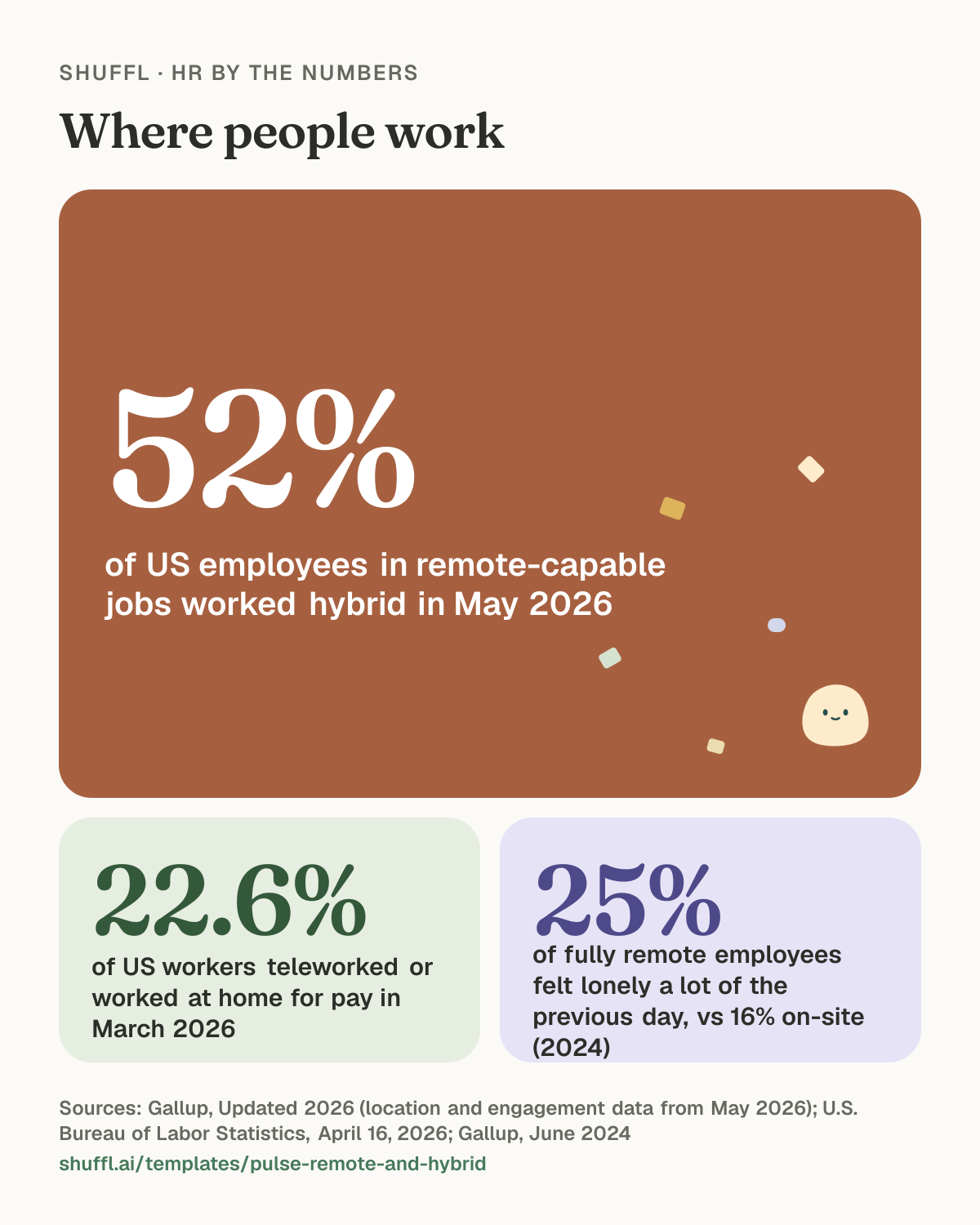
Where people work. 52% of US employees in remote-capable jobs worked hybrid in May 2026 (Gallup, Updated 2026 (location and engagement data from May 2026)). 22.6% of US workers teleworked or worked at home for pay in March 2026 (U.S. Bureau of Labor Statistics, April 16, 2026). 25% of fully remote employees felt lonely a lot of the previous day, vs 16% on-site (2024) (Gallup, June 2024).
Remote and hybrid work questions
Each line shows the answer scale and what the question measures.
1. I feel as connected to my team as people who sit near them. (strongly disagree to strongly agree; Belonging)
2. I hear about important news at the same time as everyone else. (strongly disagree to strongly agree; Clarity)
3. My meetings this week were worth the time. (strongly disagree to strongly agree; Workload)
4. How easy was it to work with people in other locations this week? (1 to 5; Tools and process)
How to adapt it
- Ask one question at a time, a few times a week, rather than all of them at once.
- Keep the wording about the last week or two, so people answer about now.
- Ask the same question again later to see whether something you changed helped.
What the research says
Hybrid is now the most common arrangement for remote-capable jobs. In May 2026, 52% of US employees in those jobs were hybrid, 26% exclusively remote and 22% on-site. Engagement was 37% for exclusively remote employees, 34% for hybrid and 29% for on-site staff in remote-capable roles.1 Across all US workers, 22.6% teleworked or worked at home for pay in March 2026.2
Distance has costs that this set is meant to catch. Gallup found 25% of fully remote employees felt lonely a lot of the previous day, compared with 21% of hybrid and 16% of on-site workers.3 Remote and hybrid employees also saw clarity of expectations fall at twice the rate of the wider workforce.4
Whether people work where they’d like to also matters. In APA’s 2025 survey, 31% of US workers were not working in their preferred environment. Those who were felt tense or stressed out during the workday less often (37% vs. 51%).5
How to read the results
The most useful view is the gap between people in the office and people who aren’t. If remote staff score lower on hearing news in time or working across locations, the cause is usually how information moves, which a team can change. If everyone scores low on meetings, the meetings themselves need work.
Location splits create small groups quickly, so only compare them when each has at least five answers, and combine teams if needed. After any change to office days or meeting habits, read the trend over at least a month, since the first weeks after a policy change are noisy.
Common mistakes
- Comparing remote and office groups that are too small, which can expose the few remote people on a team.
- Assuming one arrangement suits every team, without looking at each team’s results.
- Relying on social events while decisions still happen in hallway chats that remote staff miss.
- Changing office-day rules and the survey questions at the same time, so you can’t tell what caused a change.
Common questions
- What questions should you ask remote employees?
- Ask whether they feel connected to their team, hear important news in time, find meetings useful and can work well with people in other locations. Use the same questions for everyone so you can compare remote, hybrid and office staff.
- Are remote workers less engaged?
- Not in Gallup’s US data. In May 2026, exclusively remote employees were the most engaged group at 37%, compared with 34% for hybrid and 29% for on-site staff in remote-capable jobs. Remote workers did report more loneliness, so connection is the thing to watch.
- How do you keep hybrid teams connected?
- Share decisions and news in writing where everyone can see them, run meetings so remote people can speak as easily as those in the room, and plan in-person time around work that benefits from it. Check results by location to see whether it’s working.
Sources
Read on . Numbers change as new studies come out, so check the source before you quote it.
- Gallup, Global Indicator: Hybrid Work, Updated 2026 (location and engagement data from May 2026). Self-administered web surveys of U.S. employees on the probability-based Gallup Panel, weighted to Current Population Survey demographics. Hybrid means 10% to under 100% remote.
- U.S. Bureau of Labor Statistics, 22.6 percent of workers teleworked in March 2026, April 16, 2026. The Economics Daily. Current Population Survey data, not seasonally adjusted.
- Gallup, 1 in 5 Employees Worldwide Feel Lonely, June 2024. Global figures from the State of the Global Workplace 2024 report (Gallup World Poll). U.S. comparisons from a web survey of 19,846 U.S. employees on the Gallup Panel, Feb. 6-16, 2024 (±1.0 points).
- Gallup, Employee Wellbeing Hinges on Management, Not Work Mode, August 2024. Survey of 10,570 full-time remote-capable U.S. workers drawn from a sample of 21,543, May 11-25, 2024 (±1.2 points at 95% confidence).
- American Psychological Association, 2025 Work in America Survey: The Experience of Working in America During Times of Change, July 2025. Online survey by The Harris Poll of 2,017 employed U.S. adults, March 26 to April 4, 2025. Weighted; ±3.2 points at 95% confidence.