
Pulse question sets
Weekly check-in pulse questions
The starter set: priorities, workload, manager, growth, belonging and tools. 18 pulse survey questions to copy.
Pulse questions. Opens this set in Pulse questions. Nothing is added until you choose Add questions.
A general set to start a weekly pulse with: priorities, workload, managers, growth, belonging and tools.
Use it when you want a steady read on how people are doing before you know what to focus on.
Shuffl · HR by the numbers
Engagement at work

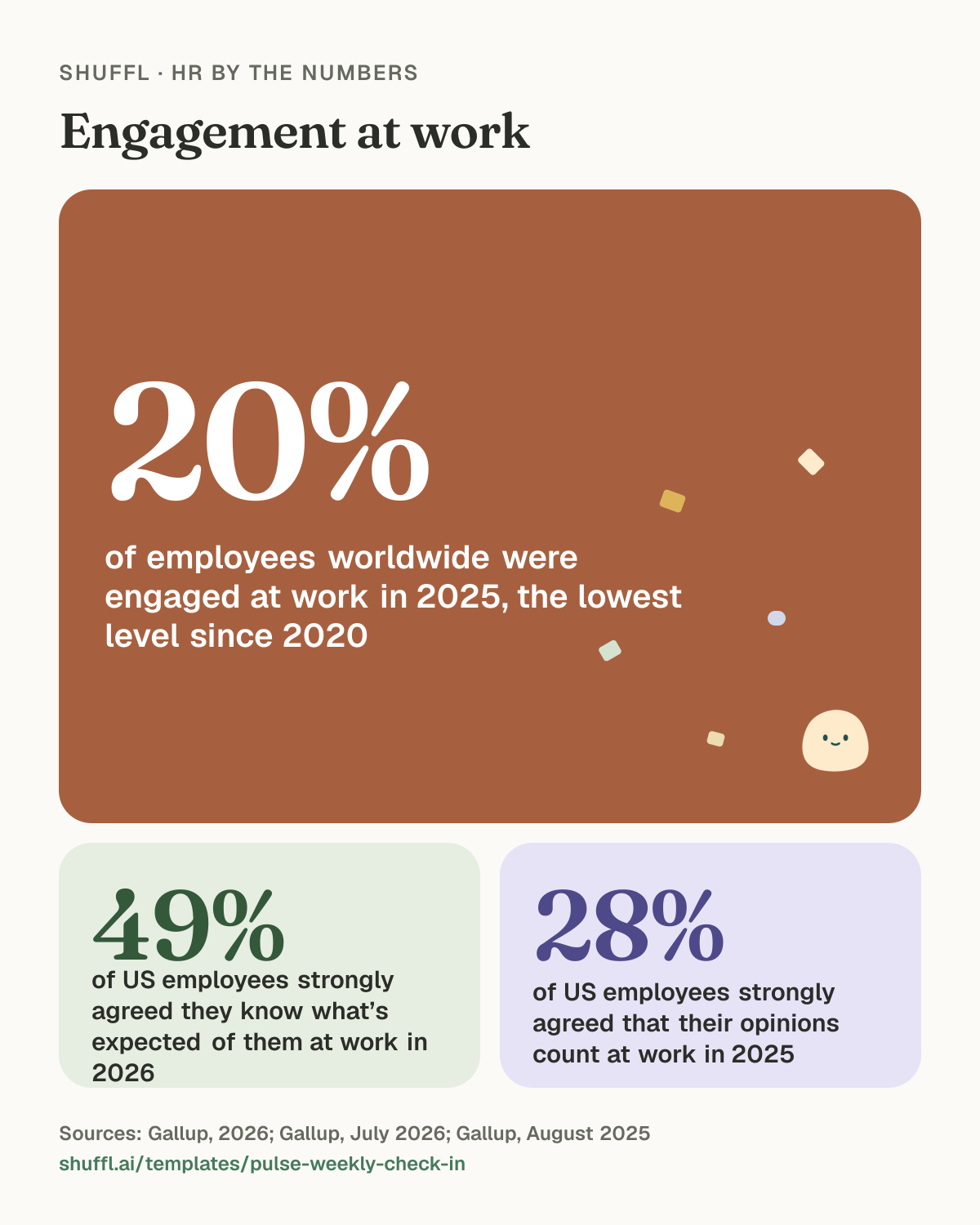
Engagement at work. 20% of employees worldwide were engaged at work in 2025, the lowest level since 2020 (Gallup, 2026). 49% of US employees strongly agreed they know what’s expected of them at work in 2026 (Gallup, July 2026). 28% of US employees strongly agreed that their opinions count at work in 2025 (Gallup, August 2025).
Weekly check-in questions
Each line shows the answer scale and what the question measures.
1. I knew what my priorities were this week. (strongly disagree to strongly agree; Clarity)
2. When a decision affected my work, I heard about it in time. (strongly disagree to strongly agree; Clarity)
3. My workload this week felt sustainable. (strongly disagree to strongly agree; Workload)
4. I had enough uninterrupted time to do my best work. (strongly disagree to strongly agree; Workload)
5. I got the support I needed from my manager this week. (strongly disagree to strongly agree; Manager support)
6. I received useful feedback on my work recently. (strongly disagree to strongly agree; Manager support)
7. I learned something this week that will help me in my role. (strongly disagree to strongly agree; Growth)
8. I can see a way to grow here over the next year. (strongly disagree to strongly agree; Growth)
9. I can be myself at work. (strongly disagree to strongly agree; Belonging)
10. I felt connected to the people I work with this week. (strongly disagree to strongly agree; Belonging)
11. Good work gets noticed here. (strongly disagree to strongly agree; Recognition)
12. Did someone thank you for your work this week? (yes or no; Recognition)
13. I had the tools and information I needed to do my job well this week. (strongly disagree to strongly agree; Tools and process)
14. How easy was it to get things done here this week? (1 to 5; Tools and process)
15. AI tools saved me real time this week. (strongly disagree to strongly agree; AI at work)
16. I know what I am allowed to use AI for at work. (strongly disagree to strongly agree; AI at work)
17. I feel confident using AI tools in my role. (strongly disagree to strongly agree; AI at work)
18. I had time to switch off and recharge outside work this week. (strongly disagree to strongly agree; Workload)
How to adapt it
- Ask one question at a time, a few times a week, rather than all of them at once.
- Keep the wording about the last week or two, so people answer about now.
- Ask the same question again later to see whether something you changed helped.
What the research says
Gallup’s global data puts engagement at 20% in 2025, the lowest level since 2020 and the first time it has fallen two years in a row. Managers drove much of the drop, with their engagement falling from 27% to 22% in a single year.1
In the US, 31% of employees were engaged and 18% actively disengaged in the first half of 2026. Only 49% strongly agreed they know what’s expected of them at work, well below the 2015 peak of 61%.2 A weekly set that touches priorities, workload, managers and growth gives you a running read on these basics.
In 2025, 28% of US employees strongly agreed that their opinions count at work.3 What happens after a survey shapes that. In an older Gallup analysis of workgroups surveyed twice, groups who most strongly agreed the last survey’s action plans had improved their workplace raised engagement by an average of 10%. Groups who least agreed fell by an average of 3%.4
How to read the results
Look at the share who agree or strongly agree, and watch it over four to eight weeks before reacting. A single week can swing with a deadline, a holiday or a few people away. A drop that holds for three weeks or more, or shows up in only one team, is worth a conversation.
Keep results hidden for any group with fewer than five answers, and keep that rule the same every week. Compare a team with its own past results before comparing it with other teams, since teams differ in their work and in how strictly people tend to rate.
Common mistakes
- Changing a question’s wording partway through, which breaks the trend line.
- Reporting only a company average, which hides the one team that is struggling.
- Collecting answers for months without telling people what you heard or what changed.
- Using early results to judge individual managers before they’ve seen and discussed their own team’s results.
Common questions
- What questions should a weekly check-in survey include?
- Cover the basics that drive engagement: clear priorities, a manageable workload, support from a manager, growth and a sense of belonging. Keep each question to one idea and about the last week or two. Add a topic set later if one area keeps scoring low.
- How long should a weekly pulse survey take?
- Aim for under a minute, with one or a few questions at a time. Short check-ins get answered more consistently, and consistent answers matter more than depth when you’re tracking trends.
- Should a weekly pulse survey be anonymous?
- Answers should be confidential, and results should only appear for groups big enough that nobody can be identified, often five or more. Tell people who sees what before the first question goes out, and stick to it.
Sources
Read on . Numbers change as new studies come out, so check the source before you quote it.
- Gallup, State of the Global Workplace: 2026 Report, 2026. Primarily the Gallup World Poll. 2025 data: 263,810 respondents (141,444 employed) in 140+ countries and territories, collected January to December 2025, plus U.S. web samples.
- Gallup, Employee Engagement Remains Flat as AI Adoption Accelerates, July 2026. Self-administered web surveys of 43,262 U.S. employees on the Gallup Panel, Feb. 4-19 and May 6-20, 2026. Margin of error ±0.7 points at 95% confidence.
- Gallup, Anemic Employee Engagement Points to Leadership Challenges, August 2025. Web survey of 17,660 U.S. employees on the Gallup Panel, May 7-16, 2025 (±1.1 points). Open-ended themes from 7,542 valid responses (±1.7 points).
- Gallup, What to Do With Employee Survey Results, August 2006. Workgroups with Q12 data trended across two consecutive survey administrations, sorted into quartiles on the item “Action plans from the last survey have had a positive impact on my workplace.” No sample size reported.