
Pulse question sets
Through a change pulse questions
During a reorg, new leader or big change: trust and clarity. 4 pulse survey questions to copy.
Pulse questions. Opens this set in Pulse questions. Nothing is added until you choose Add questions.
During a reorg, a new leader or another big change: do people understand why, what it means for them, and can they be heard?
Ask soon after the change is announced, then again a few weeks later.
Shuffl · HR by the numbers
Change at work

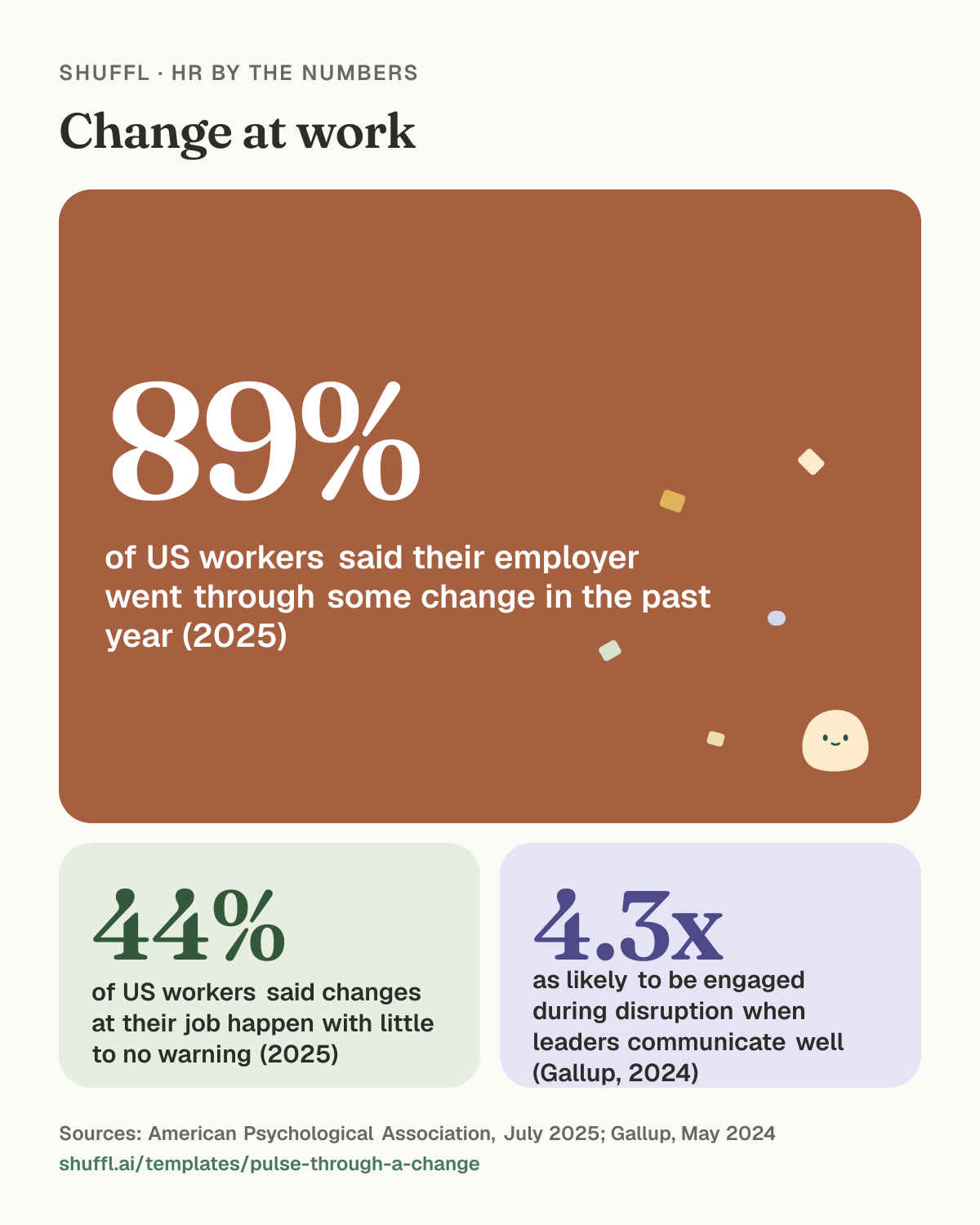
Change at work. 89% of US workers said their employer went through some change in the past year (2025) (American Psychological Association, July 2025). 44% of US workers said changes at their job happen with little to no warning (2025) (American Psychological Association, July 2025). 4.3x as likely to be engaged during disruption when leaders communicate well (Gallup, 2024) (Gallup, May 2024).
Through a change questions
Each line shows the answer scale and what the question measures.
1. I understand why this change is happening. (strongly disagree to strongly agree; Clarity)
2. I know what the change means for my work. (strongly disagree to strongly agree; Clarity)
3. I can raise concerns about the change and be heard. (strongly disagree to strongly agree; Manager support)
4. I feel good about my future here after this change. (strongly disagree to strongly agree; Growth)
How to adapt it
- Ask one question at a time, a few times a week, rather than all of them at once.
- Keep the wording about the last week or two, so people answer about now.
- Ask the same question again later to see whether something you changed helped.
What the research says
Change is now routine. In APA’s 2025 survey, 89% of US workers said their organization had gone through at least some change in the past year, most often in job roles or responsibilities (35%) and workplace technology (30%).1 Gallup found seven in 10 US workers reported disruptive change in the past year, and leaders and managers were 56% more likely to face extensive disruption.2
How change is handled matters. 44% of workers said changes happen with little to no warning, and they were far more likely to say their work environment harms their mental health (52% vs. 17%).1 In significant disruption, employees who strongly agreed their leaders communicate effectively were 4.3 times as likely to be engaged and 65% less likely to feel frequently burned out.2
Most workers still feel able to push back. 78% felt very or somewhat safe speaking out against changes, and 74% said their organization explains the reasons for change well.1 The rest are the people this set is designed to hear from.
How to read the results
Ask the first round soon after the announcement, as a baseline. Understanding of why the change is happening often starts low and should rise as leaders explain it. If it hasn’t by the second or third round, the message isn’t landing. Falling scores on being heard are more serious, because people who feel unheard tend to stop raising problems.
Compare the teams most affected by the change with the rest, as long as each group has five or more answers. Read results across several rounds. One bad week after the news is normal. A gap between affected teams and everyone else that widens over a month means leaders need to go back and talk to those teams.
Common mistakes
- Waiting until the change is finished to ask, when it’s too late to adjust the plan.
- Asking whether people support the change, which invites guarded answers. Ask whether they understand it and can be heard.
- Sharing results with leaders only, so the people affected never see that their concerns reached anyone.
- Running the survey after a restructure with groups so small that answers can be traced.
Common questions
- How do you measure employee sentiment during organizational change?
- Ask a few short questions soon after the change is announced and repeat them every few weeks: whether people understand why, know what it means for them and feel they can be heard. Compare affected teams with the rest and watch the trend.
- Why do employees resist change?
- People push back most when they don’t understand the reason, can’t see what it means for them, or feel they had no say. Surprises make it worse: in APA’s 2025 survey, workers who said changes happen with little warning were much more likely to say work harms their mental health.
- What is change fatigue?
- Change fatigue is the tiredness and disengagement that builds when people go through many changes close together. It shows up as apathy, cynicism and less effort, and it’s a reason to space changes out and explain how each one connects to the last.
Sources
Read on . Numbers change as new studies come out, so check the source before you quote it.
- American Psychological Association, 2025 Work in America Survey: The Experience of Working in America During Times of Change, July 2025. Online survey by The Harris Poll of 2,017 employed U.S. adults, March 26 to April 4, 2025. Weighted; ±3.2 points at 95% confidence.
- Gallup, Disruptive Change Is Hitting Leaders and Managers Hardest, May 2024. Gallup Panel web surveys of U.S. employees in Q1 to Q3 2023, about 18,700 per wave (Q3: 18,665). Margin of error ±1.1 points at 95% confidence.