
Pulse question sets
Wellbeing pulse questions
Spot burnout early: energy, hours, stress and asking for help. 4 pulse survey questions to copy.
Pulse questions. Opens this set in Pulse questions. Nothing is added until you choose Add questions.
Four questions about energy, hours, stress and whether people feel they can ask for help.
Use them in a busy season, or when people seem tired, to see whether workload is turning into burnout.
Shuffl · HR by the numbers
Stress and exhaustion at work

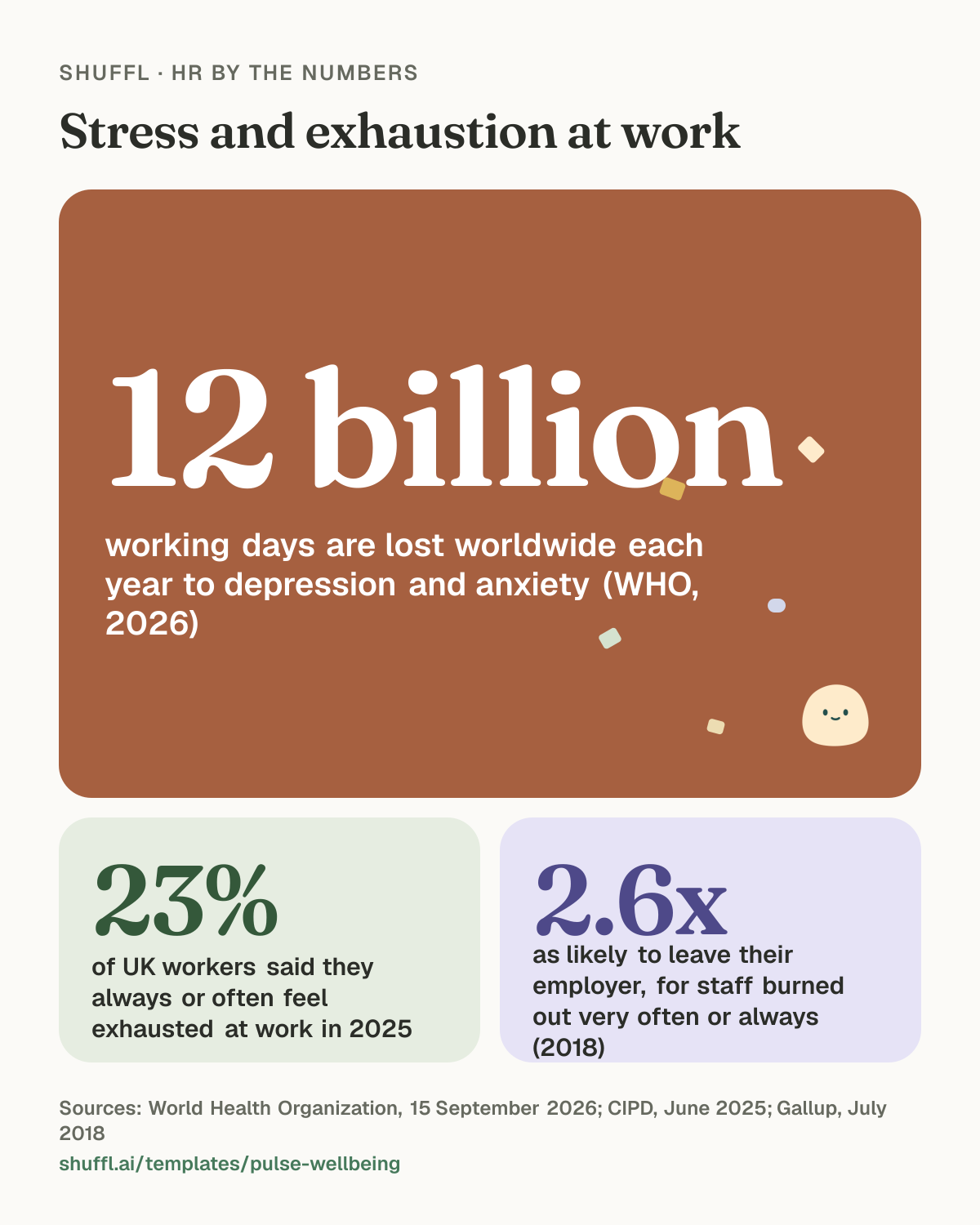
Stress and exhaustion at work. 12 billion working days are lost worldwide each year to depression and anxiety (WHO, 2026) (World Health Organization, 15 September 2026). 23% of UK workers said they always or often feel exhausted at work in 2025 (CIPD, June 2025). 2.6x as likely to leave their employer, for staff burned out very often or always (2018) (Gallup, July 2018).
Wellbeing questions
Each line shows the answer scale and what the question measures.
1. How was your energy at work this week? (1 to 5; Workload)
2. I got my work done without working late this week. (strongly disagree to strongly agree; Workload)
3. My stress at work felt manageable this week. (strongly disagree to strongly agree; Workload)
4. I would feel comfortable telling my team I was struggling. (strongly disagree to strongly agree; Belonging)
How to adapt it
- Ask one question at a time, a few times a week, rather than all of them at once.
- Keep the wording about the last week or two, so people answer about now.
- Ask the same question again later to see whether something you changed helped.
What the research says
The World Health Organization estimates that 12 billion working days are lost every year to depression and anxiety, at a cost of US$1 trillion in lost productivity. Its list of risks at work includes heavy workloads, long or inflexible hours, little control over workload and weak support from colleagues or supervisors.1
In the UK, 23% of workers said they always or often feel exhausted at work in 2025, and 21% always or often feel under excessive pressure. A quarter said their work has a negative impact on their mental health, a share that has stayed about the same across eight years of the survey.2
Gallup’s burnout research found that 23% of full-time employees felt burned out at work very often or always, and another 44% sometimes. Those burned out most often were 63% more likely to take a sick day and 2.6 times as likely to leave their employer.3
How to read the results
Energy and stress move with the calendar, so compare them with the same weeks last quarter or last year. A one-week dip during a launch is expected. Act on several weeks of falling energy alongside fewer people finishing without staying late: it matches what the WHO describes as burnout, exhaustion from workplace stress that hasn’t been managed.4
Watch the last question closely. If stress scores look manageable but fewer people would tell their team they’re struggling, problems may be hidden. Show results only for groups of five or more, and never try to work out who gave a low score.
Common mistakes
- Answering low scores with a wellness app or webinar when the cause is workload.
- Asking wellbeing questions in a team so small that people can be identified from their answers.
- Treating one good week after a busy season as proof the problem is solved.
- Leaving managers out, when they’re the ones who can move deadlines and share out work.
Common questions
- What are good questions to ask about employee wellbeing?
- Ask about things people can judge for themselves this week: their energy, whether they worked late, whether stress felt manageable and whether they could ask for help. Leave health conditions and diagnoses out. Those belong in private conversations with a manager, HR or a professional.
- How can you tell if employees are burning out?
- Look for several signs together over a few weeks: falling energy scores, more late working, rising sick days and people pulling back in meetings. The WHO describes burnout as exhaustion, mental distance from the job and reduced effectiveness, caused by workplace stress that hasn’t been managed.
- Should you ask employees about their mental health in a survey?
- Ask about work, such as stress, workload and support, rather than about anyone’s health. Keep answers confidential, report only for groups large enough to protect people, and point to support such as an employee assistance program alongside the survey.
Sources
Read on . Numbers change as new studies come out, so check the source before you quote it.
- World Health Organization, Mental health at work, 15 September 2026. WHO fact sheet. Global estimates of working days and productivity lost to depression and anxiety.
- CIPD, CIPD Good Work Index 2025, June 2025. Eighth wave of the CIPD/YouGov UK Working Lives survey: 5,017 UK workers (unweighted), January and February 2025, weighted to be representative of UK working adults.
- Gallup, Employee Burnout, Part 1: The 5 Main Causes, July 2018. Gallup study of nearly 7,500 full-time U.S. employees. No fieldwork dates given.
- World Health Organization, Burn-out an “occupational phenomenon”: International Classification of Diseases, 28 May 2019. WHO statement on the ICD-11 definition of burn-out.