
Pulse question sets
Clarity pulse questions
Do people know what good work looks like and what comes first? 4 pulse survey questions to copy.
Pulse questions. Opens this set in Pulse questions. Nothing is added until you choose Add questions.
Do people know what good work looks like, what their goals are and what comes first?
Use this set after a reorg, a change in goals or a run of missed deadlines.
Shuffl · HR by the numbers
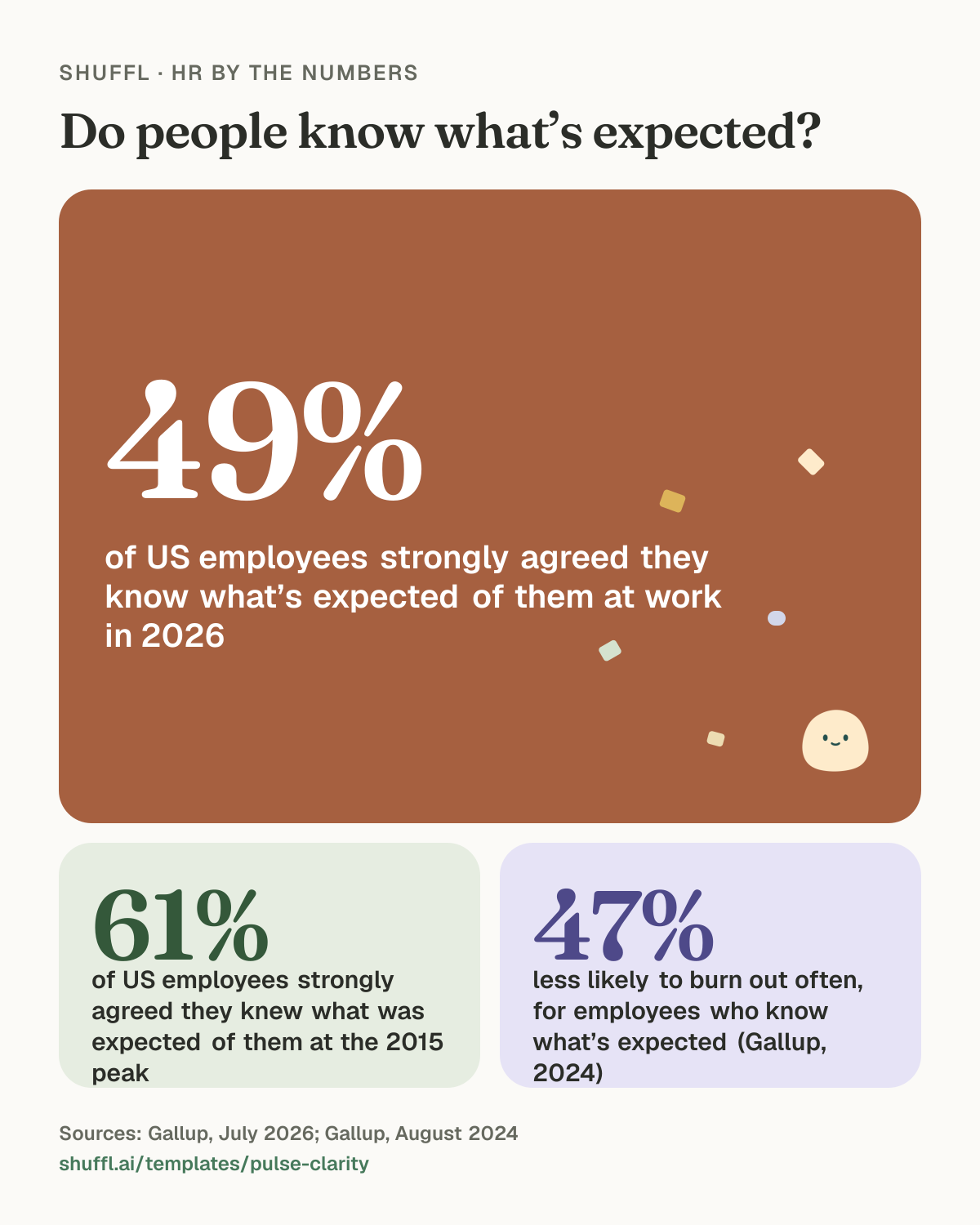
Do people know what’s expected?

Do people know what’s expected?. 49% of US employees strongly agreed they know what’s expected of them at work in 2026 (Gallup, July 2026). 61% of US employees strongly agreed they knew what was expected of them at the 2015 peak (Gallup, July 2026). 47% less likely to burn out often, for employees who know what’s expected (Gallup, 2024) (Gallup, August 2024).
Clarity questions
Each line shows the answer scale and what the question measures.
1. I know what good work looks like in my role. (strongly disagree to strongly agree; Clarity)
2. My goals for the next few weeks are clear. (strongly disagree to strongly agree; Clarity)
3. I know which decisions are mine to make. (strongly disagree to strongly agree; Clarity)
4. When priorities change, someone explains what it means for my work. (strongly disagree to strongly agree; Clarity)
How to adapt it
- Ask one question at a time, a few times a week, rather than all of them at once.
- Keep the wording about the last week or two, so people answer about now.
- Ask the same question again later to see whether something you changed helped.
What the research says
Knowing what’s expected is one of the most basic needs at work, and it has slipped. In early 2026, 49% of US employees strongly agreed they know what’s expected of them, up from 47% but well below the 2015 peak of 61%.1 In 2024 it had fallen to 46%, from 56% in March 2020.2
Clarity affects wellbeing as well as performance. Employees who strongly agree they know what’s expected are 47% less likely to experience frequent burnout. Remote and hybrid employees saw clarity fall at twice the rate of the wider workforce.3
Google’s study of 180 teams found structure and clarity was one of five dynamics that set effective teams apart. It defines this as understanding what’s expected, how to meet those expectations and what follows from your performance.4
How to read the results
The questions on good work and current goals usually move together. If both score well but the question on changing priorities scores low, the gap is likely in how changes are explained when they happen. If the question on decisions scores low, people may be waiting for permission they already have.
Read results by team, comparing each with its own scores from before a reorg or goal change, and combine any team with fewer than five answers with another. A low week right after a planning cycle is normal. A score still low a month after the change has settled means people need to talk priorities with their manager.
Common mistakes
- Sending a long goals document and assuming that settles it. Clarity comes from conversations as well as documents.
- Asking in the same week a reorg is announced, before anything has been decided.
- Treating low scores as an employee problem when goals or decision rights haven’t been set.
- Fixing clarity only at company level. Answers often differ most between teams.
Common questions
- What is role clarity?
- Role clarity is how well someone understands what their job involves, what good work looks like and which decisions are theirs to make. Low clarity is linked to stress and burnout, and it often follows reorgs and shifting goals.
- How do you measure role clarity in a survey?
- Ask short agree-or-disagree statements about expectations, current goals, decision rights and how changes in priorities are explained. Track the share who agree over time and by team instead of relying on one score.
- How can managers improve clarity on their team?
- Agree a few goals with each person for the next few weeks and write them down. When priorities change, say what drops off and why, and check at the next one-on-one that the change has landed.
Sources
Read on . Numbers change as new studies come out, so check the source before you quote it.
- Gallup, Employee Engagement Remains Flat as AI Adoption Accelerates, July 2026. Self-administered web surveys of 43,262 U.S. employees on the Gallup Panel, Feb. 4-19 and May 6-20, 2026. Margin of error ±0.7 points at 95% confidence.
- Gallup, U.S. Employee Engagement Sinks to 10-Year Low, January 2025. Self-administered web surveys throughout 2024 of 79,087 U.S. employees on the Gallup Panel. Margin of error ±0.5 points at 95% confidence.
- Gallup, Employee Wellbeing Hinges on Management, Not Work Mode, August 2024. Survey of 10,570 full-time remote-capable U.S. workers drawn from a sample of 21,543, May 11-25, 2024 (±1.2 points at 95% confidence).
- Google re:Work, Guide: Understand team effectiveness, 2015. Project Aristotle studied 180 Google teams (115 engineering project teams and 65 sales pods), with more than 35 statistical models run on hundreds of variables.