
Pulse question sets
New hire experience pulse questions
For people in their first months: setup, people and purpose. 4 pulse survey questions to copy.
Pulse questions. Opens this set in Pulse questions. Nothing is added until you choose Add questions.
For people in their first months: setup, welcome, understanding the role and knowing who to ask.
Aim these at people with short tenure so the answers come from recent hires.
Shuffl · HR by the numbers
The first year at work

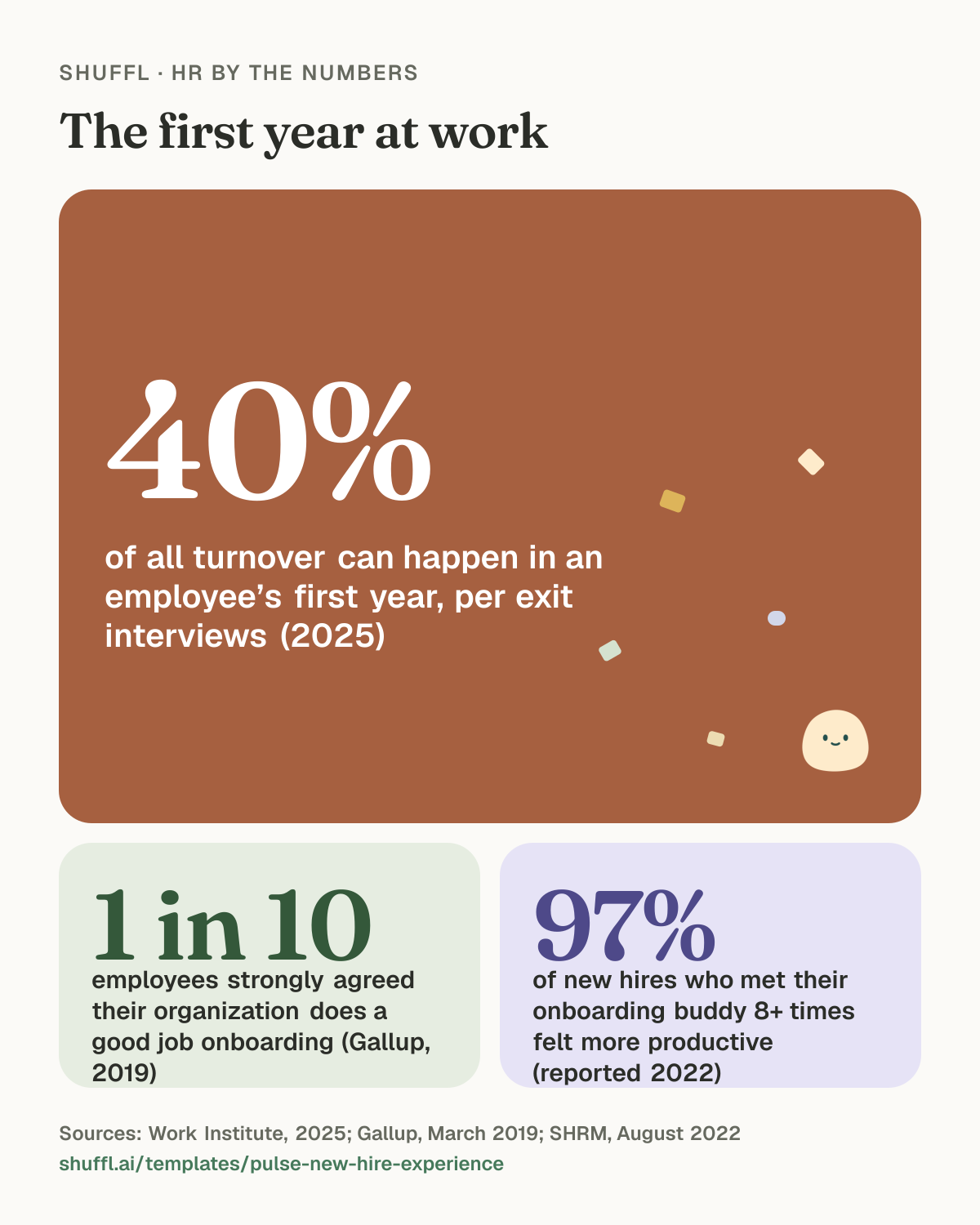
The first year at work. 40% of all turnover can happen in an employee’s first year, per exit interviews (2025) (Work Institute, 2025). 1 in 10 employees strongly agreed their organization does a good job onboarding (Gallup, 2019) (Gallup, March 2019). 97% of new hires who met their onboarding buddy 8+ times felt more productive (reported 2022) (SHRM, August 2022).
New hire experience questions
Each line shows the answer scale and what the question measures.
1. I had what I needed to get started in my first weeks. (strongly disagree to strongly agree; Tools and process)
2. I feel welcome on my team. (strongly disagree to strongly agree; Belonging)
3. I understand how my work fits into what the company does. (strongly disagree to strongly agree; Clarity)
4. Do you know who to ask when you have a question? (yes or no; Belonging)
How to adapt it
- Ask one question at a time, a few times a week, rather than all of them at once.
- Keep the wording about the last week or two, so people answer about now.
- Ask the same question again later to see whether something you changed helped.
What the research says
The first year carries much of the turnover risk. Exit interview data from 2019 to 2024 found that as much as 40% of all turnover happens in an employee’s first year, and involuntary exits in the first year rose from 6.7% in 2022 to 9.3% in 2024.1
Few employees think their organization gets onboarding right. Gallup found only about one in 10 strongly agree their organization does a good job onboarding new people. Employees who strongly agreed they had partners they could rely on at work were 1.9 times as likely to say their onboarding was exceptional, and those with a clear development plan 3.5 times as likely.2
Knowing who to ask makes a difference. In one large employer’s buddy program, 56% of new hires who met their buddy at least once in the first 90 days said the buddy helped them become productive quickly, and 97% of those who met more than eight times said they were more productive.3
How to read the results
Send the set at fixed points, such as the end of week one, month one and month three, so every hire answers at the same stage. Compare each group of hires with earlier groups, since new people tend to answer differently from long-tenured staff.
New-hire groups are small, so combine several months of starters until you have at least five answers before showing results. A low score on setup in week one points to IT or preboarding. A low score on knowing who to ask at month three points to the team and the buddy, and is worth a quick conversation with the manager.
Common mistakes
- Surveying new hires only once, so you can’t see whether things improved after the first weeks.
- Showing results for a single start date with two or three people, which makes answers easy to trace.
- Sending the survey from the hiring manager, which makes honest answers about that manager harder.
- Fixing problems for the next group of hires without telling the people who raised them.
Common questions
- When should you survey new hires?
- Common points are the end of the first week, the first month and the third month, with an optional check at six months. Early questions cover setup and welcome, and later ones cover understanding the role and fitting into the team.
- What should a new hire survey ask?
- Ask whether people had what they needed on day one, felt welcomed, understand what’s expected of them and know who to go to with questions. Keep it to a few questions, and ask the same ones of every new hire so you can compare groups.
- How do you reduce new hire turnover?
- Make expectations clear early, give every new hire a named person to ask, and have managers check in often during the first three months. Then ask new hires what isn’t working and fix it for the next group.
Sources
Read on . Numbers change as new studies come out, so check the source before you quote it.
- Work Institute, 2025 Retention Report: Employee Retention Truths in Today’s Workplace, 2025. Based on 123,297 exit interviews Work Institute conducted from 2019 to 2024 with employees of more than 175 companies, over 90% collected after the employee left and by Work Institute as a third party.
- Gallup, 5 Questions Every Onboarding Program Must Answer, March 2019. Figures attributed to Gallup analytics. The article does not give sample size or fieldwork dates.
- SHRM, Work Buddies Can Help New Employees Transition into Job, Organizational Culture, August 2022. SHRM article by Kathy Gurchiek reporting a large employer’s onboarding buddy program (a 2018 pilot with 600 participants, formal program from 2019). Figures are self-reported answers from new hires about their first 90 days.