
Policies
Performance review policy template
Review cycles, promotions, pay reviews and improving performance. A complete policy to adapt with your own rules.
A starting point, not legal advice. Leave, pay and expense rules differ by country, state and city. Use the checks on this page to see what to look up where your people work, and have someone qualified review your policy before you publish it.
Knowledge draft. Opens a Knowledge draft with this policy, its checks and what Shuffl already knows, like your HR contact and countries. Draft with Mello can write the rest and show where each value came from. Nothing is published until you choose Publish.
A performance policy explains how reviews, promotions and pay reviews work, and what happens when performance needs to improve.
Writing it down makes decisions easier to explain and more consistent across managers.
Shuffl · HR by the numbers
Performance reviews in numbers

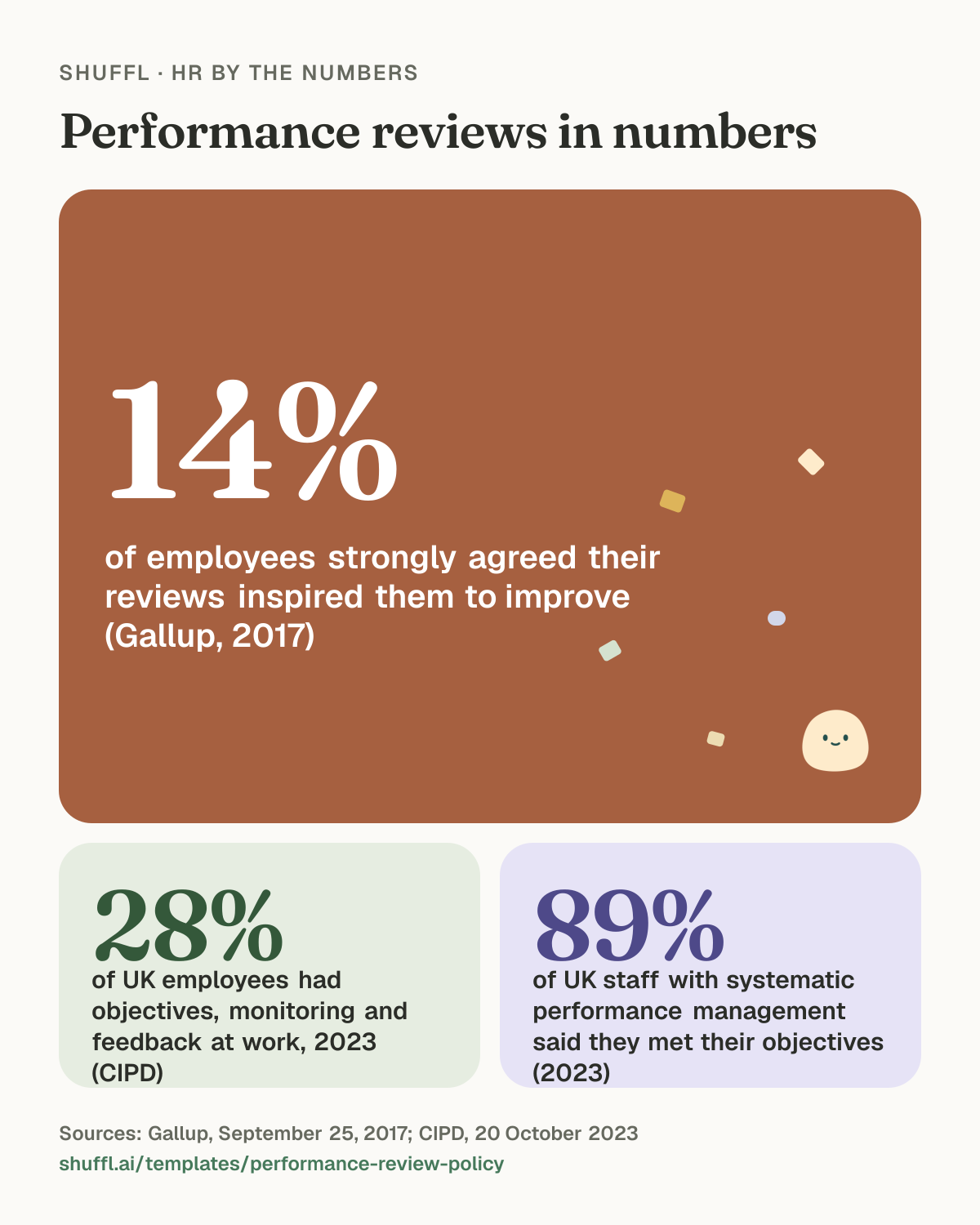
Performance reviews in numbers. 14% of employees strongly agreed their reviews inspired them to improve (Gallup, 2017) (Gallup, September 25, 2017). 28% of UK employees had objectives, monitoring and feedback at work, 2023 (CIPD) (CIPD, 20 October 2023). 89% of UK staff with systematic performance management said they met their objectives (2023) (CIPD, 20 October 2023).
Performance reviews and growth
Words in [square brackets] are for you to fill in. The policy has every section a real handbook policy has, but no allowances, dates or amounts of its own.
# Performance reviews and growth

## Purpose
This policy explains how we review work, decide promotions and review pay, so everyone knows how decisions are made and what to expect.

## Who this covers
[Which employees take part, and when new joiners have their first review.]

## How reviews work
- How often: [for example twice a year, and when]
- Who takes part: [for example yourself, your manager and peers]
- What you get: [written feedback, a rating, or both]

## What we look at
[What people are assessed on, for example goals, the skills in the career levels and how they live the company values, and where the career levels are kept.]

## Promotions
[How and when promotions are decided, who decides, and how to raise one with your manager.]

## Pay reviews
[Whether pay is reviewed with performance, when, and how ranges are set.]

## When performance needs to improve
[How concerns are raised early, the support offered, and how a formal improvement plan works.]

## Disagreeing with a review
[How to ask for a second look, and who decides.]

## Responsibilities
- **You:** prepare for reviews and ask for feedback during the year.
- **Your manager:** give regular, specific feedback and apply the same standards to everyone.
- **HR:** run the review cycle, check results for fairness and keep records.

## Fairness
Reviews, promotions and pay decisions are based on work and skills, never on a protected characteristic. HR checks results across teams for unexplained gaps.

## Where local law differs
If the law where you work gives you more rights about pay or reviews, the law applies. These places have their own rules: [list them, or "none"].

## Records
Review records are kept for [period] and can be seen by you, your manager and HR.

## Related policies
Equal opportunity and anti-harassment and Benefits.

## About this policy
Owned by [team or person]. Applies in [countries or states]. We may update this policy and will tell you at least [number] days before a change takes effect. This policy is not part of your employment contract.

## Questions
Contact [team or person] at [email or channel].
Check before you publish
Rules that often catch teams out, by place. They are not part of the policy, and not legal advice.
United States
- Colorado, California, Washington, New York and other places require pay ranges in job postings, and some require them for promotions or internal moves. Apply criteria the same way for everyone and keep notes; uneven reviews are common evidence in discrimination claims.
United Kingdom
- People doing equal work are entitled to equal pay, and employers with 250 or more staff publish gender pay gap figures each year.
European Union
- Under the Pay Transparency Directive, which member states must apply from June 2026, employees can ask for pay levels by category, and the criteria for pay and progression must be gender neutral and easy to find.
How to adapt it
- Say when reviews happen and who takes part.
- Link to the career levels people are assessed against.
- Explain how someone can ask for a second look at a review.
What the research says
Traditional reviews often miss their purpose. Gallup reported in 2017 that only 14% of employees strongly agreed the performance reviews they receive inspire them to improve, and only two in 10 strongly agreed their performance is managed in a way that motivates them to do outstanding work.1
Done well, the process makes a difference. The CIPD’s 2023 analysis of its Good Work Index survey of about 5,000 UK workers found 48% had at least specific objectives for their job, but only 28% had systematic performance management: objectives, monitoring, feedback and accountability.2 With it, 89% agreed they achieve their job’s objectives, against 76% with none, and feedback was linked to the largest gains.2
Common mistakes
- Saving all feedback for the annual review, so the rating is a surprise.
- Rating people against vague traits instead of the expectations written down for their level.
- Tying pay to ratings without calibration, so the outcome depends on which manager someone has.
- Using the review process as the first warning about serious performance concerns, instead of raising them when they happen.
Common questions
- How often should performance reviews happen?
- Many companies hold a formal review once or twice a year, with regular one-to-ones in between. What matters most is that feedback comes often enough that the formal review holds no surprises.
- Should performance reviews be linked to pay?
- Many companies link them, but it changes the conversation, as people focus on the rating instead of the feedback. Some hold the development conversation and the pay decision at different times of year. Either way, explain in the policy how ratings feed into pay.
- What is calibration in performance reviews?
- Calibration is a meeting where managers compare proposed ratings across teams before they’re final. It helps make sure the same performance gets the same rating, whoever the manager is.
Sources
Read on . Numbers change as new studies come out, so check the source before you quote it.
- Gallup, Give Performance Reviews That Actually Inspire Employees, September 25, 2017. By Ben Wigert and Annamarie Mann, drawing on Gallup’s workplace research.
- CIPD, Impact of performance management on employees, 20 October 2023. Analysis by Mark Beatson of the CIPD Good Work Index 2023 survey of about 5,000 UK workers, run with YouGov; employees only.