
Policies
Bereavement leave policy template
Time off and support after a death, including pregnancy loss. A complete policy to adapt with your own rules.
A starting point, not legal advice. Leave, pay and expense rules differ by country, state and city. Use the checks on this page to see what to look up where your people work, and have someone qualified review your policy before you publish it.
Knowledge draft. Opens a Knowledge draft with this policy, its checks and what Shuffl already knows, like your HR contact and countries. Draft with Mello can write the rest and show where each value came from. Nothing is published until you choose Publish.
A bereavement leave policy says how much paid time off people get when someone close to them dies, and the support available.
People read it on a very hard day, so keep it short and kind, and ask for as little as possible.
Shuffl · HR by the numbers
Bereavement leave in numbers

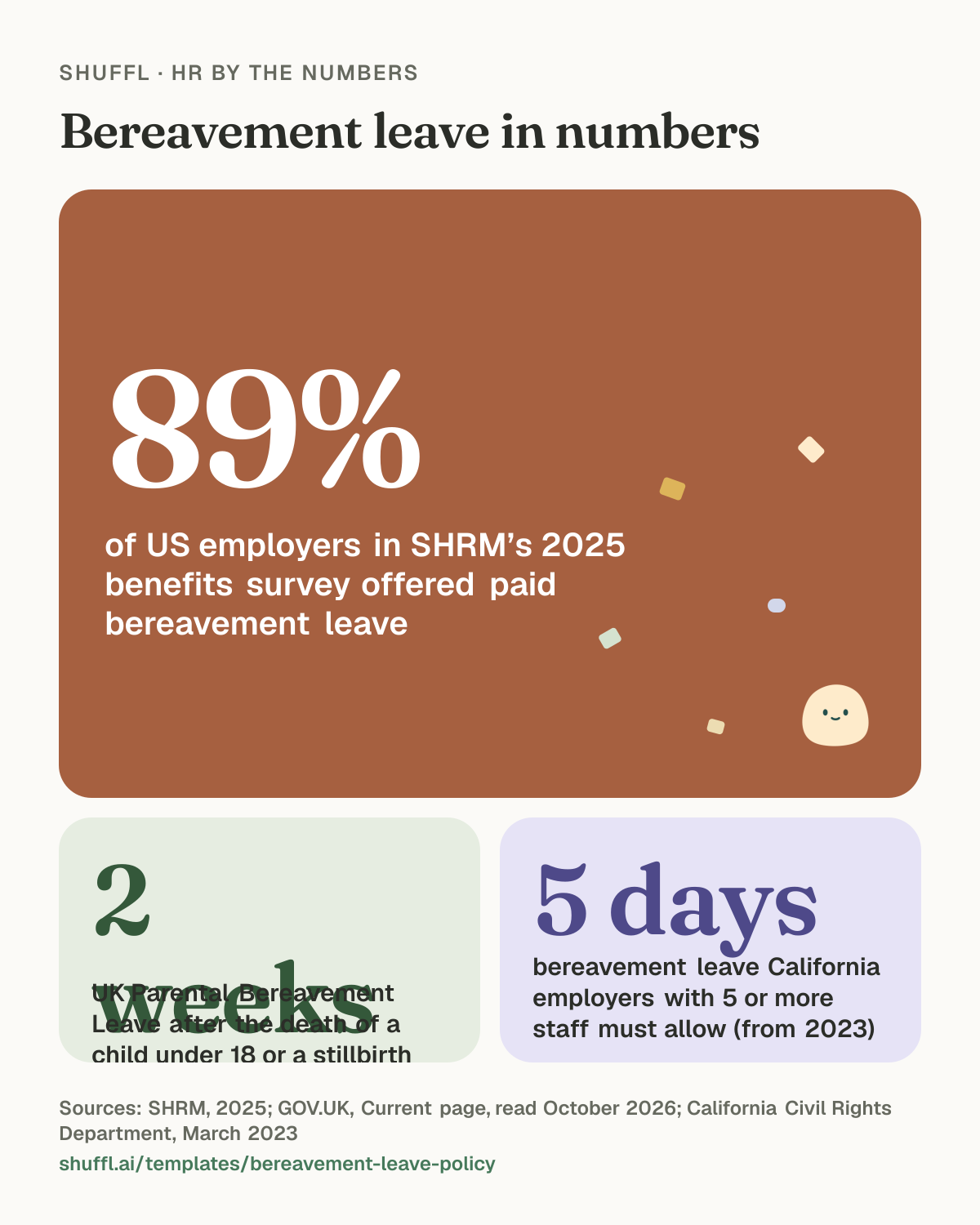
Bereavement leave in numbers. 89% of US employers in SHRM’s 2025 benefits survey offered paid bereavement leave (SHRM, 2025). 2 weeks UK Parental Bereavement Leave after the death of a child under 18 or a stillbirth (GOV.UK, Current page, read October 2026). 5 days bereavement leave California employers with 5 or more staff must allow (from 2023) (California Civil Rights Department, March 2023).
Bereavement leave
Words in [square brackets] are for you to fill in. The policy has every section a real handbook policy has, but no allowances, dates or amounts of its own.
# Bereavement leave

## Purpose
When someone close to you dies, you should be able to take time away without worrying about work. This policy explains the time off and support available.

## Who this covers
[Which employees this applies to, and from when.]

## Time off
| Whose death | Paid time off |
| --- | --- |
| [Partner, child or parent] | [number of days] |
| [Sibling, grandparent, grandchild or in-law] | [number of days] |
| [Someone else close to you] | [number of days] |

- Pregnancy loss: [time off and pay]
- Travel: [extra days if you need to travel for a funeral]
- Extra time: you can take [more time from your paid time off or unpaid leave], and talk to your manager about coming back gradually.

The days do not need to be taken all at once. You can use them [within a number of months], for example for a funeral or memorial held later.

## How to let us know
Tell [your manager or HR] as soon as you are able. You do not need to share details, and [whether any proof is needed, or "no proof is needed"].

## Support
[Support available, for example an employee assistance programme, counselling, or flexible hours when you return.]

## Responsibilities
- **You:** let us know when you can, in whatever way is easiest.
- **Your manager:** cover your work, keep it private and check in kindly when you return.
- **HR:** record the leave and explain the support available.

## Where local law differs
If the law where you work gives you more bereavement leave or pay, the law applies. These places have their own rules: [list them, or "none"].

## Related policies
Paid time off and Sick leave.

## About this policy
Owned by [team or person]. Applies in [countries or states]. We may update this policy and will tell you at least [number] days before a change takes effect. This policy is not part of your employment contract.

## Questions
Contact [team or person] at [email or channel].
Check before you publish
Rules that often catch teams out, by place. They are not part of the policy, and not legal advice.
United States
- There is no federal bereavement leave. Some states require it or let people use other paid leave for it, for example California, Illinois, Oregon and Maryland. California and Illinois also cover pregnancy loss and some failed adoptions.
United Kingdom
- Parents who lose a child under 18, or after 24 weeks of pregnancy, get two weeks of parental bereavement leave, and everyone can take reasonable unpaid time off for dependants. These rules are expanding, so check gov.uk.
European Union
- Several countries set paid days by law, for example France, Spain and Italy, with more days for a child or partner.
How to adapt it
- Say the days can be taken later, for a funeral or memorial.
- Cover pregnancy loss.
- Ask for no proof, or as little as the law allows.
What the research says
Bereavement leave is one of the most widely offered benefits. In SHRM’s 2025 survey of 3,969 US organizations, 89% offered paid bereavement leave, down 2 percentage points from 2024.1 SHRM’s 2024 survey found that more than a third of employers offering bereavement leave also covered a failed pregnancy, surrogacy or adoption.2
The amount is usually short. SHRM notes that most companies offer only a few days, and that most policies don’t allow for longer leave for international travel or religious and cultural practices.2 Letting people split their days, and take some later for a funeral or memorial, costs little and helps a lot.
What the law requires
The Department of Labor says the Fair Labor Standards Act doesn’t require pay for time not worked, including attending a funeral, so bereavement leave is mostly a matter of employer policy.3 Some states set their own rules, so check each state where you employ people.
In California, private employers with five or more employees must allow up to five days of bereavement leave after the death of a spouse, child, parent, sibling, grandparent, grandchild, domestic partner or parent-in-law, for employees with at least 30 days’ service. The days must be taken within three months of the death and don’t have to be paid.4
In the UK, employees whose child dies before turning 18, or who have a stillbirth after 24 weeks of pregnancy, can take two weeks of Parental Bereavement Leave, as one block, two separate weeks or one week, within 56 weeks of the death.5
The leave has no minimum length of service. Statutory Parental Bereavement Pay needs 26 weeks’ service and average earnings of at least £129 a week, and is £194.32 a week or 90% of average weekly earnings, whichever is lower.65
The UK government has announced a new right to bereavement leave from April 2027 for the loss of a spouse or partner, parent, adult child or sibling, and up to two weeks of unpaid leave after pregnancy loss before 24 weeks. The details will be set by secondary legislation.7
Common mistakes
- Defining family so narrowly that people have to argue about whether a loss counts.
- Requiring the days to be taken in one block straight after the death.
- Asking for a death certificate or other proof at the worst possible moment.
- Leaving out pregnancy loss, or treating it as sick leave.
Common questions
- How many days of bereavement leave is normal?
- Most US employers that offer it give a few days, often more for a close family member. California requires employers with five or more employees to allow up to five days. Many companies let managers give more when someone needs it.
- Is bereavement leave paid?
- In the US it’s paid only if the employer’s policy says so, although 89% of employers in SHRM’s 2025 survey offered paid bereavement leave. In the UK, Statutory Parental Bereavement Pay is available for the loss of a child to employees who meet the service and earnings conditions.
- Should bereavement leave cover pregnancy loss?
- Many employers now include it. In the UK, Parental Bereavement Leave already covers stillbirth after 24 weeks, and the government has announced up to two weeks of leave for pregnancy loss before 24 weeks from April 2027.
Sources
Read on . Laws change, so check the source before you act. This page is general information, not legal advice.
- SHRM, 2025 Employee Benefits Survey: Executive Summary, 2025. Online survey of U.S.-based SHRM professional members, Jan. 21 to March 10, 2025; 3,969 organizations; unweighted.
- SHRM, Why Employers Need to Step Up on Bereavement Benefits, June 28, 2024. By Kathryn Mayer; cites SHRM’s 2024 Employee Benefits Survey.
- U.S. Department of Labor, Funeral Leave, Current page, read October 2026.
- California Civil Rights Department, Bereavement Leave (frequently asked questions), March 2023. Government Code section 12945.7, effective January 1, 2023.
- GOV.UK, Statutory Parental Bereavement Pay and Leave: What you’re entitled to, Current page, read October 2026.
- GOV.UK, Statutory Parental Bereavement Pay and Leave: Check if you’re eligible, Current page, read October 2026.
- GOV.UK, “No one should have to fight for time to grieve” - New rights for family bereavement and pregnancy loss, 22 September 2026.