
Policies
Jury duty and voting policy template
Time off and pay for jury duty, voting and other public duties. A complete policy to adapt with your own rules.
A starting point, not legal advice. Leave, pay and expense rules differ by country, state and city. Use the checks on this page to see what to look up where your people work, and have someone qualified review your policy before you publish it.
Knowledge draft. Opens a Knowledge draft with this policy, its checks and what Shuffl already knows, like your HR contact and countries. Draft with Mello can write the rest and show where each value came from. Nothing is published until you choose Publish.
A jury duty and voting policy explains the time off and pay people get for public duties.
Most places protect people who serve, and some require pay, so write down what you do before the first summons arrives.
Shuffl · HR by the numbers
Jury duty in numbers

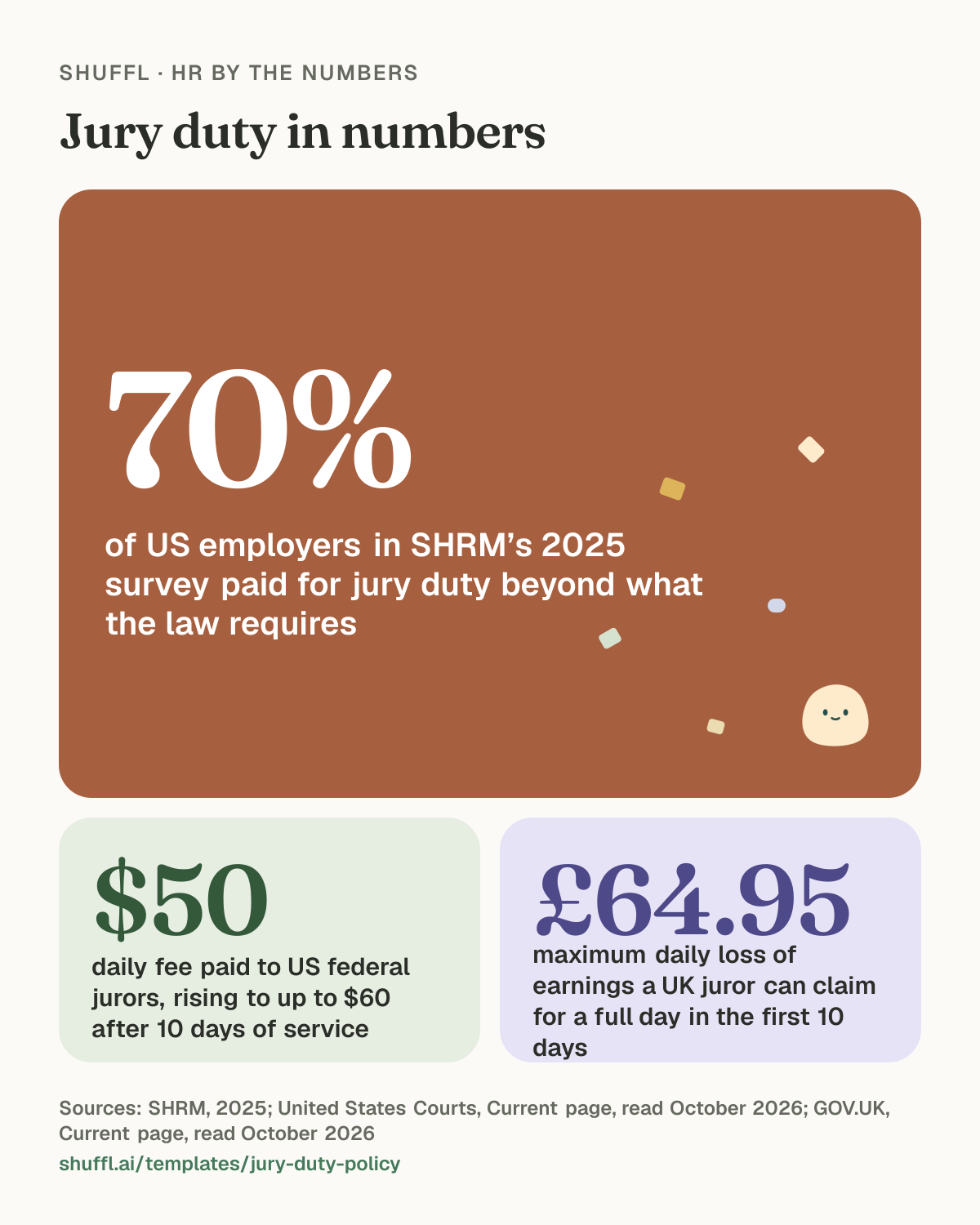
Jury duty in numbers. 70% of US employers in SHRM’s 2025 survey paid for jury duty beyond what the law requires (SHRM, 2025). $50 daily fee paid to US federal jurors, rising to up to $60 after 10 days of service (United States Courts, Current page, read October 2026). £64.95 maximum daily loss of earnings a UK juror can claim for a full day in the first 10 days (GOV.UK, Current page, read October 2026).
Jury duty, voting and public duties
Words in [square brackets] are for you to fill in. The policy has every section a real handbook policy has, but no allowances, dates or amounts of its own.
# Jury duty, voting and public duties

## Purpose
Serving on a jury, voting and other public duties matter. This policy explains the time off you can take for them and how you are paid.

## Who this covers
[Which employees this applies to.]

## Jury duty
- Tell [your manager] as soon as you receive a summons, and share a copy with [HR].
- You get [paid time off for up to a number of days, or unpaid time off] for jury service.
- [Whether the company tops up or deducts any allowance the court pays.]
- If you are released early on a day, [whether you return to work].

## Being a witness
[Time off and pay if you are called as a witness.]

## Voting
You can take [up to a number of hours of paid time] to vote if your working hours do not leave enough time to vote. Tell [your manager] at least [number of days] before election day.

## Other public duties
[Time off for other duties, for example serving as a magistrate, a councillor, a school governor, or in the military reserves.]

## Military service
[Time off and job protection for military service and training.]

## Responsibilities
- **You:** tell us early and share the dates you will be away.
- **Your manager:** plan cover and never discourage you from serving.
- **HR:** record the time off and apply the right pay.

## Protection from retaliation
Nobody will lose their job, be disciplined or be treated worse for serving on a jury, voting or carrying out a public duty.

## Where local law differs
If the law where you work gives you more time off or pay for public duties, the law applies. These places have their own rules: [list them, or "none"].

## Related policies
Paid time off.

## About this policy
Owned by [team or person]. Applies in [countries or states]. We may update this policy and will tell you at least [number] days before a change takes effect. This policy is not part of your employment contract.

## Questions
Contact [team or person] at [email or channel].
Check before you publish
Rules that often catch teams out, by place. They are not part of the policy, and not legal advice.
United States
- Every state protects jurors from being fired or punished for serving. Some, for example Colorado, Connecticut, Massachusetts and New York, require pay for the first few days. Salaried exempt employees cannot have pay docked for part of a week spent on jury duty.
- Many states require time off to vote, often paid and often with a notice rule, and some require a notice posted before elections. USERRA protects the jobs of employees who serve in the military.
United Kingdom
- You must allow time off for jury service but do not have to pay for it; jurors can claim loss of earnings from the court. Employees who hold some public roles are entitled to reasonable unpaid time off.
How to adapt it
- Say how many days are paid, and whether court allowances are deducted.
- Give the notice needed to take time off to vote.
- Cover military service and other public roles in the same place.
What the research says
Most employers keep paying people who are called for jury service, even where the law doesn’t require it. In SHRM’s 2025 survey of 3,969 US organizations, 70% offered paid jury duty beyond what the law requires, and 32% offered paid military leave beyond legal requirements.1
Court allowances rarely replace a salary. US federal jurors get $50 a day, and up to $60 a day after 10 days if the judge orders it.2 In England and Wales, an employee can claim up to £64.95 a day for loss of earnings for more than four hours at court in the first 10 days, rising to £129.91 a day after 10 working days.3
What the law requires
In the US, federal law forbids employers from discharging, threatening, intimidating or coercing a permanent employee because of federal jury service.4 Employers may continue salary during jury duty but don’t have to.2 Exempt employees can’t have salary deducted for jury duty absences, though an employer can offset jury fees received that week.5
State laws can add to this, for jury service and for voting. New York, for example, lets registered voters without four consecutive hours outside their shift take up to two hours off without loss of pay to vote, with two to ten days’ notice.6
Military service is protected separately. Under USERRA, people returning from service must be promptly re-employed in the position they would have attained, with the same seniority, status and pay.7
UK employers must allow time off for jury service and can’t dismiss an employee for it. If the absence would seriously harm the business, they can ask the employee to seek a delay, but only once in 12 months.8 Pay isn’t required. Unpaid employees can claim a loss of earnings allowance from the court, with the employer’s certificate.9
Common mistakes
- Not saying whether court allowances are deducted from pay, or how to hand them over.
- Asking people to come back to work on days or half days when they aren’t needed at court, without saying so in the policy.
- Deducting jury duty days from an exempt employee’s salary in the US.
- Forgetting the paperwork, like the UK certificate of loss of earnings, so the employee can’t claim from the court.
Common questions
- Do employers have to pay employees for jury duty?
- US federal law doesn’t require it, although 70% of employers in SHRM’s 2025 survey paid for jury duty beyond legal requirements. In the UK, employers don’t have to pay, and the employee can claim a loss of earnings allowance from the court instead. Check the rules where each person works.
- Can an employer stop someone doing jury service?
- No. In the US, employers can’t fire, threaten or coerce a permanent employee because of federal jury service. In the UK, employers must allow the time off, though they can ask the employee to seek a delay if the absence would seriously harm the business.
- Do employees get time off to vote?
- In the US this depends on the state. New York, for example, allows up to two hours off without loss of pay for registered voters who don’t have four consecutive hours to vote outside their shift, with between two and ten days’ notice.
Sources
Read on . Laws change, so check the source before you act. This page is general information, not legal advice.
- SHRM, 2025 Employee Benefits Survey: Executive Summary, 2025. Online survey of U.S.-based SHRM professional members, Jan. 21 to March 10, 2025; 3,969 organizations; unweighted.
- United States Courts, Juror Pay, Current page, read October 2026.
- GOV.UK, Jury service: What you can claim if you’re an employee, Current page, read October 2026.
- Legal Information Institute, Cornell Law School, 28 U.S. Code § 1875 - Protection of jurors’ employment, Current page, read October 2026.
- Legal Information Institute, Cornell Law School, 29 CFR § 541.602 - Salary basis, Current page, read October 2026.
- New York State Board of Elections, Time Off to Vote Notice, Revised April 14, 2020. New York Election Law section 3-110.
- U.S. Department of Labor, Veterans’ Employment and Training Service, USERRA - Uniformed Services Employment and Reemployment Rights Act, Current page, read October 2026.
- GOV.UK, Giving staff time off for jury service, Current page, read October 2026.
- GOV.UK, Giving staff time off for jury service: Paying staff on jury service, Current page, read October 2026.