
Policies
Equal opportunity and anti-harassment policy template
Equal opportunity, what harassment is, how to report it and protection for those who do. A complete policy to adapt with your own rules.
A starting point, not legal advice. Leave, pay and expense rules differ by country, state and city. Use the checks on this page to see what to look up where your people work, and have someone qualified review your policy before you publish it.
Knowledge draft. Opens a Knowledge draft with this policy, its checks and what Shuffl already knows, like your HR contact and countries. Draft with Mello can write the rest and show where each value came from. Nothing is published until you choose Publish.
An equal opportunity and anti-harassment policy says what is not tolerated, gives examples, and explains how to report it and what happens next.
It is the policy most often required by law, and the one people need to trust most.
Shuffl · HR by the numbers
Workplace harassment in numbers

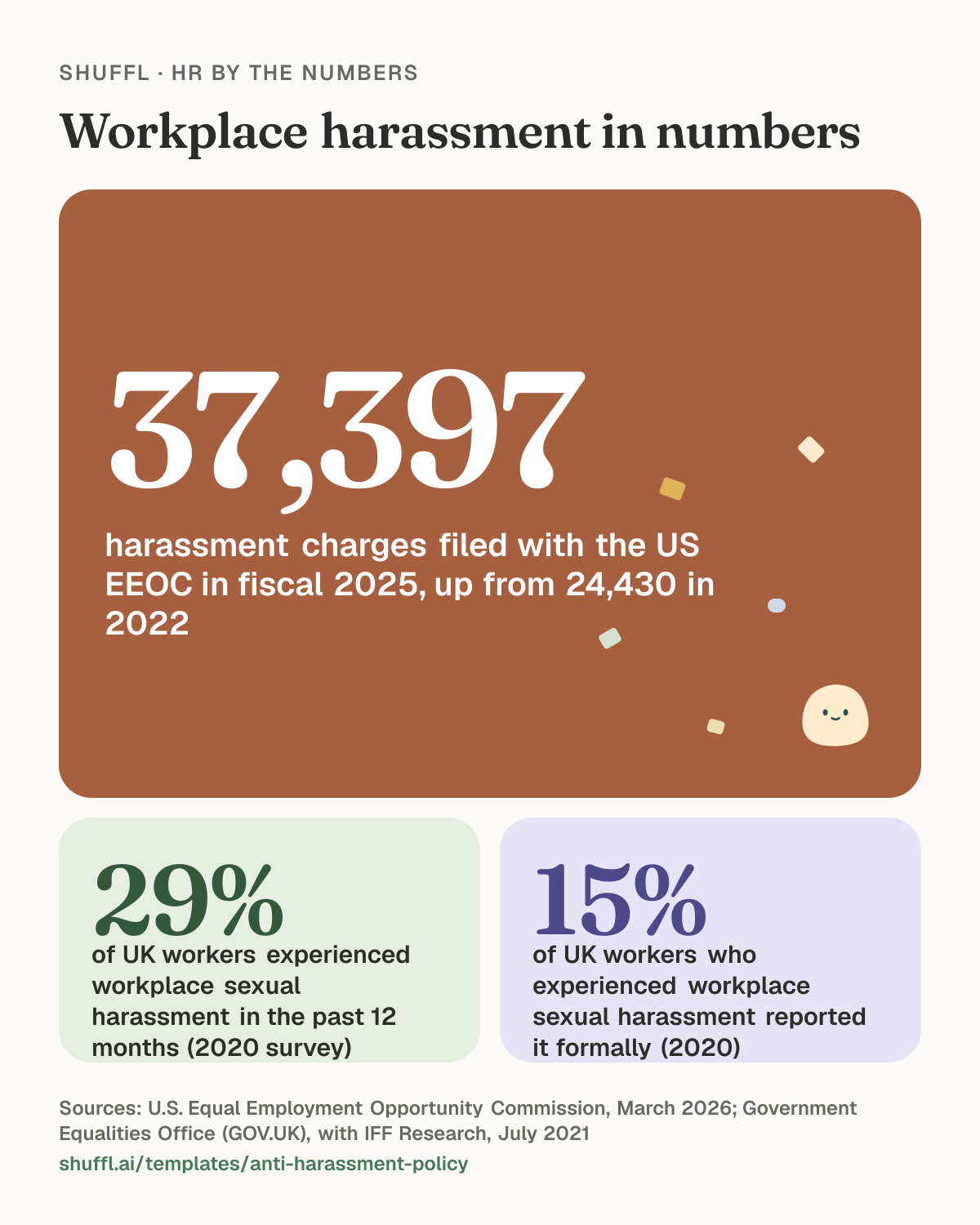
Workplace harassment in numbers. 37,397 harassment charges filed with the US EEOC in fiscal 2025, up from 24,430 in 2022 (U.S. Equal Employment Opportunity Commission, March 2026). 29% of UK workers experienced workplace sexual harassment in the past 12 months (2020 survey) (Government Equalities Office (GOV.UK), with IFF Research, July 2021). 15% of UK workers who experienced workplace sexual harassment reported it formally (2020) (Government Equalities Office (GOV.UK), with IFF Research, July 2021).
Equal opportunity and anti-harassment
Words in [square brackets] are for you to fill in. The policy has every section a real handbook policy has, but no allowances, dates or amounts of its own.
# Equal opportunity and anti-harassment

## Purpose
Everyone here should be treated fairly and with respect. This policy explains our commitment to equal opportunity, what harassment is, and what to do if it happens.

## Who this covers
Everyone who works here, including [contractors, interns and job applicants], and everyone they deal with at work, including customers and partners. It applies at work, at company events, on business trips and online.

## Equal opportunity
We make decisions about hiring, pay, promotion, training, discipline and dismissal based on skills and work. We do not discriminate because of [the protected characteristics where you work, for example race, colour, religion, sex, pregnancy, sexual orientation, gender identity, national origin, age, disability or genetic information], or any other characteristic protected by law.

## Reasonable adjustments
If you need an adjustment because of a disability, pregnancy or religious belief, ask [HR contact]. We will talk with you and make reasonable changes.

## What harassment is
Harassment is unwanted behaviour linked to a protected characteristic that makes someone feel intimidated, humiliated or offended. It can be a single serious incident or a pattern. Examples:
- Jokes, slurs, nicknames or comments about someone's characteristics
- Unwanted touching, sexual comments, messages or images
- Pressure for dates or sexual favours, or linking them to work decisions
- Excluding or undermining someone because of who they are

Bullying is not tolerated either, whether or not it is linked to a protected characteristic.

## If it happens to you or you see it
1. If you feel able to, tell the person their behaviour is unwelcome.
2. Report it to [your manager, HR contact or another named person], or through [the anonymous route].
3. You can report it even if it did not happen to you.

## What happens next
We look into every report promptly and fairly, and take action where needed, up to and including dismissal. We tell the people involved the outcome as far as we can while protecting others' privacy.

## Protection from retaliation
Nobody will be treated worse for reporting harassment or discrimination in good faith, or for helping with a review.

## Responsibilities
- **Everyone:** treat others with respect and speak up when something is wrong.
- **Managers:** act on anything they see or hear about, even without a formal report, and tell HR.
- **HR:** run reviews fairly, keep records and provide training.

## Where local law differs
If the law where you work gives you more protection, the law applies. These places have their own rules: [list them, or "none"].

## Related policies
Raising a concern and Code of conduct.

## About this policy
Owned by [team or person]. Applies in [countries or states]. We may update this policy and will tell you at least [number] days before a change takes effect. This policy is not part of your employment contract.

## Questions
Contact [team or person] at [email or channel].
Check before you publish
Rules that often catch teams out, by place. They are not part of the policy, and not legal advice.
United States
- Federal law protects race, colour, religion, sex (including pregnancy, sexual orientation and gender identity), national origin, age 40 and over, disability and genetic information. Many states add more, such as marital status, and their laws often cover smaller employers. List every characteristic that applies where you have people.
- California, Connecticut, Delaware, Illinois, Maine and New York require harassment prevention training. New York also requires a written policy with set contents and a complaint form.
United Kingdom
- The Equality Act 2010 protects nine characteristics. Since October 2024 employers must take reasonable steps to prevent sexual harassment of their workers, which a written policy and training help show.
European Union
- EU directives protect sex, racial or ethnic origin, religion or belief, disability, age and sexual orientation. Some countries require a named contact person or a committee for harassment reports.
How to adapt it
- List the protected characteristics that apply where you have people.
- Give more than one way to report, including someone outside the reporting line.
- Say managers must act on what they see, even without a formal report.
What the research says
Harassment is common, and most of it goes unreported. In a UK government survey of 12,131 people, 29% of those in employment had experienced some form of sexual harassment at work or in a work-related setting in the previous 12 months, and only 15% of them reported it formally.2 Most often they addressed the person themselves, and 40% saw their job change as a result.2
The US picture is similar. The EEOC’s task force found roughly three in four people who experienced harassment never talked to a supervisor about it, and only 6% to 13% filed a formal complaint.3 Charges are rising: 37,397 alleged harassment in fiscal year 2025, up from 24,430 in 2022, and the EEOC secured $261.9 million for people through its administrative process that year.1
What the law requires
The EEOC treats harassment based on race, color, religion, sex (including sexual orientation, transgender status and pregnancy), national origin, age 40 and over, disability or genetic information as employment discrimination.4 Most of these federal laws cover employers with 15 or more employees, and age discrimination law those with 20 or more. State or local laws may cover smaller employers.5
Where a supervisor’s harassment creates a hostile environment, an employer can only avoid liability by showing it took reasonable care to prevent and correct the behavior and the employee unreasonably failed to use the complaint options available.4
In the UK, all employers must take reasonable steps to prevent sexual harassment of their workers, a duty that came into effect on 26 October 2024. Employers that fail can face action by the Equality and Human Rights Commission and higher compensation at tribunal.6 From 30 October 2026, employers will be liable unless they have taken all reasonable steps to prevent it.6
In the EU, the equal treatment directive defines harassment and sexual harassment as discrimination, and requires member states to encourage employers to take effective measures to prevent them.7 National law sets the details, so check each country where you employ people.
Common mistakes
- Offering one reporting route, through the manager, which fails when the manager is the problem.
- Waiting for a formal written complaint before acting on something a manager has seen or heard.
- Forgetting harassment from customers, clients and contractors, and harassment at work socials or online.
- Writing the policy and never training managers on how to respond in the first conversation.
Common questions
- Is an anti-harassment policy required by law?
- In the US, the EEOC encourages a clear policy, a complaint process and training, and an employer’s defense to some harassment claims rests on showing it reasonably tried to prevent and correct harassment. UK employers must take reasonable steps to prevent sexual harassment. Acas suggests a specific policy, complaints procedure, training and a reporting route, including an anonymous one.
- What counts as workplace harassment?
- Harassment is unwelcome conduct linked to a protected characteristic, like sex, race, disability or age. It can be spoken, written, physical or online, and it includes conduct at work events, in messages and from people outside the company such as customers.
- Can someone report harassment anonymously?
- You can offer an anonymous route, and many companies do, because so few people report formally. Be honest in the policy that an anonymous report can be harder to investigate, and explain how you protect people who report from retaliation.
Sources
Read on . Laws change, so check the source before you act. This page is general information, not legal advice.
- U.S. Equal Employment Opportunity Commission, Table E2a. Charges Alleging Harassment, Charge Receipts and Resolutions by Type (All Statutes), FY 2010 - FY 2025, March 2026. Charges filed with the EEOC under all statutes; excludes charges filed only with state or local agencies, and monetary benefits obtained through litigation.
- Government Equalities Office (GOV.UK), with IFF Research, 2020 Sexual Harassment Survey, July 2021. Nationally representative online survey of 12,131 people in the UK.
- U.S. Equal Employment Opportunity Commission, Select Task Force on the Study of Harassment in the Workplace: Report of Co-Chairs Chai R. Feldblum and Victoria A. Lipnic, June 2016.
- U.S. Equal Employment Opportunity Commission, Harassment, Current page, read October 2026.
- U.S. Equal Employment Opportunity Commission, Coverage of Business/Private Employers, Current page, read October 2026.
- Acas, Preventing sexual harassment, Current page, read October 2026.
- legislation.gov.uk (EU text as adopted), Directive 2006/54/EC of the European Parliament and of the Council of 5 July 2006 on the implementation of the principle of equal opportunities and equal treatment of men and women in matters of employment and occupation (recast), 5 July 2006. Articles 2 and 26.