
Policies
Resignation and leaving policy template
Resigning, notice, the last day, final pay, references and benefits after leaving. A complete policy to adapt with your own rules.
A starting point, not legal advice. Leave, pay and expense rules differ by country, state and city. Use the checks on this page to see what to look up where your people work, and have someone qualified review your policy before you publish it.
Knowledge draft. Opens a Knowledge draft with this policy, its checks and what Shuffl already knows, like your HR contact and countries. Draft with Mello can write the rest and show where each value came from. Nothing is published until you choose Publish.
A leaving policy covers resignation, notice periods, the last day, final pay and what happens to benefits, so departures are calm and consistent.
Final pay and notice rules are set by law in most places, so this is one to check carefully.
Shuffl · HR by the numbers
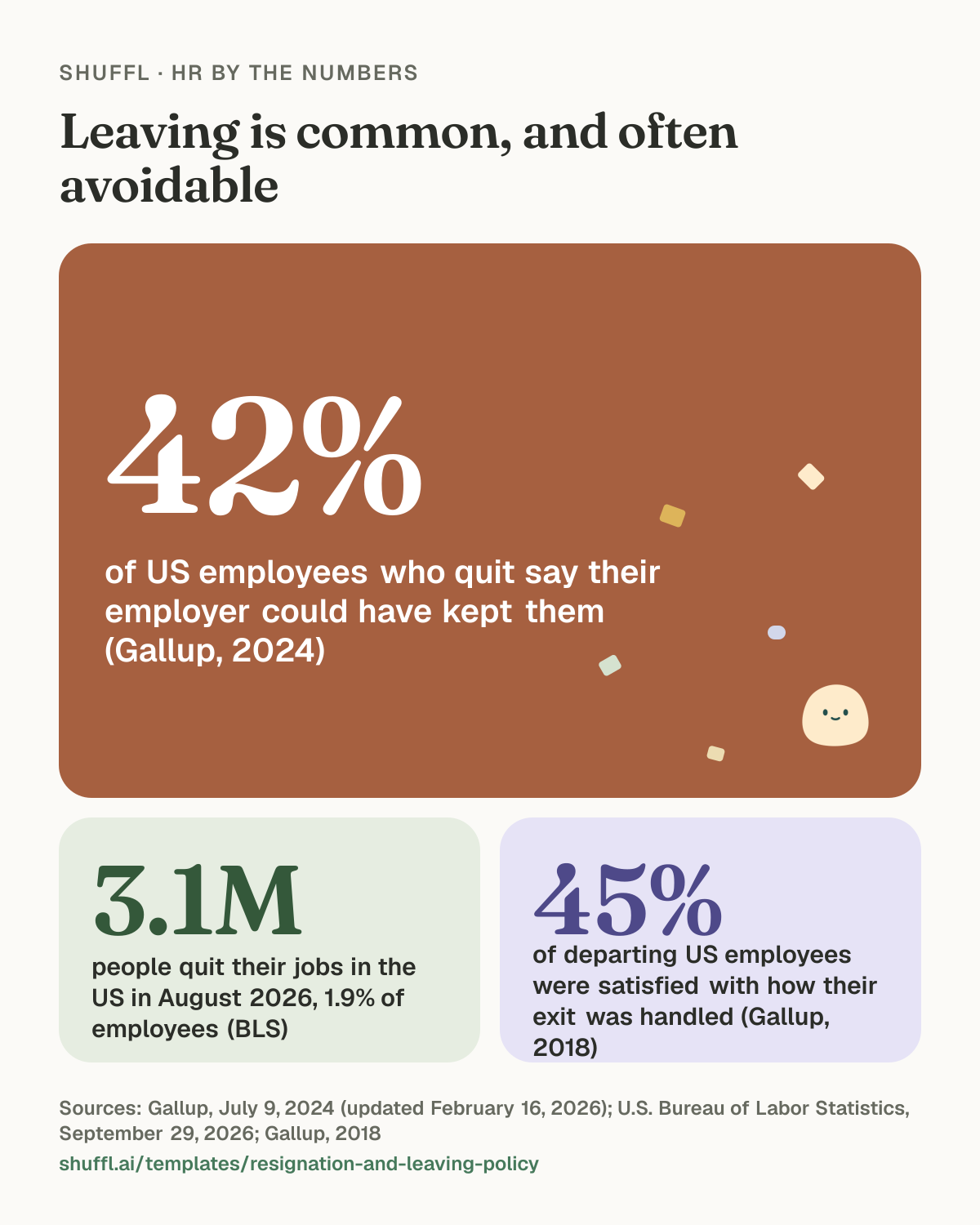
Leaving is common, and often avoidable

Leaving is common, and often avoidable. 42% of US employees who quit say their employer could have kept them (Gallup, 2024) (Gallup, July 9, 2024 (updated February 16, 2026)). 3.1M people quit their jobs in the US in August 2026, 1.9% of employees (BLS) (U.S. Bureau of Labor Statistics, September 29, 2026). 45% of departing US employees were satisfied with how their exit was handled (Gallup, 2018) (Gallup, 2018).
Leaving the company
Words in [square brackets] are for you to fill in. The policy has every section a real handbook policy has, but no allowances, dates or amounts of its own.
# Leaving the company

## Purpose
This policy explains what happens when you leave the company, whether you resign or we end your employment, so the last weeks are clear and fair for everyone.

## Who this covers
[Which employees this applies to, and whether different rules apply during a probation period.]

## Resigning
Tell [your manager and HR] in writing. Your notice period is:

| Who | Notice you give |
| --- | --- |
| [During probation] | [notice period] |
| [After probation] | [notice period] |
| [Managers or senior roles] | [notice period] |

## During your notice period
- You keep working as normal and hand over your work, unless we agree otherwise.
- [Whether you can take remaining time off during notice, or must agree it with your manager.]
- [Whether the company may ask you to stay at home on full pay for some or all of your notice.]

## If the company ends your employment
[How much notice or pay in place of notice the company gives, and how it relates to the Disciplinary and grievance process.]

## Your last day
- Return [laptop, phone, badge, cards and any other company property] by [how and when].
- Your access to company systems ends at [time] on your last day.
- Save any personal files before then. Company files stay with the company.

## Final pay
Your final pay includes your pay up to your last day, [unused time off, as set out in the Paid time off policy], and any approved expenses. It is paid [when and how].

## Benefits after you leave
[When each benefit ends, and any option to keep cover, for example continuation cover.]

## References
[What the company confirms in a reference, for example dates and job title only, and who to ask.]

## Exit conversation
You will be invited to [an exit conversation or survey] with [who]. It is optional, and we use what you tell us to improve.

## Responsibilities
- **You:** give notice in writing, hand over your work and return company property.
- **Your manager:** plan the handover and tell the team.
- **HR:** confirm your last day and final pay in writing, end access and arrange the exit conversation.

## Where local law differs
If the law where you work gives you more notice, pay or protection, the law applies. These places have their own rules: [list them, or "none"].

## Related policies
Paid time off, Benefits, Acceptable use of company systems and Disciplinary and grievance process.

## About this policy
Owned by [team or person]. Applies in [countries or states]. We may update this policy and will tell you at least [number] days before a change takes effect. This policy is not part of your employment contract.

## Questions
Contact [team or person] at [email or channel].
Check before you publish
Rules that often catch teams out, by place. They are not part of the policy, and not legal advice.
United States
- Final pay deadlines differ by state. California, for example, requires final pay immediately when the company ends employment, and within 72 hours when someone quits without notice. Say whether employment is at will; Montana does not allow at-will employment after a probation period.
- Health plan continuation rules (COBRA for employers with 20 or more employees, or state rules) require a notice when someone leaves. Some states require paying out unused vacation; see the Paid time off checks.
United Kingdom
- After one month of employment the employer must give at least one week of notice per complete year of service, up to 12 weeks, and the employee at least one week. Untaken statutory holiday must be paid on leaving.
European Union
- Notice periods and dismissal protection are set by law and often by collective agreements. In Germany, for example, notice of termination is only valid in writing with a handwritten signature.
How to adapt it
- Put notice periods in a table by role or length of service.
- List the company property to return and how.
- Say when final pay arrives and what it includes.
What the research says
Resignations are routine. In August 2026, 3.1 million people in the US quit their jobs, 1.9% of all employees in a single month.1 A leaving policy is one of the HR documents people actually use.
Many of those exits could have gone differently. In a 2023 Gallup study of people who had recently quit, 42% said their manager or organization could have done something to keep them. 45% said no manager or leader had talked with them about their satisfaction, performance or future in the three months before they left.2
How the exit itself is handled matters too. In earlier Gallup research, fewer than half of departing employees (45%) were satisfied with how their organization handled their exit.3 Notice, handover and final pay are the parts of leaving you fully control, so it’s worth getting them right.
What the law requires
In the US, federal law doesn’t require employers to give a final paycheck immediately, but some states do.4 California, for example, requires all final wages, including accrued vacation, immediately when someone is dismissed. When someone quits, they’re due at the time of quitting if the person gave at least 72 hours’ notice, and within 72 hours if they didn’t.5
COBRA generally applies to private employers with at least 20 employees. When a job ends for reasons other than gross misconduct, group health coverage can continue for up to 18 months, and the employer must notify the plan within 30 days.6
UK employees with more than a month’s service must give at least a week’s notice.7 The employer’s statutory minimum is one week after a month’s service, one week per year between 2 and 12 years, and 12 weeks after 12 years. A contract can give more, not less.8 Employers must also pay for untaken statutory holiday built up by the leaving date.9
These are minimums and examples. Check the rules in every state and country where your people work, and your own contracts, before you set notice periods and final pay dates.
Common mistakes
- Holding back final pay until a laptop comes back. Deadlines like California’s don’t wait for equipment, so arrange returns separately.
- Accepting a resignation without a conversation. Ask why they’re leaving while they’re still there to tell you.
- Leaving benefits vague. Say what happens to health cover, pension contributions and unused holiday, and when.
- Announcing a departure before the person has agreed how and when it’s shared with their team and clients.
Common questions
- How much notice should an employee give when resigning?
- In the UK the legal minimum is one week once someone has worked for more than a month, and contracts often ask for more. In the US, notice usually comes from the contract or company policy, and two weeks is a common expectation. Put your notice periods in writing so nobody has to guess.
- When is a final paycheck due?
- It depends on where the person works. US federal law sets no deadline, but some states do, and California requires final pay immediately on dismissal and within 72 hours of quitting without notice. Check the rule for each location before the last day.
- Do employees get paid for unused holiday when they leave?
- In the UK, yes: employers must pay for any untaken statutory holiday that has built up. In the US it depends on state law and your own policy, and California counts accrued vacation as wages that must be paid out. Say clearly in the policy how unused time is handled.
Sources
Read on . Laws change, so check the source before you act. This page is general information, not legal advice.
- U.S. Bureau of Labor Statistics, Job Openings and Labor Turnover Summary, September 29, 2026. Monthly JOLTS release for August 2026, seasonally adjusted.
- Gallup, 42% of Employee Turnover Is Preventable but Often Ignored, July 9, 2024 (updated February 16, 2026). By Corey Tatel and Ben Wigert. Nationally representative study of 717 U.S. employees who voluntarily left an employer in the past 12 months, fielded Nov. 8-20, 2023, margin of error ±5 points.
- Gallup, Exit Programs That Retain Stars and Build Brand Ambassadors, 2018. Gallup perspective paper (PDF, copyright 2018), drawing on Gallup surveys of U.S. employees who left their jobs.
- U.S. Department of Labor, Last Paycheck, No date stated; read October 2026.
- California Department of Industrial Relations, Labor Commissioner’s Office, Paydays, pay periods, and the final wages, No date stated; read October 2026.
- U.S. Department of Labor, Employee Benefits Security Administration, An Employer’s Guide to Group Health Continuation Coverage Under COBRA, No date stated; read October 2026.
- GOV.UK, Handing in your notice: Giving notice, No date stated; read October 2026.
- GOV.UK, Redundancy: your rights: Notice periods, No date stated; read October 2026.
- Acas, Holidays and final pay – Final pay when someone leaves a job, Last updated 19 May 2026.