
Policies
Disciplinary and grievance policy template
Fair handling of conduct and performance, warnings, appeals and raising a grievance. A complete policy to adapt with your own rules.
A starting point, not legal advice. Leave, pay and expense rules differ by country, state and city. Use the checks on this page to see what to look up where your people work, and have someone qualified review your policy before you publish it.
Knowledge draft. Opens a Knowledge draft with this policy, its checks and what Shuffl already knows, like your HR contact and countries. Draft with Mello can write the rest and show where each value came from. Nothing is published until you choose Publish.
A disciplinary and grievance policy explains how conduct and performance problems are handled, and how people raise complaints about their own work.
A written, consistent process protects people and the company when something goes wrong.
Shuffl · HR by the numbers
Unresolved conflict is expensive

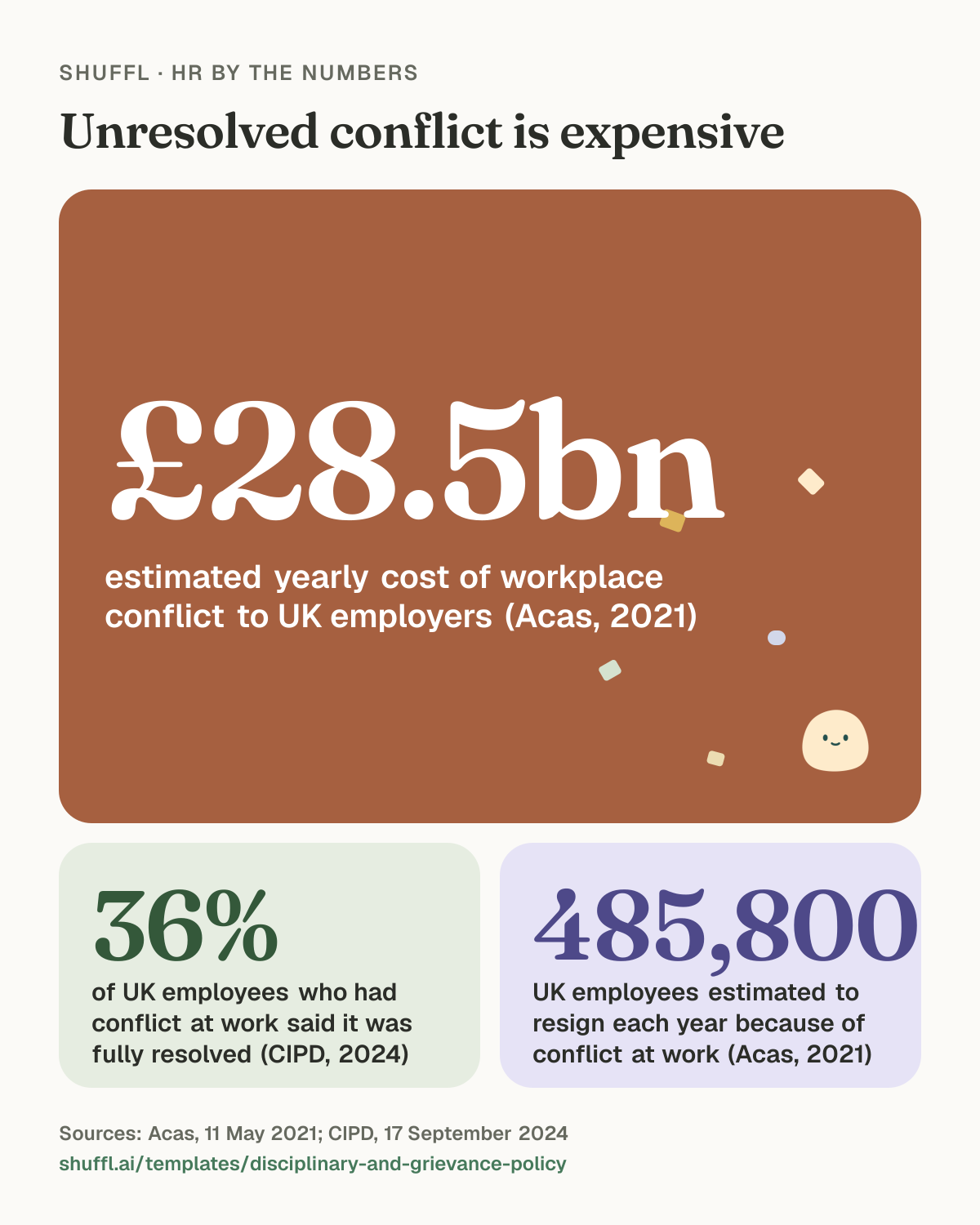
Unresolved conflict is expensive. £28.5bn estimated yearly cost of workplace conflict to UK employers (Acas, 2021) (Acas, 11 May 2021). 36% of UK employees who had conflict at work said it was fully resolved (CIPD, 2024) (CIPD, 17 September 2024). 485,800 UK employees estimated to resign each year because of conflict at work (Acas, 2021) (Acas, 11 May 2021).
Disciplinary and grievance process
Words in [square brackets] are for you to fill in. The policy has every section a real handbook policy has, but no allowances, dates or amounts of its own.
# Disciplinary and grievance process

## Purpose
This policy explains how we deal with problems at work fairly: how concerns about conduct or performance are handled, and how you can raise a complaint about your own work.

## Who this covers
[Which employees this applies to, and whether a shorter process applies during probation.]

## How we handle problems
- We try to settle things early and informally, with a conversation.
- We look into the facts before deciding anything.
- We tell you in writing what the concern is, and give you the evidence and a chance to answer it.
- You can bring [a colleague or union representative] to formal meetings.
- We treat similar cases in the same way, and you can appeal any formal decision.

## The disciplinary process
1. **Investigation:** [who] gathers the facts. You may be asked to a meeting to give your side.
2. **Disciplinary meeting:** we write to you at least [number] working days before, saying what the concern is.
3. **Outcome:** we confirm the outcome in writing within [number] working days.

| Outcome | How long it stays on your record |
| --- | --- |
| [First written warning] | [period] |
| [Final written warning] | [period] |
| Dismissal | Not applicable |

## Gross misconduct
Some things are serious enough that they can lead to dismissal for a first offence, for example [theft, violence, harassment, serious breach of data rules, or being unfit for work because of alcohol or drugs]. We still follow the process above before deciding.

## Performance concerns
[How concerns about performance are raised, the support and time given to improve, and when the formal process is used.]

## Appeals
Appeal in writing to [who] within [number] working days of the outcome, saying why. Someone not involved before hears the appeal, and their decision is final.

## Raising a grievance
A grievance is a concern or complaint about your own work, for example your workload, pay or how you are treated.
1. If you can, talk to your manager first.
2. If that does not settle it, or the grievance is about your manager, write to [HR contact].
3. We meet you within [number] working days, and confirm the outcome in writing.
4. You can appeal the outcome as above.

To report wrongdoing that affects others, use the Raising a concern policy.

## Records and privacy
HR keeps records of formal meetings and outcomes for [period], shared only with people who need them.

## Responsibilities
- **You:** take part in meetings and tell us if you need an adjustment.
- **Managers:** raise problems early, keep notes and involve HR before any formal step.
- **HR:** make sure the process is followed fairly and consistently.

## Where local law differs
If the law where you work gives you more rights in this process, the law applies. These places have their own rules: [list them, or "none"].

## Related policies
Code of conduct, Raising a concern, Equal opportunity and anti-harassment and Performance reviews and growth.

## About this policy
Owned by [team or person]. Applies in [countries or states]. We may update this policy and will tell you at least [number] days before a change takes effect. This policy is not part of your employment contract.

## Questions
Contact [team or person] at [email or channel].
Check before you publish
Rules that often catch teams out, by place. They are not part of the policy, and not legal advice.
United Kingdom
- Follow the Acas Code of Practice on disciplinary and grievance procedures. A tribunal can adjust an award by up to 25 percent if either side unreasonably fails to follow it. Workers have a legal right to be accompanied by a colleague or union representative at formal hearings.
United States
- If employment is at will, say that this process does not change it, and apply the process consistently; uneven discipline is common evidence in discrimination claims. Unionised employees can ask for a representative at investigatory interviews (Weingarten rights).
European Union
- Many countries require a works council or employee representatives to be heard before a dismissal, for example Germany, where a dismissal without that hearing is invalid.
How to adapt it
- Investigate before any formal meeting, and give people the evidence.
- Let people bring a colleague, and offer an appeal to someone new.
- Keep warnings on record for a set time, then remove them.
What the research says
Conflict at work is common and costly. Research for Acas estimated that 9.7 million UK employees experienced conflict in 2018 to 2019. About 485,800 people resign each year as a result, 874,000 take sickness absence, and the total cost to employers is around £28.5 billion a year.1
Employers tend to rate their processes more highly than employees do. In 2024, 70% of UK employers said they had effective procedures for resolving conflict between people, but only 36% of employees who had experienced conflict in the past year said it had been fully resolved.2
A written procedure is only part of the answer. Managers who know the process, act early and keep good notes are what make it work in practice.
What the law requires
In the UK, the Acas Code of Practice on disciplinary and grievance procedures mainly applies to employees. Employment tribunals can adjust awards by up to 25% when either side unreasonably fails to follow it.3
The Code sets out a statutory right to be accompanied at a hearing by a fellow worker or a trade union representative. Decisions should be confirmed in writing, employees can appeal, and appeal results should be given in writing as soon as possible.3
In the US, it is unlawful to retaliate against employees for raising discrimination or harassment with a manager, and taking part in a complaint process is protected.4 Handle any grievance that mentions discrimination with that in mind. State laws and union agreements can add more, so check the rules where your people work.
Common mistakes
- Going straight to a formal process. An early, private conversation often settles what a hearing would harden.
- Treating similar cases differently. Two people with the same issue should get the same process and similar outcomes.
- Taking action against someone soon after they complain without clear, recorded reasons. The timing can look like retaliation.
- Outcome letters that don’t say what happens next. State what needs to change, by when, and how to appeal.
Common questions
- What is the difference between a disciplinary and a grievance?
- A disciplinary is started by the employer about an employee’s conduct or performance. A grievance is a complaint an employee raises about their own work, colleagues or treatment. Many companies cover both in one policy because the steps are similar.
- Can an employee bring someone to a disciplinary meeting?
- In the UK, workers have a statutory right to be accompanied by a colleague or a trade union representative at disciplinary and grievance hearings. Elsewhere, check local law and any union agreement. Many employers allow a colleague anyway because it makes the meeting fairer.
- How long should a warning stay on file?
- There’s no single rule. Most policies set a period for each level of warning, and what matters is that you state it, apply it the same way to everyone and remove warnings when it ends.
Sources
Read on . Laws change, so check the source before you act. This page is general information, not legal advice.
- Acas, Estimating the costs of workplace conflict, 11 May 2021. Report by Richard Saundry and Peter Urwin. Estimates combine a 2019 CIPD/YouGov survey of 2,211 adults with WERS 2011 and SETA 2018 data; the authors call the approach conservative.
- CIPD, Only around a third of employees feel the conflict they experienced at work has been fully resolved, 17 September 2024. Employer figures: 2,009 UK senior HR professionals and decision-makers, YouGov, 26 March to 18 April 2024. Employee figures: 5,496 UK workers, YouGov, January and February 2024, for the CIPD Good Work Index.
- Acas, Code of Practice on disciplinary and grievance procedures, 11 March 2015.
- U.S. Equal Employment Opportunity Commission, Retaliation, No date stated; read October 2026.