
Policies
Benefits overview template
What benefits you offer, who is eligible, when they start and how to enrol. A complete policy to adapt with your own rules.
A starting point, not legal advice. Leave, pay and expense rules differ by country, state and city. Use the checks on this page to see what to look up where your people work, and have someone qualified review your policy before you publish it.
Knowledge draft. Opens a Knowledge draft with this policy, its checks and what Shuffl already knows, like your HR contact and countries. Draft with Mello can write the rest and show where each value came from. Nothing is published until you choose Publish.
A benefits overview helps people use what the company already pays for: what is offered, who is covered, when it starts and how to enrol.
The plan documents hold the exact terms; this page is the map that points to them.
Shuffl · HR by the numbers
Employee benefits in numbers

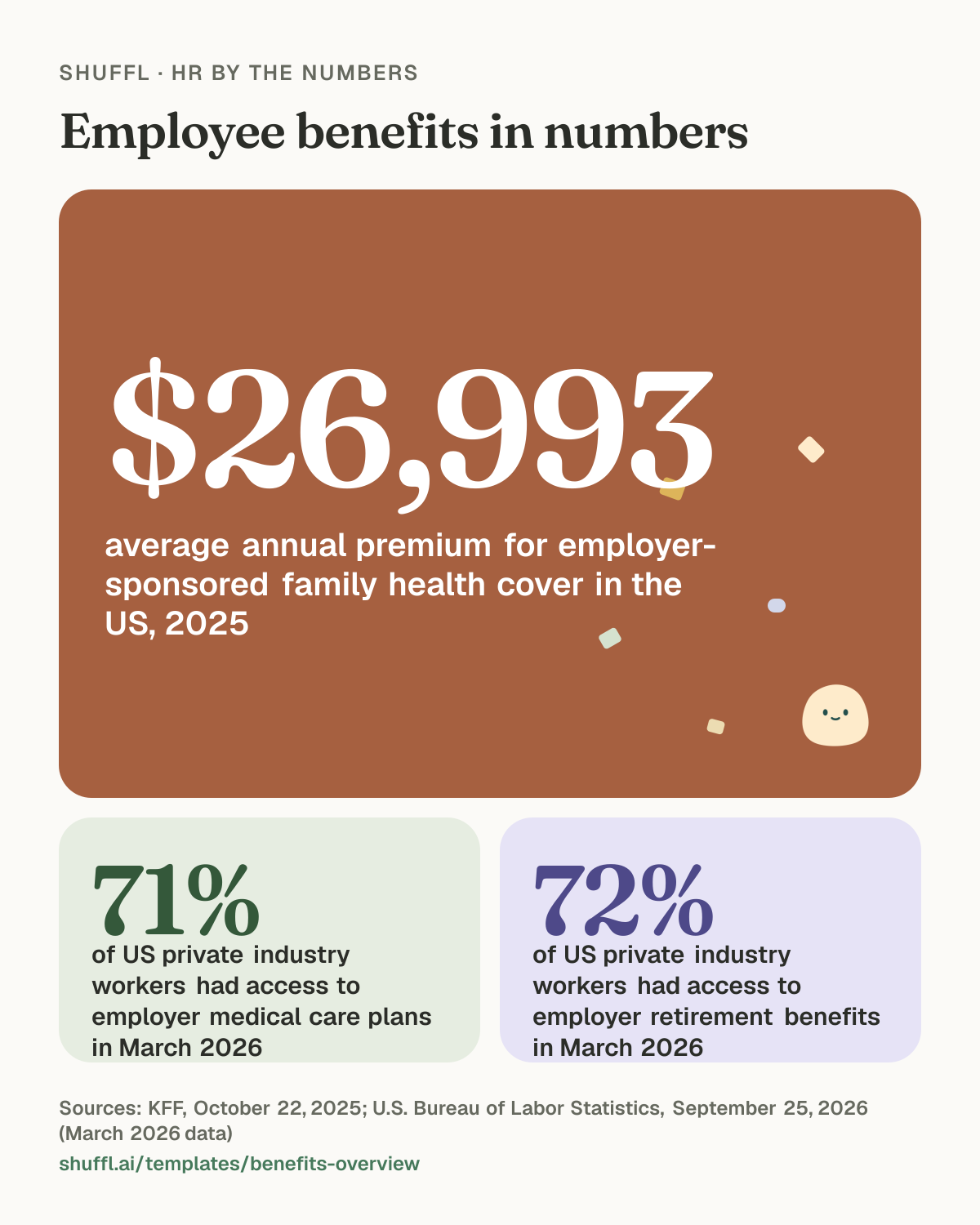
Employee benefits in numbers. $26,993 average annual premium for employer-sponsored family health cover in the US, 2025 (KFF, October 22, 2025). 71% of US private industry workers had access to employer medical care plans in March 2026 (U.S. Bureau of Labor Statistics, September 25, 2026 (March 2026 data)). 72% of US private industry workers had access to employer retirement benefits in March 2026 (U.S. Bureau of Labor Statistics, September 25, 2026 (March 2026 data)).
Benefits overview
Words in [square brackets] are for you to fill in. The policy has every section a real handbook policy has, but no allowances, dates or amounts of its own.
# Benefits overview

## Purpose
This page explains the benefits the company offers, when they start and how to use them. The plan documents set the exact terms; this page helps you find your way.

## What you get
| Benefit | Details | Who is covered |
| --- | --- | --- |
| [Health cover] | [provider and what it includes] | [you, partner, children] |
| [Retirement or pension] | [company contribution] | [who is eligible] |
| [Life or disability cover] | [details] | [who is eligible] |
| [Other benefit] | [details] | [who is eligible] |

## Who this covers
[Which employees can join, for example everyone working a number of hours a week or more, and how part-time employees are treated.]

## When benefits start
[From your first day, after a waiting period, or on the first of the next month.]

## Enrolling and making changes
- New joiners enrol within [number of days] of starting, at [where].
- You can change your choices during [the yearly enrolment window] or within [number of days] of a life event, such as marriage, a new child or losing other cover.

## When you leave
[When each benefit ends, and any option to keep cover, for example continuation cover or converting a policy.]

## Plan documents
The full terms are in [where the plan documents are kept]. If this page and a plan document differ, the plan document applies.

## Where local law differs
If the law where you work gives you more benefits, the law applies. These places have their own rules: [list them, or "none"].

## Related policies
Paid time off, Sick leave and Parental leave.

## About this policy
Owned by [team or person]. Applies in [countries or states]. We may update this policy and will tell you at least [number] days before a change takes effect. This policy is not part of your employment contract.

## Questions
Contact [team or person] at [email or channel].
Check before you publish
Rules that often catch teams out, by place. They are not part of the policy, and not legal advice.
United States
- ERISA requires a Summary Plan Description for health and retirement plans. Link to it rather than restating it, and keep the line saying the plan documents apply.
- Employers with 50 or more full-time equivalents must offer affordable health cover or may owe a penalty, and waiting periods cannot be longer than 90 days. COBRA (20 or more employees) or state rules give people the right to keep cover when they leave.
United Kingdom
- You must enrol eligible workers in a workplace pension and pay at least 3 percent of qualifying earnings. Some benefits in kind are taxable, so check with your payroll provider.
Everywhere
- Many benefits are set by law or collective agreement. Check what you must already provide before you describe something as an extra.
How to adapt it
- Put every benefit in one table with who it covers.
- Say when people can make changes, including after a life event.
- Link to the plan documents and say they apply if the two differ.
What the research says
Benefits are a large part of what employers spend on people. In 2025, the average annual premium for employer-sponsored family health cover was $26,993, of which workers paid $6,850 on average. Single cover averaged $9,325.1 Among firms with 10 or more workers, 59% of small firms and 97% of large firms offered health benefits.1
Access isn’t the same as use. In March 2026, 71% of private industry workers had access to medical care plans, but 46% took part. Retirement benefits were available to 72%, and 52% participated.2 Some of the gap is people covered elsewhere, like through a partner, and some is people who never understood the offer. A clear overview before each enrolment window helps close it.
What the law requires
In the US, plan administrators of plans covered by ERISA must give participants a summary plan description free of charge, explaining what the plan provides and how it works. Group health plans must also provide a summary of benefits and coverage in a standard, plain-language format.3 Your overview should point to these documents, not replace them.
Under the Affordable Care Act, employers that averaged at least 50 full-time employees, including full-time equivalents, in the prior year must offer affordable coverage that provides minimum value to their full-time employees and dependents, or may owe a payment to the IRS.4
In the UK, employers must automatically enrol workers aged between 22 and State Pension age who earn at least £10,000 a year and usually work in the UK into a workplace pension.5 The minimum total contribution is 8% of qualifying earnings, of which the employer pays at least 3%.6
Common mistakes
- Listing benefit names without saying who is eligible, when cover starts and what it costs the employee.
- Leaving out the deadline for changes after a life event, so people miss their window.
- Letting the overview drift from the plan documents after renewal, so the two disagree.
- Only sharing it at onboarding, when most people make benefit changes once a year.
Common questions
- What is the difference between a benefits overview and a summary plan description?
- A summary plan description is a legal document for one ERISA plan that the administrator must give participants. A benefits overview is a plain guide to everything the company offers, and it should link to each plan’s documents for the exact terms.
- Do small companies have to offer health insurance in the US?
- The Affordable Care Act’s employer requirement applies to employers with an average of at least 50 full-time employees, including equivalents. Smaller employers aren’t covered by that rule, though many still offer health benefits to attract and keep people.
- How much do UK employers have to pay into a pension?
- For automatic enrolment, the employer must pay at least 3% of qualifying earnings, with a minimum total of 8% including the employee’s contribution. Many employers pay more.
Sources
Read on . Laws change, so check the source before you act. This page is general information, not legal advice.
- KFF, 2025 Employer Health Benefits Survey, October 22, 2025. 1,862 interviews with non-federal public and private employers with 10 or more workers, fielded January to July 2025.
- U.S. Bureau of Labor Statistics, Employee Benefits in the United States Summary, September 25, 2026 (March 2026 data). National Compensation Survey; about 16,020 sampled establishments in private industry and state and local government.
- U.S. Department of Labor, Plan Information, Current page, read October 2026.
- GOV.UK, Workplace pensions: Joining a workplace pension, Current page, read October 2026.
- GOV.UK, Workplace pensions: What you, your employer and the government pay, Current page, read October 2026.