
HR playbook
Your first 30 days as a solo HR person
A week-by-week plan for a startup’s first HR hire: listen, audit the basics, write the policies people need and share a plan.
For the first HR hire at a startup or small company
You’re the first person whose job is HR. Founders have been doing it on the side, there’s a folder of contracts somewhere, and everyone has a list of things you should fix. The first month decides whether you become the person who answers questions or the person who builds how the company works.
This plan spends the first two weeks listening and checking what’s legally required, then turns that into a short list of policies, an onboarding routine and a plan you can share. It’s a general guide, not legal advice: rules differ by country, state and company size.
Why it matters
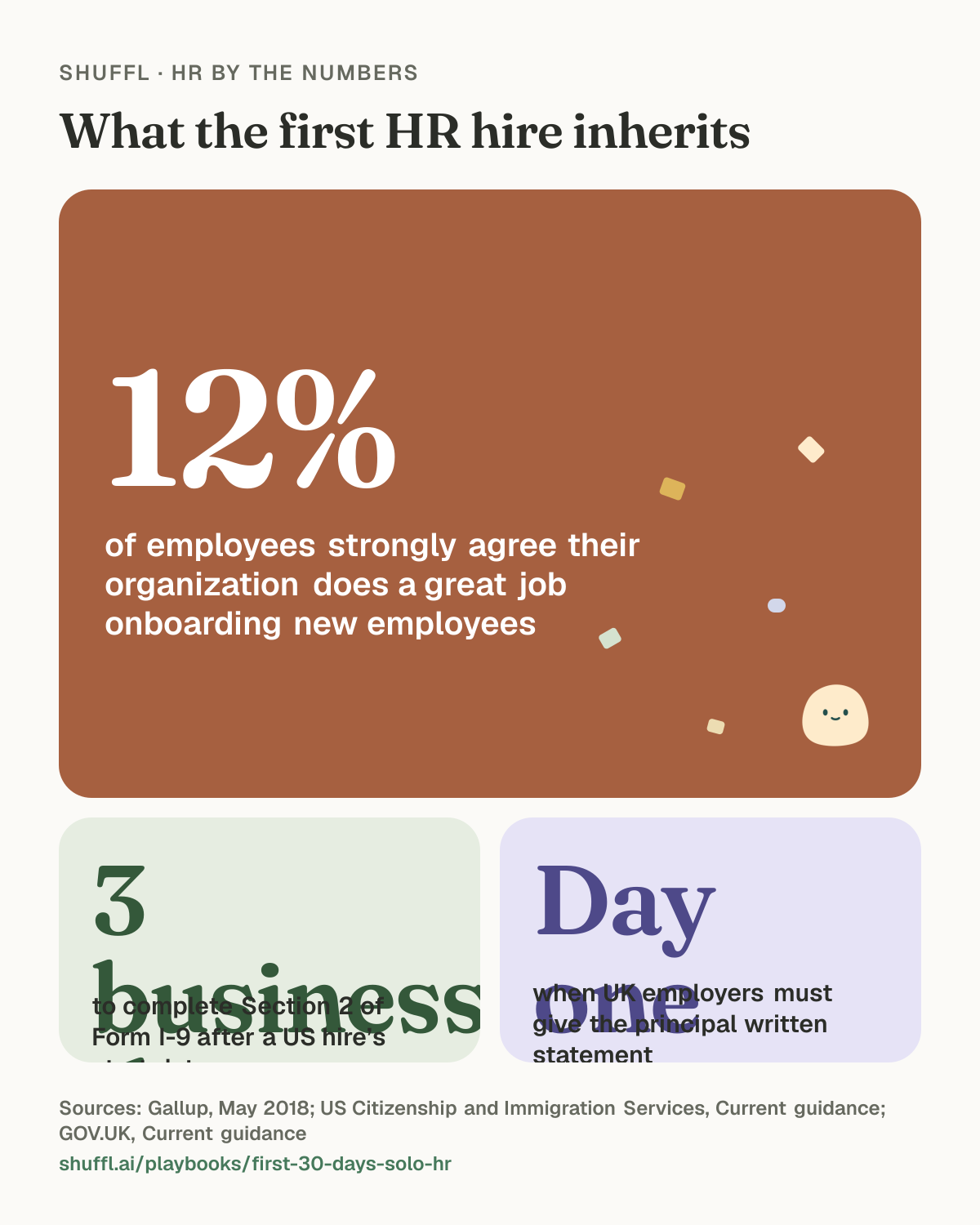
Some HR work has a clock on it from day one. In the US, employers must complete Section 2 of Form I-9 within 3 business days of the date of hire2. In the UK, employers must give the principal statement of employment particulars on the first day, and the wider written statement within 2 months3. Check the rules where your people work.
The rest is about how people experience the company. Only 12% of employees strongly agree their organization does a great job onboarding new employees1. At a startup that is hiring every month, onboarding is one of the first things you can fix that everyone notices.
Shuffl · HR by the numbers
What the first HR hire inherits

What the first HR hire inherits. 12% of employees strongly agree their organization does a great job onboarding new employees (Gallup, May 2018). 3 business days to complete Section 2 of Form I-9 after a US hire’s start date (US Citizenship and Immigration Services, Current guidance). Day one when UK employers must give the principal written statement (GOV.UK, Current guidance).
The plan, week by week
Resist fixing things as you find them, except anything with a legal deadline or someone’s pay at stake. You’ll make better choices once you’ve seen the whole picture.
- Week 1, listen. Meet each founder and manager, and as many employees as you can, for 30 minutes each. Ask the same questions every time and write down what you hear.
- Week 2, audit. Go through records, contracts, payroll, benefits, time off and access with the checklist below. Mark each item fine, fix now or fix later.
- Week 3, write. Publish the 5 to 10 policies people ask about most, starting with time off, sick leave, expenses and benefits. Fix anything marked fix now.
- Week 4, build and share. Write a simple onboarding checklist for the next hire, choose where people will find answers, and share a one-page plan for the next 90 days with the leadership team.
What to audit
This is a list of what to look at, not a complete compliance review. Requirements depend on where people work and how many you employ, so confirm anything uncertain with an employment lawyer or the regulator for that location.
- A complete file for everyone: signed contract or offer letter, right-to-work paperwork where it applies, tax forms and emergency contact.
- Payroll: pay dates, overtime eligibility and how each role is classified (employee or contractor, exempt or non-exempt where that applies).
- Benefits: what’s offered, who administers it, eligibility rules and the next renewal or enrollment date.
- Required workplace notices and posters for each location, including remote workers.
- Time off: the actual policy, where balances are tracked and how requests are approved.
- Access: who can see personnel files and salaries, and how leavers lose access to systems.
- Open issues: complaints, investigations or leave cases that someone was handling informally.
A worked example
A 60-person startup hires its first HR manager. In week one she meets the 3 founders, 8 managers and 20 employees. The same three themes come up: nobody knows the time off rules, new hires spend their first day waiting for a laptop, and pay questions go to the CEO.
Her audit in week two finds 4 contractors working full time on core roles and 2 new hires with incomplete right-to-work paperwork. She fixes the paperwork that week and takes the contractor question to an employment lawyer.
In week three she publishes 6 policies and tells everyone where to find them. In week four she writes a two-page onboarding checklist with IT, starts a monthly one-question check-in, and shares a 90-day plan: choose an HRIS, settle the contractor roles and run the first benefits renewal.
Common mistakes
- Rewriting everything in week one before you know what’s broken.
- Treating compliance as a later project when some deadlines start on a new hire’s first day.
- Buying an HRIS before you know your payroll, benefits and headcount plan.
- Listening only to founders and skipping employees and managers.
- Keeping your plan in your head instead of sharing it with the leadership team.
Listening session questions
Use the same questions with everyone, 30 minutes each.

1. What’s working well here that we should protect?
2. What HR question did you last have, and how did you get the answer?
3. What was your first week like? What would have helped?
4. Is there anything about pay, time off or benefits you’re unsure of?
5. If you could fix one thing about how we work, what would it be?
6. Who else should I talk to?

For managers, add:
7. What do you spend time on that HR should own?
8. Which people decisions do you feel least sure about?
In Shuffl
Do this in Shuffl
- Open Settings → Setup from the HR workspace and choose Connect Slack. Everyone appears in People waiting for access. Leave them waiting until launch, because turning access on sends each person a welcome message.
- Add the 5 to 10 policies people ask about most, from a template or your own file. Check the text, set the audience to Everyone in this workspace and publish each one.
- Take the ten questions you heard most in your listening sessions and ask each in Chat, in the words people used. Open Supporting sources and fix any source Mello missed or got wrong.
- On launch day, use Copy post on the Tell your team what they can ask card in Today, send the post, then turn on access in People with Enable access for N people in the same hour.
- Turn on programs one at a time, about a week apart: Pulse with Start pulse first, then Onboarding before your next hire starts.
- At the end of the first week, open Knowledge → Insights for Missing guidance and set up the HR digest under Settings → Notifications.
The guide: Roll out Shuffl to your company
Read the guideHave your agent do thisPaste the prompt into Claude Code, Cursor or another agent. It reads this playbook and the guide, works over MCP and asks before it changes anything others will see.Show the promptHide the prompt
Help me with "Your first 30 days as a solo HR person" in my Shuffl workspace.

1. Read the playbook: https://shuffl.ai/playbooks/markdown/first-30-days-solo-hr
2. Read the Shuffl guide it uses: https://shuffl.ai/docs/markdown/rollout
3. Add Shuffl's MCP server: https://shuffl.ai/api/mcp
   Claude Code: claude mcp add --transport http shuffl https://shuffl.ai/api/mcp
   When the browser opens, choose my workspace and allow the access the guide needs.
4. Work through the playbook's Shuffl steps in order (6 of them). Do what you can over MCP and tell me which steps only I can do in the browser or in Slack.

Ask me about our company first where the playbook needs it, like our values, policies or dates. Show me what you will change and who it affects, and wait for my yes before publishing, inviting or sending anything.
Common questions
- What should I fix first?
- Whatever has a legal deadline or puts someone’s pay at risk. Check that new hires’ paperwork is complete, payroll and classification are right, and required notices are in place. Everything else can wait a week.
- Do I need an HRIS right away?
- Probably not in month one. Start from what you have, even a spreadsheet, and write down what you need it to do. Choose a system once you know your headcount plan, payroll setup and where people already work.
- Is this legal advice?
- No. It’s a general checklist of what to look at. Employment rules differ by country, state and company size, so confirm anything you’re unsure of with an employment lawyer or the relevant regulator.
Sources
Read on . Numbers change as new studies come out, so check the source before you quote it. This page is general guidance, not legal advice.
- Gallup, Why the Onboarding Experience Is Key for Retention, May 2018. Gallup workplace article drawing on Gallup’s research on onboarding.
- US Citizenship and Immigration Services, Completing Section 2, Employer Review and Attestation, Current guidance. Federal agency guidance for employers completing Form I-9. Page last reviewed September 2026.
- GOV.UK, Employment contracts and conditions: Written statement of employment particulars, Current guidance. UK government guidance on the written statement of employment particulars.