
HR playbook
Plan a new hire’s first 90 days
A week-by-week plan for a new hire’s first 90 days: preboarding, a buddy who actually meets them, weekly manager check-ins and 30, 60 and 90-day goals.
For HR leads and hiring managers at growing companies
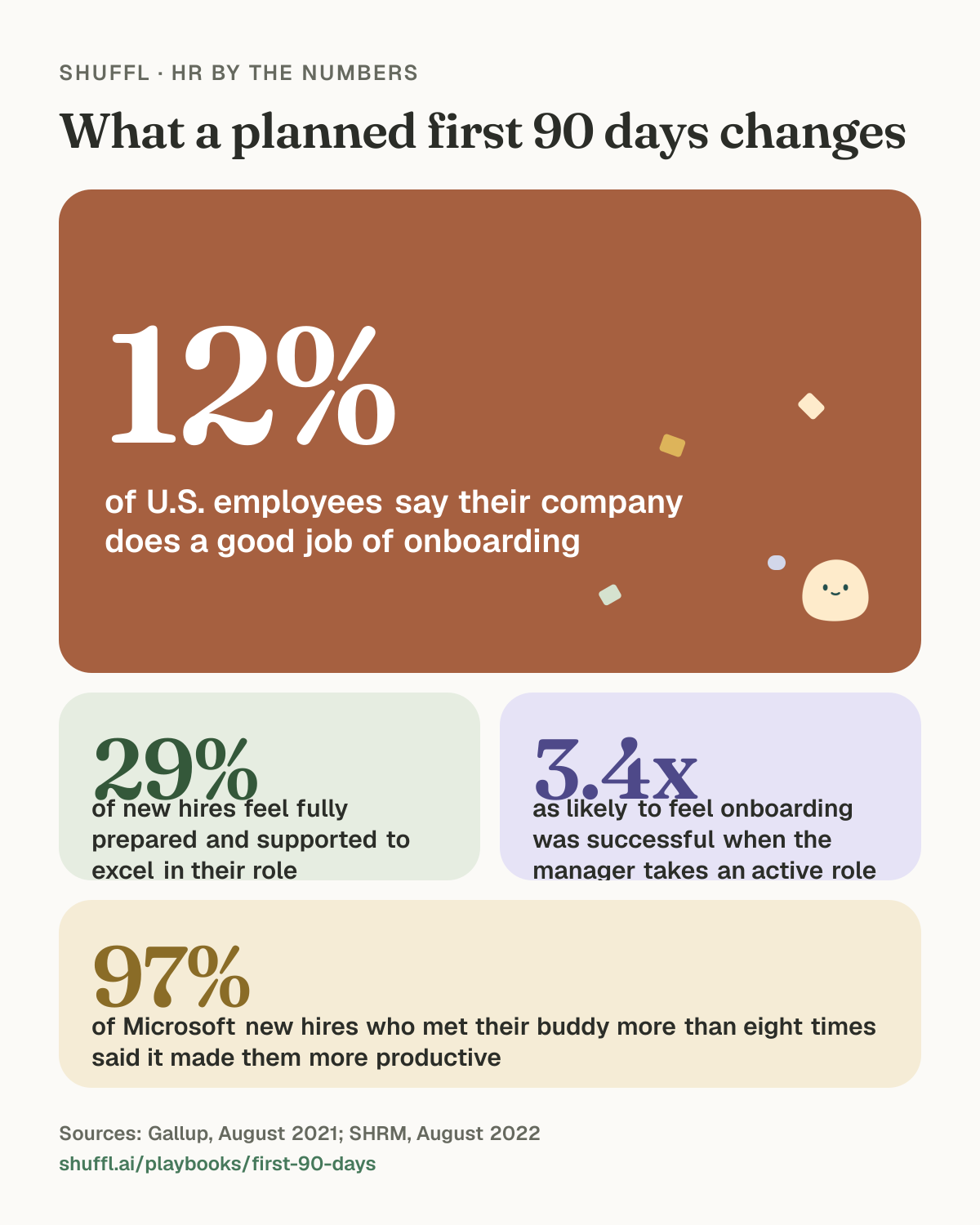
A new hire works out a lot in their first three months: whether they chose well, who they can ask, and whether anyone notices how they’re doing. Most companies leave that to chance. Only 12% of U.S. employees say their company does a good job of onboarding1.
This plan covers the stretch from a signed offer to day 90: what to send before day one, how to pair a buddy, when the manager checks in, and which goals to set at 30, 60 and 90 days.
Why the first 90 days matter
Only 29% of new hires say they feel fully prepared and supported to excel in their role. When managers take an active part in onboarding, employees are 3.4 times as likely to feel it was successful1.
Buddies help too, if they actually meet. In Microsoft’s buddy program, 56% of new hires who met their buddy at least once in their first 90 days said the buddy helped them become productive. That rose to 86% for four to eight meetings and 97% for more than eight2.
So the plan has two jobs: get the manager in the room every week, and make sure the buddy meetings happen more than once.
Shuffl · HR by the numbers
What a planned first 90 days changes

What a planned first 90 days changes. 12% of U.S. employees say their company does a good job of onboarding (Gallup, August 2021). 29% of new hires feel fully prepared and supported to excel in their role (Gallup, August 2021). 3.4x as likely to feel onboarding was successful when the manager takes an active role (Gallup, August 2021). 97% of Microsoft new hires who met their buddy more than eight times said it made them more productive (SHRM, August 2022).
Before day one
Preboarding is the time between the signed offer and the first day. It’s mostly logistics, and it’s where a new hire first sees whether you’re organised.
- Send a welcome note from the manager within a few days of the signed offer.
- Share the first-week schedule: who they meet, when, and where to go or which link to open.
- Order equipment and create accounts so they work on day one.
- Choose the buddy and tell them the start date, so they can block time.
- Book the manager’s weekly check-ins for the first 12 weeks before day one.
The plan, week by week
The schedule matters more than the content. Put every meeting in the calendar up front, so nothing depends on someone remembering.
- Week 1: the buddy and hire meet on day one or two. The manager walks through the 30-day goals.
- Weeks 1 to 12: the manager holds a 15-minute check-in each week. Ask what’s unclear, what’s slow and what they’d change.
- Weeks 1 to 6: the buddy meets the hire every week. After that, every other week until day 90.
- Day 30, 60 and 90: ask the hire a short set of the same questions each time, so you can compare answers across hires.
- Day 90: ask one open question about what to fix before the next person starts, then fix it.
Shuffl · HR by the numbers
The rhythm of a first 90 days
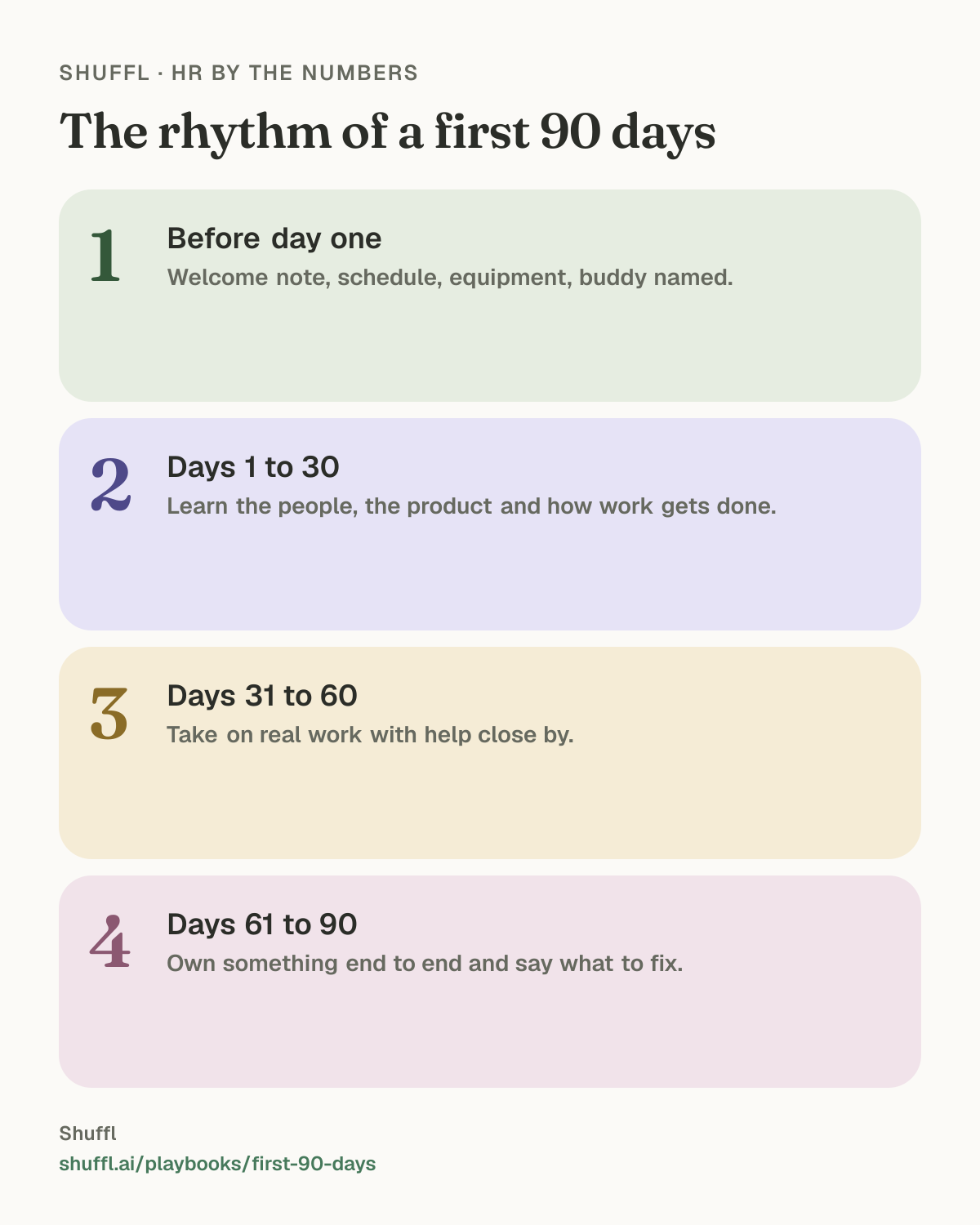
The rhythm of a first 90 days. 1. Before day one: Welcome note, schedule, equipment, buddy named. 2. Days 1 to 30: Learn the people, the product and how work gets done. 3. Days 31 to 60: Take on real work with help close by. 4. Days 61 to 90: Own something end to end and say what to fix.
Set 30, 60 and 90-day goals
Write the 30, 60 and 90-day goals before the hire starts and share them in week one. Keep each one observable, so the hire and manager can both tell whether it happened. Adjust them in the weekly check-in instead of waiting for day 90.
- By day 30: knows their team and key partners by name, has shipped or finished one small piece of work, and knows where to ask questions.
- By day 60: works on a real project with a named outcome, and has had one piece of written feedback from their manager.
- By day 90: owns one area or project end to end, and has agreed goals for the next quarter with their manager.
An example
A 150-person software company hires 8 people in a quarter. HR writes one onboarding plan, and each hiring manager fills in the 30, 60 and 90-day goals for their own hire before the start date.
Each hire gets a buddy from a different team who has been there at least six months. Buddies meet weekly for six weeks, then every other week, which comes to about nine meetings by day 90. Managers hold 12 weekly 15-minute check-ins, three hours over the quarter.
At day 30, two of the 8 hires say they still don’t know who to ask about expenses. HR adds the answer to the welcome note for the next group. At day 90, three hires say their laptop arrived late, so IT starts ordering equipment on the day the offer is signed.
Common mistakes
- Going quiet between the signed offer and day one.
- Treating onboarding as the first week of paperwork and logins.
- Naming a buddy and never checking that they actually met.
- Leaving manager check-ins to whenever the calendar allows.
- Asking how onboarding went and never changing anything for the next hire.
Day 30, 60 and 90 check-in questions
Ask the same questions at day 30, 60 and 90 so you can compare.

1. I know what’s expected of me in my role. (Agree / Not sure / Disagree)
2. I know who to ask when I’m stuck. (Agree / Not sure / Disagree)
3. I have the tools and access I need to do my work. (Agree / Not sure / Disagree)
4. My manager checks in with me regularly. (Agree / Not sure / Disagree)
5. What has been harder than it needed to be?

Day 90 only:
6. What should we fix before the next person starts?
In Shuffl
Do this in Shuffl
- Open Playbooks from the HR workspace and choose New playbook. Start from a template such as New hire onboarding or Remote new hires, or choose Review and start on the playbook Mello suggests.
- Name the playbook, choose the accountable HR responder and the send time, and edit the buddy invitation, introduction and help check-in with {{hire}} and {{buddy}}. Choose Start playbook.
- Choose Add people and pick hires from People, add everyone in a group, or upload a CSV with their emails, start dates, time zones and buddies.
- Choose Review and approve messages, read each message with its date, and approve. Messages go out in Slack in each hire’s own time zone.
- Start from the First 90 days template, or keep the day 30, 60 and 90 check-ins every starter playbook has, and add the manager’s one-to-ones as playbook steps through week 12.
- Read What new hires said once enough hires have answered, and act on the day 90 question about what to fix.
The guide: Playbooks and onboarding
Read the guideHave your agent do thisPaste the prompt into Claude Code, Cursor or another agent. It reads this playbook and the guide, works over MCP and asks before it changes anything others will see.Show the promptHide the prompt
Help me with "Plan a new hire’s first 90 days" in my Shuffl workspace.

1. Read the playbook: https://shuffl.ai/playbooks/markdown/first-90-days
2. Read the Shuffl guide it uses: https://shuffl.ai/docs/markdown/playbooks
3. Add Shuffl's MCP server: https://shuffl.ai/api/mcp
   Claude Code: claude mcp add --transport http shuffl https://shuffl.ai/api/mcp
   When the browser opens, choose my workspace and allow the access the guide needs.
4. Work through the playbook's Shuffl steps in order (6 of them). Do what you can over MCP and tell me which steps only I can do in the browser or in Slack.

Ask me about our company first where the playbook needs it, like our values, policies or dates. Show me what you will change and who it affects, and wait for my yes before publishing, inviting or sending anything.
Common questions
- When should onboarding start?
- At offer acceptance. The weeks between the signature and day one are when a new hire is most likely to hear nothing. A welcome note, a first-week schedule and the name of their buddy cost little and answer most of their questions.
- How long should onboarding last?
- Plan the first 90 days in detail and check in again at one year. Gallup’s experience is that new employees take around 12 months to reach their peak performance[^gallup-onboarding-tips], so the 90-day plan is a start, not the finish.
- Who makes a good onboarding buddy?
- A peer who has been around long enough to know how things really work, who isn’t the hire’s manager and who has time to meet often. In Microsoft’s program, new hires who met their buddy more often were more likely to say it made them productive[^shrm-buddies].
- Should HR or the manager own onboarding?
- Both, with different jobs. HR owns the system: the schedule, the messages and the check-ins. The manager owns the week-to-week conversation and the goals. Gallup finds that when managers take an active role, new hires are 3.4 times as likely to feel their onboarding was successful[^gallup-onboarding-tips].
Sources
Read on . Numbers change as new studies come out, so check the source before you quote it. This page is general guidance, not legal advice.
- Gallup, 8 Practical Tips for Leaders for a Better Onboarding Process, August 2021. Gallup article by Emily Wetherell and Bailey Nelson drawing on Gallup’s research and client experience with U.S. employees. The article does not give a sample size for each figure.
- SHRM, Work Buddies Can Help New Employees Transition into Job, Organizational Culture, August 2022. SHRM article by Kathy Gurchiek reporting Microsoft’s buddy program research. Figures are self-reported answers from Microsoft new hires about meetings with their buddy in their first 90 days.