
HR playbook
Write HR policies people actually read
Write HR policies people can scan and act on: one topic per page, the answer first, plain language and a review date.
For HR and people operations leads who own the handbook
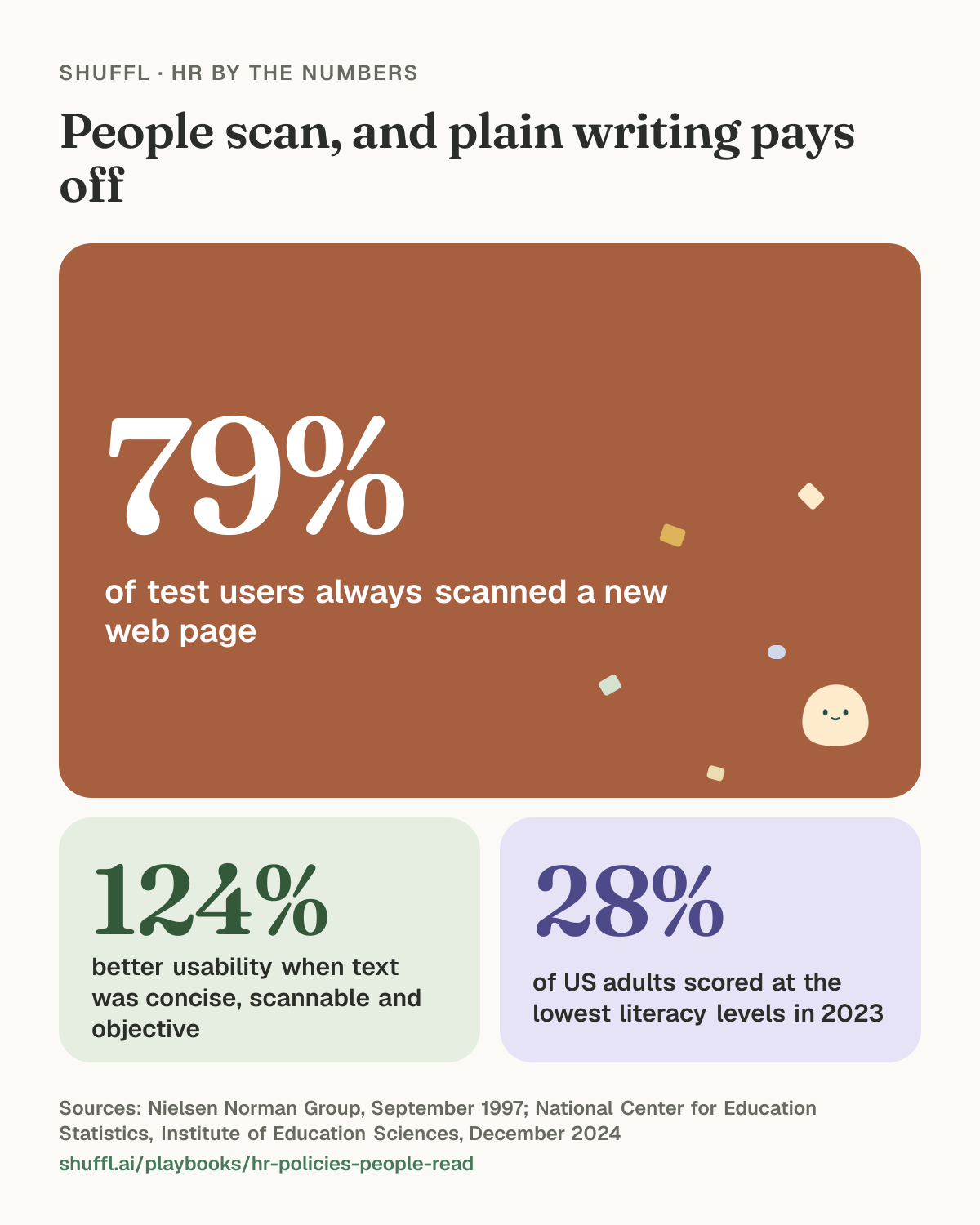
Most policies are written to be complete. Few are written to be read. Yet people don’t read pages word by word: in Nielsen Norman Group’s research, 79% of test users always scanned a new page and only 16% read word by word1.
A policy that can be scanned gets used. One that can’t turns into a question in your inbox. This playbook covers the structure, the wording and the upkeep that make the difference.
Why it matters
The same Nielsen Norman Group study tested five versions of one site. Concise text scored 58% better on usability than a promotional control, a scannable layout 47% better, and a version that was concise, scannable and objective 124% better1.
Reading skill varies more than most writers assume. The share of US adults scoring at Level 1 or below in literacy rose from 19% in 2017 to 28% in 20232. A policy pitched at a law graduate leaves many of your readers behind.
People also agree to things they haven’t read. In a study of 500 adults aged 50 and over, 77.6% accepted a privacy policy without opening it3. An acknowledgement signature tells you someone clicked, not that they understood.
Shuffl · HR by the numbers
People scan, and plain writing pays off

People scan, and plain writing pays off. 79% of test users always scanned a new web page (Nielsen Norman Group, September 1997). 124% better usability when text was concise, scannable and objective (Nielsen Norman Group, September 1997). 28% of US adults scored at the lowest literacy levels in 2023 (National Center for Education Statistics, Institute of Education Sciences, December 2024).
One topic per page, in the same order
Use one page per topic. A reader searching for parental leave should land on parental leave, not page 31 of a handbook. Each page follows the same order, so people learn where to look.
- Title it with the question people ask: “Taking time off”, not “Leave of absence policy (rev. 4)”.
- Answer in the first two lines: how much, who qualifies, how to request it.
- Then who it applies to, and how it varies by location, employment type or tenure, in a table.
- Then the steps, numbered, with who approves and how long it takes.
- One or two short examples for the cases people get wrong.
- Who to ask, and what always goes to a person.
- The owner, effective date and next review date at the bottom.
Write it plainly
Plain language doesn’t mean vague. Keep every condition the policy needs, and write it so someone reading on a phone between meetings can follow it. Have your usual reviewer check that the plain version still says what you mean. This playbook isn’t legal advice.
- Write to the reader: “you” for the employee, “we” for the company.
- Keep most sentences under 20 words, and one idea per sentence.
- Use the active voice: “Your manager approves the request”, not “Requests will be approved”.
- Say “must” for requirements. Drop “shall”, “hereinafter” and “pursuant to”.
- Use numerals for numbers and dates, and name the time zone or calendar that applies.
- Define a term the first time you use it, then use the same word every time.
A worked example
A 150-person company has a 40-page handbook in a PDF. HR gets about 30 time off questions a month, most of them answered on page 12.
They split the handbook into 15 pages, one per topic, and rewrite the time off page first: the answer in two lines, a table for the two countries they employ in, three steps to request leave, and a note on who to ask. Each page names an owner and a review date in January.
They keep the old PDF for the record, mark it as replaced, and link every old reference to the new pages.
Shuffl · HR by the numbers
The same time off rule, rewritten
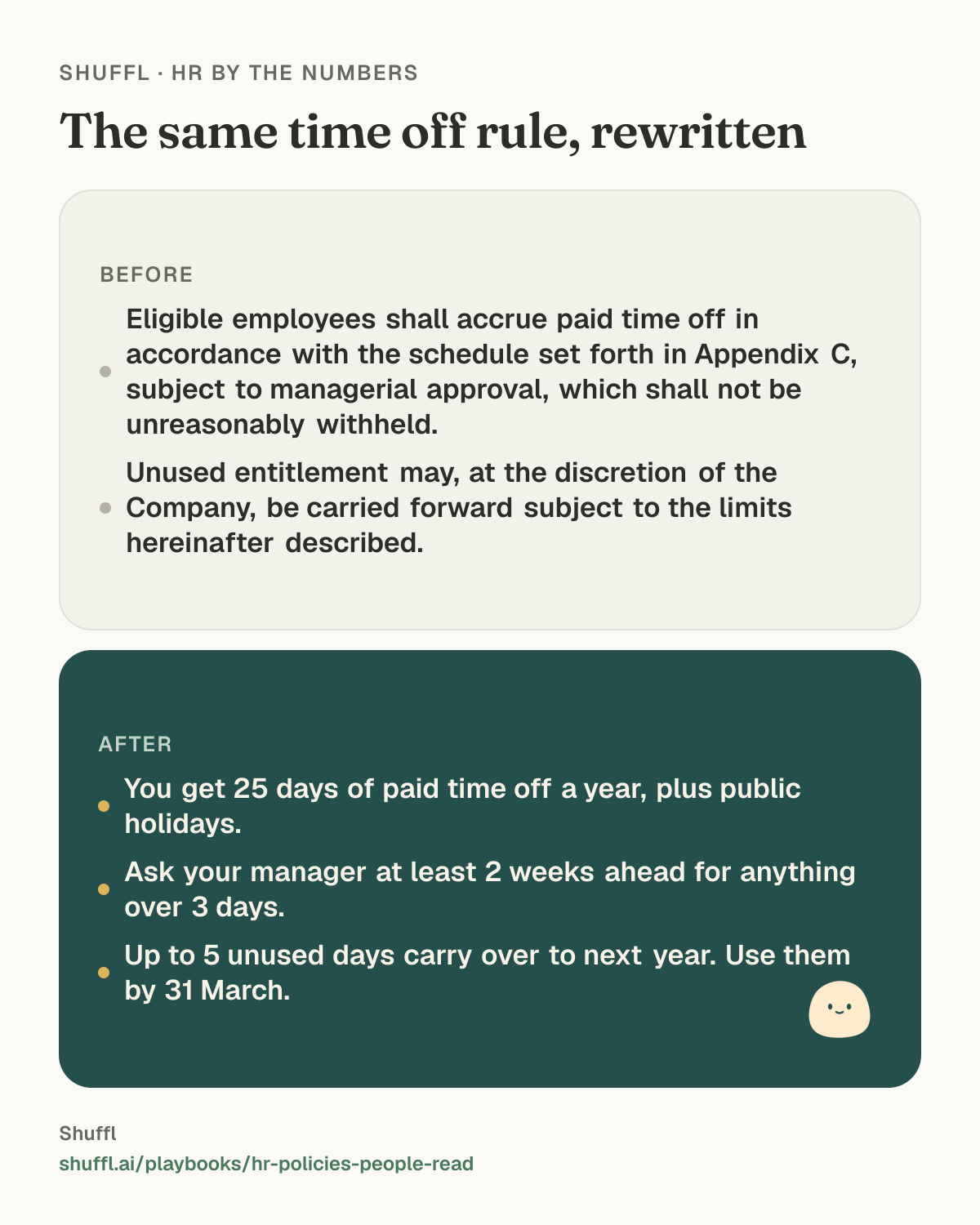
The same time off rule, rewritten. Before: Eligible employees shall accrue paid time off in accordance with the schedule set forth in Appendix C, subject to managerial approval, which shall not be unreasonably withheld.; Unused entitlement may, at the discretion of the Company, be carried forward subject to the limits hereinafter described.. After: You get 25 days of paid time off a year, plus public holidays.; Ask your manager at least 2 weeks ahead for anything over 3 days.; Up to 5 unused days carry over to next year. Use them by 31 March..
Common mistakes
- Opening with purpose and scope statements instead of the answer people came for.
- Putting several topics on one long page, so search lands people in the wrong place.
- Writing for a lawyer reading at a desk, not an employee reading on a phone.
- Leaving out who to ask, so every unclear case becomes a guess.
- Publishing without an owner or a review date.
Policy page outline
Title: the question people ask (for example, “Taking time off”)

The short answer: two lines. How much, who qualifies, how to ask.

Who this applies to: a table if it differs by location, employment type or tenure.

How to do it:
1. …
2. …
3. …

Examples: one or two cases people get wrong.

Who to ask: the team or person, and what always goes to them.

Owner: …  Effective: …  Next review: …
In Shuffl
Do this in Shuffl
- In Knowledge, choose Add source → Import a file for your handbook. A long handbook is split by its headings into one draft per section, so you start with one page per topic.
- Or choose Write an article and use Write with Mello to draft a page from its title and a short request. Nothing is saved until you save it.
- For each draft, read the extracted text, rewrite it in plain language, set Who can read this after publishing? and choose Save draft.
- Set Effective date and Review by. On the review date the source stops being used in answers until someone reviews it.
- Choose Review and publish, check the summary and confirm with Publish source. Version history keeps every published version.
- To change a live policy, choose Edit draft. Employees keep the last published version until you review and publish the new one.
The guide: Review and publish knowledge
Read the guideHave your agent do thisPaste the prompt into Claude Code, Cursor or another agent. It reads this playbook and the guide, works over MCP and asks before it changes anything others will see.Show the promptHide the prompt
Help me with "Write HR policies people actually read" in my Shuffl workspace.

1. Read the playbook: https://shuffl.ai/playbooks/markdown/hr-policies-people-read
2. Read the Shuffl guide it uses: https://shuffl.ai/docs/markdown/knowledge
3. Add Shuffl's MCP server: https://shuffl.ai/api/mcp
   Claude Code: claude mcp add --transport http shuffl https://shuffl.ai/api/mcp
   When the browser opens, choose my workspace and allow the access the guide needs.
4. Work through the playbook's Shuffl steps in order (6 of them). Do what you can over MCP and tell me which steps only I can do in the browser or in Slack.

Ask me about our company first where the playbook needs it, like our values, policies or dates. Show me what you will change and who it affects, and wait for my yes before publishing, inviting or sending anything.
Common questions
- Does plain language make a policy less legally precise?
- No. Plain language changes the wording, not the rule. Keep the precise terms where they matter, define them once, and have whoever reviews your policies for legal meaning read the plain version too. This playbook isn’t legal advice.
- Should we still have a single handbook document?
- Keep one source of truth and link to it. If the handbook PDF and the intranet page say different things, people will find the wrong one. Split a long handbook into one page per topic and retire the copies.
- How often should we review policies?
- At least once a year, and whenever the law, a benefits plan or the way you actually work changes. Put the review date on the page so readers can see it’s current.
Sources
Read on . Numbers change as new studies come out, so check the source before you quote it. This page is general guidance, not legal advice.
- Nielsen Norman Group, How Users Read on the Web, September 1997. Jakob Nielsen’s usability research with test users, including a test of five versions of the same site with the same tasks.
- National Center for Education Statistics, Institute of Education Sciences, U.S. Adults Score on Par With International Average in Literacy Skills, Below International Average in Numeracy and Problem-Solving Skills in Survey of Adult Skills, December 2024. NCES press release on the 2023 US results of the Programme for the International Assessment of Adult Competencies (PIAAC).
- York University (YFile), York researcher warns online consumers to read fine print, December 2022. York University news story on Jonathan Obar’s study of 500 adults aged 50 and over using a fictitious social network.