
HR playbook
Run an engagement check without survey fatigue
How to pick a survey rhythm you can keep, use eNPS sensibly and show people what changed, so they keep answering.
For HR leads at startups and mid-size companies
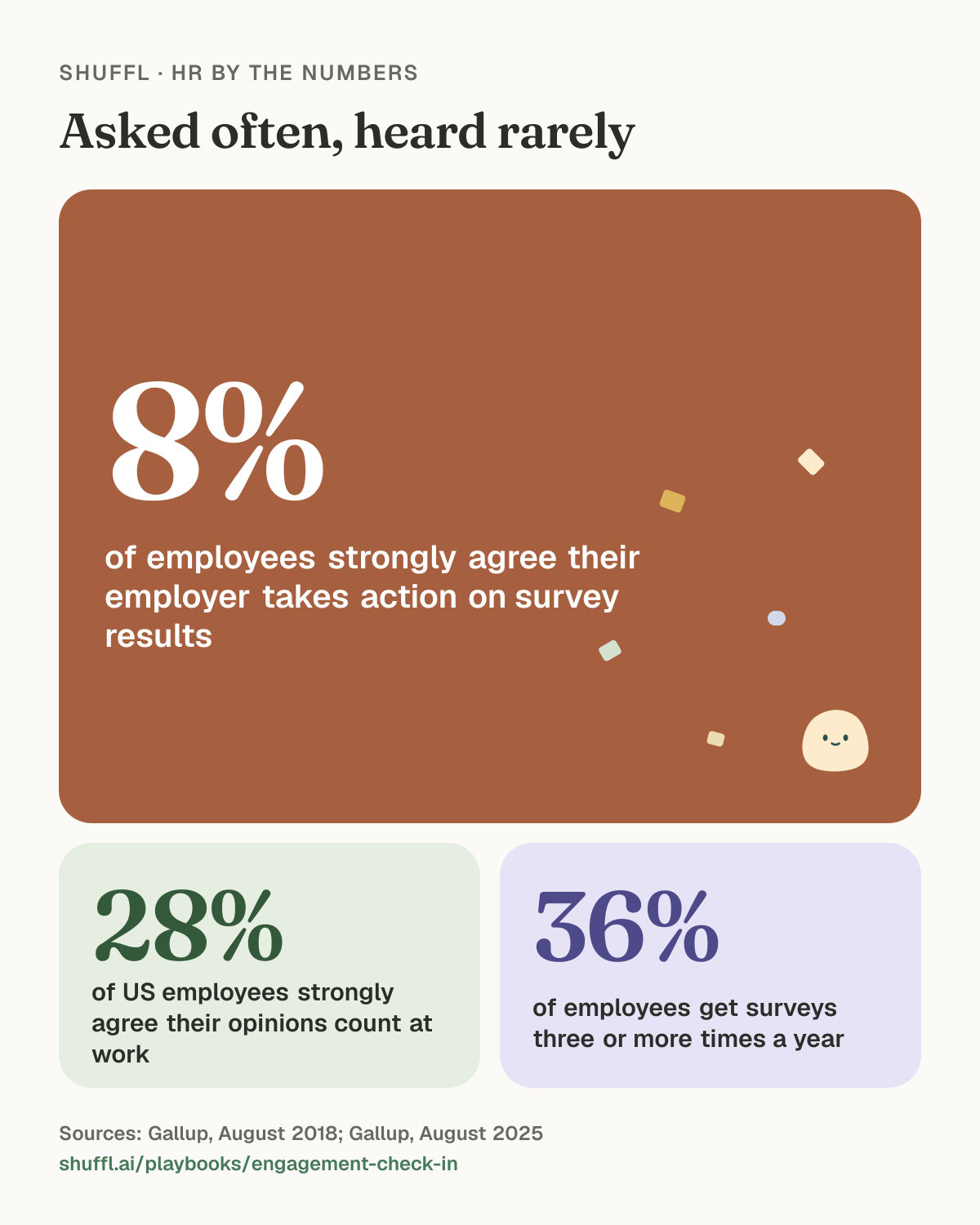
People rarely stop answering surveys because they’re asked too often. They stop because nothing seems to happen. In Gallup’s research, 36% of employees said they get surveys three or more times a year, and only 8% strongly agreed that their employer acts on the results.1
This playbook sets a rhythm you can keep: a short, frequent pulse, a few repeated questions you can trend, eNPS a few times a year, and one visible change after each round.
Why fatigue is really about follow-up
In Gallup’s US survey from May 2025, 28% of employees strongly agreed that their opinions count at work.2 Surveys are meant to fix that, but Gallup warns that asking for feedback and then doing nothing can backfire: engagement is likely to fall and turnover to rise.3
Acting on results shows up in the next round. In a 2006 Gallup analysis of workgroups surveyed twice, groups in the top quartile on “Action plans from the last survey have had a positive impact on my workplace” raised engagement scores by an average of 10%. Bottom-quartile groups fell by 3%.4 Given its age, treat it as a rough guide.
Length matters too. In a web survey experiment, the longer people were told a questionnaire would take, the fewer started and finished it, and answers near the end were faster, shorter and more uniform.5 Short and frequent beats long and rare.
Shuffl · HR by the numbers
Asked often, heard rarely

Asked often, heard rarely. 8% of employees strongly agree their employer takes action on survey results (Gallup, August 2018). 28% of US employees strongly agree their opinions count at work (Gallup, August 2025). 36% of employees get surveys three or more times a year (Gallup, August 2018).
Pick a rhythm you can keep
Gallup suggests a deeper engagement survey twice a year, with monthly or quarterly pulse surveys in between, and says the right cadence depends on your capacity to act on results.3 For a small HR team, that capacity is the real limit.
eNPS borrows the Net Promoter question: how likely are you to recommend working here to a friend, from 0 to 10? Answers of 9 or 10 are promoters, 7 or 8 passives and 0 to 6 detractors. The score is the promoter share minus the detractor share.6 It’s a useful headline to trend, but it won’t say what to fix, so pair it with specific questions.
- Under about 50 people: a pulse of one question once or twice a week is enough. Skip the big annual survey.
- From 50 to a few hundred: keep the weekly pulse and add a longer survey once or twice a year if you have time to act on it.
- Repeat two or three core questions, such as workload and clarity, every few weeks so you can see a trend.
- Ask eNPS once a quarter. Monthly is too often to see real movement.
The plan
- Decide who sees what before the first question. Set a minimum group size, such as 7, below which results stay hidden, and write it in the invite.
- Pick three to five topics that matter this year, such as workload, clarity, growth and manager support. Ask one question per send.
- Share each result with the people who answered within two weeks.
- Choose one action per result worth acting on, with an owner and a due date.
- Ask the same question again after the action is done, and report what moved.
- Say what you can’t change yet, and why. People accept a clear no better than silence.
An example
A 120-person software company asks one question every Tuesday and Thursday, and eNPS once a quarter. In the first month, 70% of people answer.
A workload question comes back at 45% favourable in the support team, down from 65% the quarter before. HR and the support lead agree on one change: a second on-call person on Mondays, owned by the lead, due in four weeks. HR posts a short note to everyone who was asked: what they said, what is changing and when.
Six weeks later the same question is asked again and lands at 60%. The note about that goes out too. Response stays near 70%, and the next eNPS is 10 points higher than the last.
Common mistakes
- Sending a 60-question survey once a year and sharing the results six months later.
- Asking more often than you can act, so every round ends in silence.
- Treating the eNPS score as the finding instead of a prompt to ask why.
- Showing results for tiny groups, so people can guess who said what.
- Promising change on everything and delivering on nothing.
A “you said, we did” note
Thanks to the 84 of you who answered last week’s question.

We asked: “My workload is manageable most weeks.”
You said: 45% agreed in Support, down from 65% last quarter.

What we’re doing: from March 3, a second person joins Monday on-call. Priya owns it.
What we can’t do yet: hire another full-time agent before July, because the budget is set until then.

We’ll ask the same question again in six weeks and share what moved.
In Shuffl
Do this in Shuffl
- Open Pulse from the HR workspace and choose Start pulse. Under Repeats, pick a pace you can act on, such as every Tuesday and Thursday at 10:00, and set Open for (48 hours by default).
- Check the reporting floor. It starts at 7 people and can only go up.
- Open Questions, preview a question set such as Workload or Clarity, and choose Add N questions to put it in the rotation.
- Under eNPS in Pulse settings, keep every quarter or choose every month or twice a year.
- When a question closes, open it on Insights and choose Plan an action. Pick an owner and a due date, and leave Ask this question again on.
- Choose Tell people to send one “You said, we did” message to a Slack channel and to everyone who was asked.
The guide: Ask one confidential question at a time with Pulse
Read the guideHave your agent do thisPaste the prompt into Claude Code, Cursor or another agent. It reads this playbook and the guide, works over MCP and asks before it changes anything others will see.Show the promptHide the prompt
Help me with "Run an engagement check without survey fatigue" in my Shuffl workspace.

1. Read the playbook: https://shuffl.ai/playbooks/markdown/engagement-check-in
2. Read the Shuffl guide it uses: https://shuffl.ai/docs/markdown/pulse
3. Add Shuffl's MCP server: https://shuffl.ai/api/mcp
   Claude Code: claude mcp add --transport http shuffl https://shuffl.ai/api/mcp
   When the browser opens, choose my workspace and allow the access the guide needs.
4. Work through the playbook's Shuffl steps in order (6 of them). Do what you can over MCP and tell me which steps only I can do in the browser or in Slack.

Ask me about our company first where the playbook needs it, like our values, policies or dates. Show me what you will change and who it affects, and wait for my yes before publishing, inviting or sending anything.
Common questions
- How often should we check in on engagement?
- Ask one or two short questions a week, or every two weeks, and ask eNPS once a quarter. Go only as fast as you can share results and act on them. If you can’t follow up monthly, a monthly pulse is too frequent.
- Is eNPS enough on its own?
- No. eNPS tells you whether the mood is moving, not why. Pair it with a few repeated questions about workload, clarity and managers so you know where to look.
- Should our surveys be anonymous?
- Confidential is usually more honest to promise than anonymous. Say plainly who sees what: totals only, for groups above a minimum size, never an individual answer. Then keep that promise every time.
- What if the results are bad?
- Share them anyway, with what you’ll do next. A bad result you acknowledge builds more trust than a good one you keep quiet about.
Sources
Read on . Numbers change as new studies come out, so check the source before you quote it. This page is general guidance, not legal advice.
- Gallup, 10 Ways to Botch Employee Surveys, August 2018. Article by Ryan Pendell drawing on Gallup workplace research. The page gives no sample size or fieldwork dates for the 36% and 8% figures.
- Gallup, Anemic Employee Engagement Points to Leadership Challenges, August 2025. Web survey of 17,660 US adults working full or part time, from the Gallup Panel, May 7 to 16, 2025 (±1.1 points).
- Gallup, Employee Surveys: Types, Tools and Best Practices, Undated. Gallup’s practitioner guide to survey types and cadence. Guidance, not a survey.
- Gallup, What to Do With Employee Survey Results, August 2006. Workgroups with Q12 data trended across two consecutive survey administrations, sorted into quartiles on the item “Action plans from the last survey have had a positive impact on my workplace.”
- Public Opinion Quarterly, Effects of Questionnaire Length on Participation and Indicators of Response Quality in a Web Survey, Summer 2009. Mirta Galesic and Michael Bosnjak. Web survey experiment in which respondents were told the questionnaire would take 10, 20 or 30 minutes. Peer reviewed.
- Bain & Company, Measuring Your Net Promoter Score, Undated. Bain & Company’s explanation of how the Net Promoter Score is calculated, written for customers. eNPS applies the same scoring to employees.