
Policies
Business travel policy template
Approval and booking, class of travel, hotels, daily costs, safety and working abroad. A complete policy to adapt with your own rules.
A starting point, not legal advice. Leave, pay and expense rules differ by country, state and city. Use the checks on this page to see what to look up where your people work, and have someone qualified review your policy before you publish it.
Knowledge draft. Opens a Knowledge draft with this policy, its checks and what Shuffl already knows, like your HR contact and countries. Draft with Mello can write the rest and show where each value came from. Nothing is published until you choose Publish.
A travel policy explains how to get trips approved and booked, what class of travel and hotel the company pays for, and how people stay safe away from home.
It sits alongside the expenses policy, which covers how costs are claimed.
Shuffl · HR by the numbers
Business travel in numbers

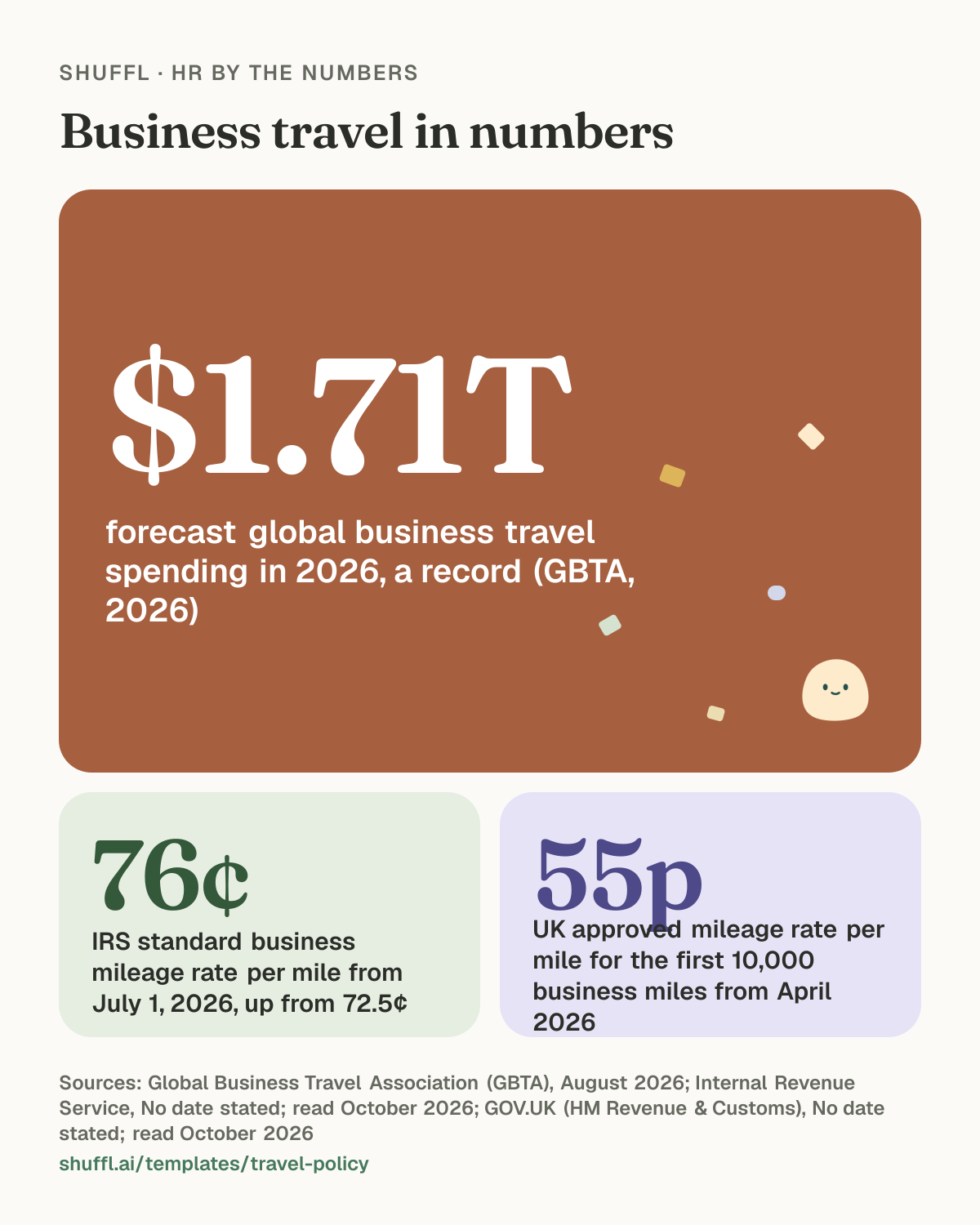
Business travel in numbers. $1.71T forecast global business travel spending in 2026, a record (GBTA, 2026) (Global Business Travel Association (GBTA), August 2026). 76¢ IRS standard business mileage rate per mile from July 1, 2026, up from 72.5¢ (Internal Revenue Service, No date stated; read October 2026). 55p UK approved mileage rate per mile for the first 10,000 business miles from April 2026 (GOV.UK (HM Revenue & Customs), No date stated; read October 2026).
Business travel
Words in [square brackets] are for you to fill in. The policy has every section a real handbook policy has, but no allowances, dates or amounts of its own.
# Business travel

## Purpose
This policy explains how to book and pay for work travel, what the company covers, and how we keep you safe while you are away.

## Who this covers
Everyone who travels for work, including [contractors and guests the company pays for].

## Before you book
- Travel needs approval from [who] before you book. [Any trips that need extra approval, for example international travel.]
- Book through [travel tool or team], so we know where you are and get our agreed rates.

## Getting there
- Flights: [class of travel, and any exception for long flights]
- Trains: [class of travel]
- Taxis, ride share and car hire: [when they are fine to use]
- Your own car: [mileage rate and insurance requirements]

## Where you stay
[The standard or limit for hotels, and when a longer stay can use an apartment.]

## Meals and daily costs
[Daily limit or what is reasonable, and what is not covered, for example minibar and personal entertainment.]

## Safety and insurance
- The company provides [travel insurance and an emergency assistance number].
- Tell [who] if your plans change or something goes wrong.
- Travel to [higher-risk places] needs approval from [who] first.

## Working abroad
[Visa checks, how many days you can work in another country before tax or permits apply, and rules for carrying company devices and data.]

## Adding personal travel
[Whether you can add personal days to a work trip, and which costs you pay yourself.]

## Time spent travelling
[How travel time outside normal hours is treated, for example time off in lieu or pay for hourly staff.]

## Paying and claiming
Use [company card or how to pay]. Claim anything else under the Expenses policy, with receipts.

## Responsibilities
- **You:** book sensibly, stay safe and claim only real costs.
- **Your manager or approver:** approve trips that are needed and within this policy.
- **Finance or the travel team:** book, track and pay for travel.

## Where local law differs
If the law where you work gives you more rights about travel time or costs, the law applies. These places have their own rules: [list them, or "none"].

## Related policies
Expenses, Health and safety and Acceptable use of company systems.

## About this policy
Owned by [team or person]. Applies in [countries or states]. We may update this policy and will tell you at least [number] days before a change takes effect. This policy is not part of your employment contract.

## Questions
Contact [team or person] at [email or channel].
Check before you publish
Rules that often catch teams out, by place. They are not part of the policy, and not legal advice.
United States
- Hourly (non-exempt) employees must be paid for travel time that cuts across their normal working hours, even on days off, and for travel between job sites during the day.
United Kingdom
- Travel to a temporary workplace can be working time for staff without a fixed workplace, and HMRC rules decide which travel costs are tax free. Mileage paid above the approved rates is taxable.
European Union
- Working in another EU country can need an A1 certificate for social security and, in some countries, a posted worker notification even for short trips.
Everywhere
- Check what business visitors may do under each country’s visa rules, and how many working days abroad create tax obligations for the person or the company.
How to adapt it
- Give a hotel standard or limit people can apply without asking.
- Name the emergency number travellers should call.
- Say how travel time outside working hours is treated.
What the research says
Companies spend a lot on travel. The Global Business Travel Association forecasts a record $1.71 trillion in global business travel spending in 2026, across about 1.84 billion trips.1 At that scale, a few clear standards for flights and hotels save more time and money than long lists of exceptions.
Reimbursement rates change, sometimes more than once a year. The IRS set its 2026 business mileage rate at 72.5 cents a mile from January 1,2 then 76 cents from July 1, 2026.3 The UK approved rate for cars and vans rose from 45p to 55p a mile for the first 10,000 miles from 6 April 2026.4 Link to the official rate instead of typing it.
What the law requires
In the US, travel time can count as hours worked for employees covered by the FLSA’s minimum wage and overtime rules. Ordinary home-to-work travel is not work time, but travel between job sites during the day is.5
Overnight travel away from home is work time when it cuts across the employee’s normal working hours, including the same hours on non-working days. As an enforcement policy, the Department of Labor does not count time spent as a passenger outside regular working hours.5
In the UK, mileage payments for using your own car or van up to the approved amount don’t have to be reported to HMRC or taxed. Payments above it must be reported and taxed.4 Tax and pay rules differ by country and state, so check them for everywhere your people travel from.
Common mistakes
- Using one nightly hotel limit everywhere. A cap that works in a small town won’t cover a central hotel in a big city.
- Not saying who approves what, so trips wait on a sign-off nobody owns.
- Having no record of where travellers are, and no plan for a cancelled flight late at night.
- Typing a mileage rate into the policy. The IRS changed its 2026 rate mid-year, so link to the current figure.3
Common questions
- Is travel time paid?
- For US employees covered by FLSA overtime rules, travel during normal working hours on a trip away from home counts as work time, and so does travel between job sites during the day. The normal commute doesn’t. Your policy should say how you treat travel outside working hours for everyone else.
- What is the IRS mileage rate for 2026?
- The IRS set the 2026 business rate at 72.5 cents a mile from January 1 and raised it to 76 cents from July 1, 2026. Check the IRS standard mileage rates page before you update your policy, because rates can change during the year.
- Should a travel policy cover personal days added to a business trip?
- It helps to. Say whether people can extend a trip, who pays for the extra nights and any change in fares, and that insurance or safety support may not cover the personal part.
Sources
Read on . Laws change, so check the source before you act. This page is general information, not legal advice.
- Global Business Travel Association (GBTA), 2026 GBTA Business Travel Index, August 2026. Covers 72 countries and 44 industries, with input from more than 4,700 business travelers in 66 markets.
- Internal Revenue Service, IRS sets 2026 business standard mileage rate at 72.5 cents per mile, up 2.5 cents, December 29, 2025. IR-2025-128.
- Internal Revenue Service, Standard mileage rates, No date stated; read October 2026.
- GOV.UK (HM Revenue & Customs), Expenses and benefits: business travel mileage for employees’ own vehicles: Rules for tax, No date stated; read October 2026.
- U.S. Department of Labor, Wage and Hour Division, Fact Sheet #22: Hours Worked Under the Fair Labor Standards Act (FLSA), Revised July 2008.