
Policies
Parental leave policy template
Leave and pay for every parent, adoption, keeping in touch and coming back. A complete policy to adapt with your own rules.
A starting point, not legal advice. Leave, pay and expense rules differ by country, state and city. Use the checks on this page to see what to look up where your people work, and have someone qualified review your policy before you publish it.
Knowledge draft. Opens a Knowledge draft with this policy, its checks and what Shuffl already knows, like your HR contact and countries. Draft with Mello can write the rest and show where each value came from. Nothing is published until you choose Publish.
A parental leave policy covers time off for a new child by birth, adoption or surrogacy, and how people come back to work afterwards.
People often read it months before they need it, and many will not want to ask HR first. Make it easy to find and easy to read.
Shuffl · HR by the numbers
Parental leave in numbers

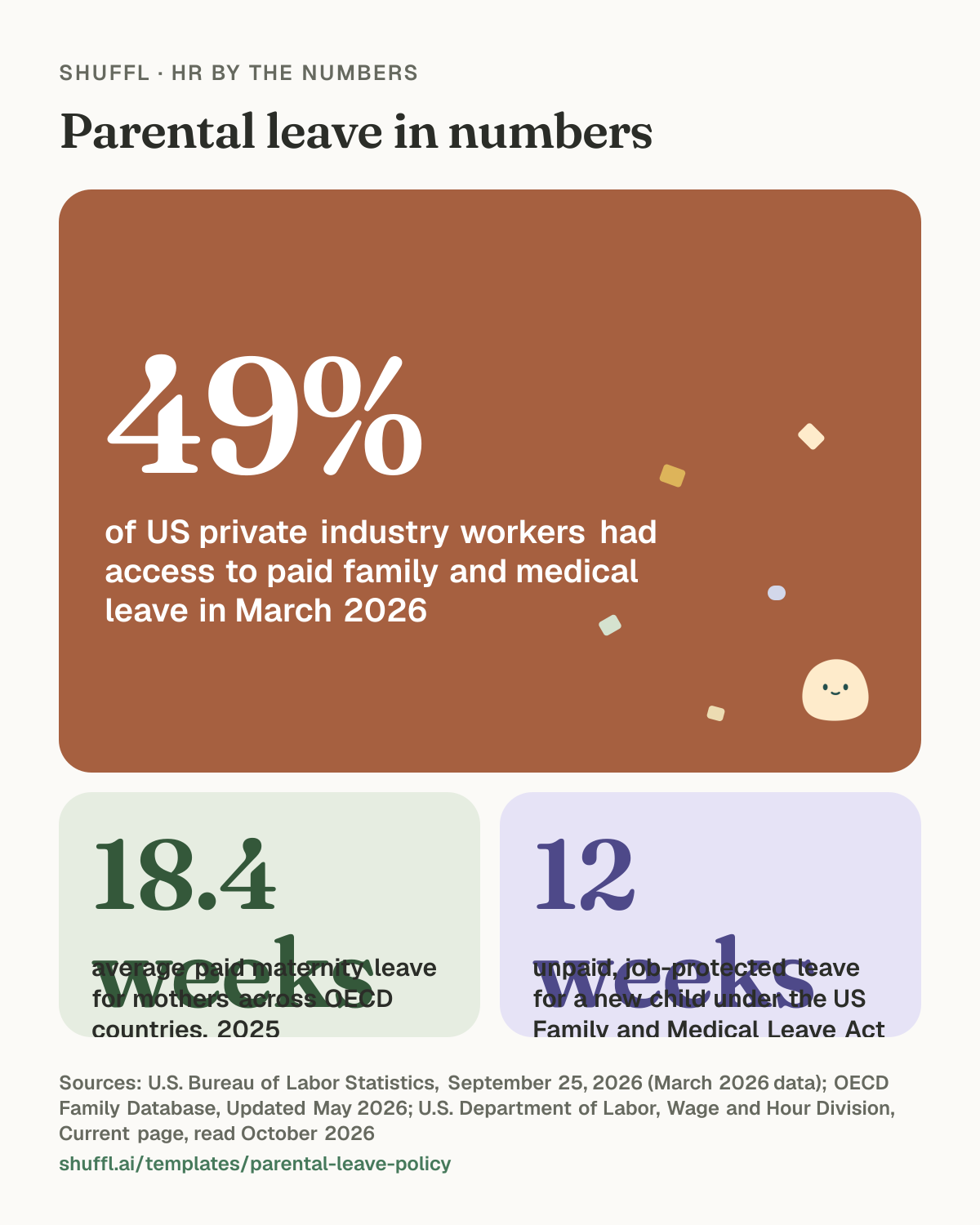
Parental leave in numbers. 49% of US private industry workers had access to paid family and medical leave in March 2026 (U.S. Bureau of Labor Statistics, September 25, 2026 (March 2026 data)). 18.4 weeks average paid maternity leave for mothers across OECD countries, 2025 (OECD Family Database, Updated May 2026). 12 weeks unpaid, job-protected leave for a new child under the US Family and Medical Leave Act (U.S. Department of Labor, Wage and Hour Division, Current page, read October 2026).
Parental leave
Words in [square brackets] are for you to fill in. The policy has every section a real handbook policy has, but no allowances, dates or amounts of its own.
# Parental leave

## Purpose
This policy explains the time off and pay you get when a child joins your family, and the support when you come back.

## Who this covers
[Which employees are eligible, and from when, for example from your first day or after a number of months.]

Every parent is covered: birth parents, partners, and parents through adoption, surrogacy or fostering.

## Time off and pay
| Who | Time off | Pay |
| --- | --- | --- |
| Birth parent | [number of weeks] | [paid or unpaid, and at what rate] |
| Other parent | [number of weeks] | [paid or unpaid, and at what rate] |
| Adoption, surrogacy or fostering | [number of weeks] | [paid or unpaid, and at what rate] |

- When it can be taken: [within a number of months of the birth or placement, all at once or in blocks]
- Medical appointments before the birth or placement: [paid time off for appointments]
- Pregnancy loss: [support and time off, for example the same leave as a birth after a number of weeks]

## How to let us know
1. Tell [manager or HR] by [how far ahead of the expected date].
2. Agree your dates and how your work will be covered.
3. [Any form or document needed]

## While you are away
Your benefits [continue, and how]. You can choose [a number of] keeping-in-touch days, which are paid and entirely optional.

## Coming back
You return to the same job, or a similar one if your job no longer exists, on the same terms. [Phased return, flexible hours, a private space and breaks for nursing, or other support.]

## Responsibilities
- **You:** tell us early enough to plan, and confirm your return date.
- **Your manager:** plan cover, keep in touch only as much as you want, and support your return.
- **HR:** explain your options and pay, and apply any government leave or pay schemes.

## Protection from retaliation
Nobody will be treated worse for being pregnant, taking parental leave or asking for flexibility when they come back.

## Where local law differs
If the law where you work gives you more leave, pay or protection, the law applies. These places have their own rules: [list them, or "none"].

## Related policies
Paid time off, Sick leave and Remote work and hours.

## About this policy
Owned by [team or person]. Applies in [countries or states]. We may update this policy and will tell you at least [number] days before a change takes effect. This policy is not part of your employment contract.

## Questions
Contact [team or person] at [email or channel].
Check before you publish
Rules that often catch teams out, by place. They are not part of the policy, and not legal advice.
United States
- The FMLA gives eligible employees up to 12 weeks of unpaid, job-protected leave for a new child. States including California, New Jersey, New York, Washington and Massachusetts run paid family leave programs, so explain how company pay works alongside them.
- The Pregnant Workers Fairness Act requires reasonable accommodations for pregnancy and recovery, and the PUMP Act requires break time and a private space for nursing for a year after birth. Bonding leave beyond medical recovery should be offered to all parents equally, whatever their gender.
United Kingdom
- Statutory maternity and adoption leave is up to 52 weeks with 39 weeks of statutory pay. Paternity leave and shared parental leave have their own rules and notice periods, so check gov.uk.
European Union
- Every member state gives at least 14 weeks of maternity leave, 10 working days of paternity leave and 4 months of parental leave for each parent, 2 of them paid and not transferable.
How to adapt it
- Cover every parent, not only the birth parent, and say how adoption and surrogacy are handled.
- Say whether leave is paid, at what rate and for how long.
- Explain what support there is on return, like a phased return or flexible hours.
What the research says
The US stands apart internationally. The OECD notes it is the only OECD country with no national statutory entitlement to paid leave, while mothers across the OECD are entitled to an average of 18.4 weeks of paid maternity leave.3 Leave reserved for fathers and partners averages just over 13 weeks, and eight OECD countries offer two weeks or less.3
In March 2026, 49% of US private industry workers had access to paid family and medical leave, which the Bureau of Labor Statistics now defines as paid time off to care for oneself or a family member, including maternity and paternity leave.12 Under the older definition, 27% of civilian workers had paid family leave in March 2023, and 90% unpaid.2
What the law requires
In the US, the Family and Medical Leave Act gives eligible employees up to 12 workweeks of unpaid, job-protected leave in 12 months for the birth or placement of a child, with group health cover continued.4 It covers private employers with 50 or more employees, and people with 12 months’ service and 1,250 hours in the past year at a site with 50 employees within 75 miles.4
No federal law guarantees paid family leave in the private sector, but thirteen states and the District of Columbia have created paid family and medical leave programs, so check the state where each person works.5
In the UK, Statutory Maternity Leave is 52 weeks, and the first two weeks after birth are compulsory (four in a factory).6 Statutory Maternity Pay runs for up to 39 weeks: 90% of average weekly earnings for six weeks, then £194.32 or 90% of earnings, whichever is lower, for 33 weeks.7
Paternity Leave is two weeks and is available from the first day of employment, while Paternity Pay needs 26 weeks’ continuous service.8 Parents can share up to 50 weeks of leave and 37 weeks of pay through Shared Parental Leave.9 Adoptive parents and parents through surrogacy may be eligible for Statutory Adoption Leave and Pay.11
In the EU, the Work-Life Balance Directive sets minimums that each country builds on: 10 working days of paternity leave, paid at least at the level of sick pay, and four months of parental leave per parent, two of which can’t be transferred to the other parent.10
Common mistakes
- Giving birth parents and other parents very different paid leave, which can raise discrimination questions and discourages partners from taking leave.
- Forgetting adoption, surrogacy and foster placements, or giving them less than birth.
- Not saying how benefits, bonuses and holiday accrual work while someone is on leave.
- Leaving the return to chance, with no keeping-in-touch plan and no conversation about hours before the first day back.
Common questions
- Is parental leave paid in the US?
- Federal law only requires unpaid leave, through the Family and Medical Leave Act, for eligible employees. Pay comes from employer policies and, in thirteen states and the District of Columbia, state paid family and medical leave programs, so what people receive depends on where they work.
- How much paternity leave do UK employees get?
- Statutory Paternity Leave is two weeks, and employees are eligible for the leave from their first day. Statutory Paternity Pay has extra conditions, including 26 weeks’ continuous employment and earning at least £129 a week.
- Should adoptive parents get the same leave as birth parents?
- Many employers give the same paid leave to every new parent, however the child arrives. In the US, FMLA covers adoption and foster placement as well as birth, and in the UK, Statutory Adoption Leave and Pay cover adoption and surrogacy. Matching them in your policy keeps it simple and fair.
Sources
Read on . Laws change, so check the source before you act. This page is general information, not legal advice.
- U.S. Bureau of Labor Statistics, Employee Benefits in the United States Summary, September 25, 2026 (March 2026 data). National Compensation Survey; about 16,020 sampled establishments in private industry and state and local government.
- U.S. Bureau of Labor Statistics, What data does the BLS publish on family leave?, September 29, 2026. From March 2026 the measure is “paid family and medical leave” and includes leave to care for oneself; estimates for 2024 and 2025 are unavailable because of the change.
- OECD Family Database, PF2.1. Parental leave systems, Updated May 2026. National or federal entitlements in place as of April 2025.
- U.S. Department of Labor, Wage and Hour Division, Family and Medical Leave Act, Current page, read October 2026.
- U.S. Department of Labor, Women’s Bureau, Paid Leave, Current page, read October 2026.
- GOV.UK, Maternity pay and leave: Leave, Current page, read October 2026.
- GOV.UK, Maternity pay and leave: Pay, Current page, read October 2026.
- GOV.UK, Paternity pay and leave: Eligibility, Current page, read October 2026.
- legislation.gov.uk (EU text as adopted), Directive (EU) 2019/1158 of the European Parliament and of the Council of 20 June 2019 on work-life balance for parents and carers and repealing Council Directive 2010/18/EU, 20 June 2019. Articles 4, 5 and 8: paternity leave, parental leave and payment.
- GOV.UK, Adoption pay and leave, Current page, read October 2026.