
Policies
Remote work policy template
Hours, remote and hybrid work, flexible requests and working from elsewhere. A complete policy to adapt with your own rules.
A starting point, not legal advice. Leave, pay and expense rules differ by country, state and city. Use the checks on this page to see what to look up where your people work, and have someone qualified review your policy before you publish it.
Knowledge draft. Opens a Knowledge draft with this policy, its checks and what Shuffl already knows, like your HR contact and countries. Draft with Mello can write the rest and show where each value came from. Nothing is published until you choose Publish.
A remote work policy says who can work away from the office, how often, and what the company provides for it.
It also sets expectations about core hours and how quickly people reply, which saves a lot of guessing on distributed teams.
Shuffl · HR by the numbers
Remote work in numbers

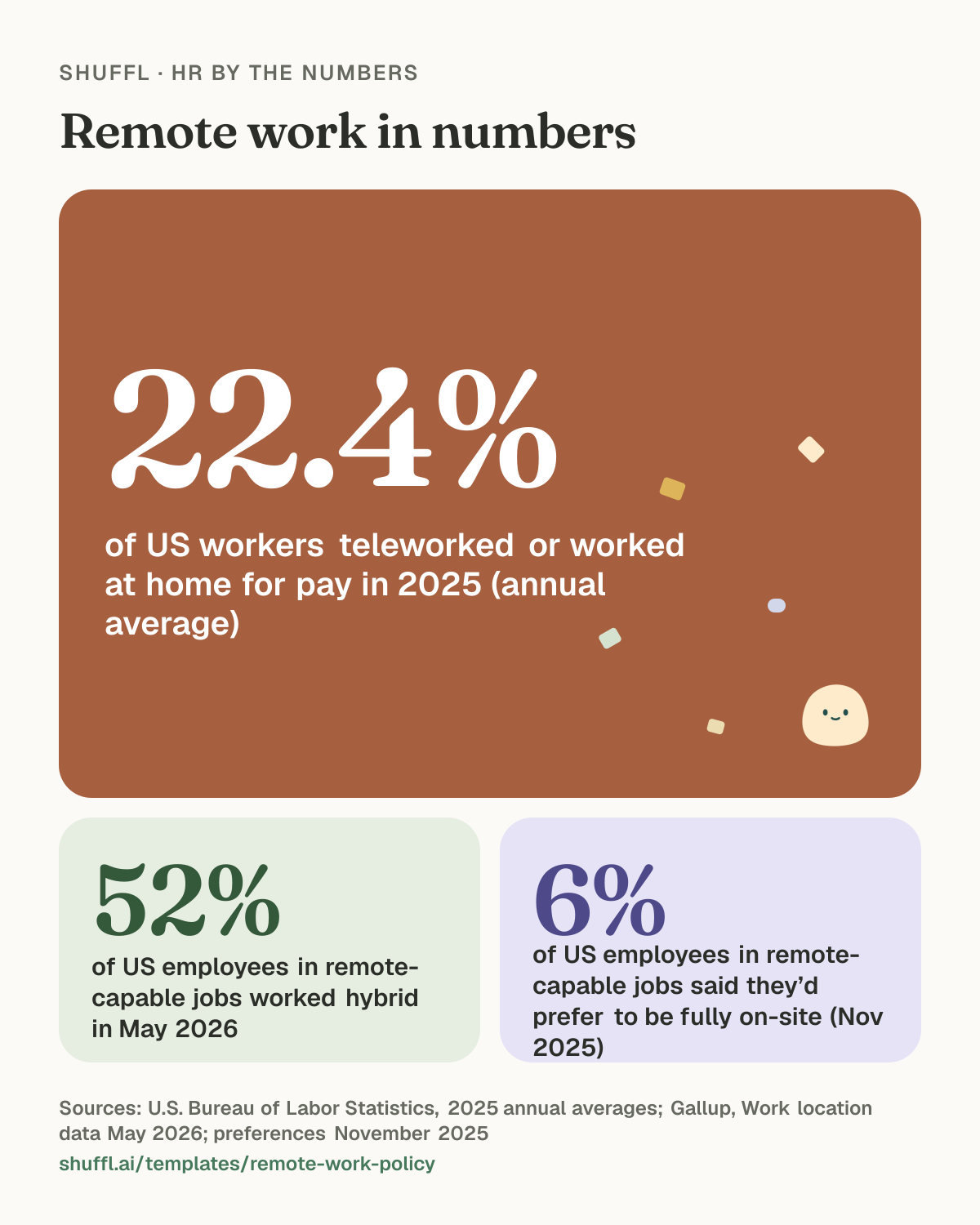
Remote work in numbers. 22.4% of US workers teleworked or worked at home for pay in 2025 (annual average) (U.S. Bureau of Labor Statistics, 2025 annual averages). 52% of US employees in remote-capable jobs worked hybrid in May 2026 (Gallup, Work location data May 2026; preferences November 2025). 6% of US employees in remote-capable jobs said they’d prefer to be fully on-site (Nov 2025) (Gallup, Work location data May 2026; preferences November 2025).
Working hours and remote work
Words in [square brackets] are for you to fill in. The policy has every section a real handbook policy has, but no allowances, dates or amounts of its own.
# Working hours and remote work

## Purpose
This policy sets out where and when people work, so teams can plan around each other and nobody has to guess what is expected.

## Who this covers
[Which employees this applies to, and any roles that must work on site.]

## Working hours
- Normal working week: [hours per week]
- Core hours, when everyone should be reachable: [hours and time zone, or "none"]
- Breaks: [how breaks work]
- Overtime: [who can work overtime, who must approve it first, and how it is paid or given back as time off]

## Where you work
[Fully remote, hybrid with a number of office days, or office based, and how that is agreed.]

## Asking for a different arrangement
1. Talk to your manager about [what you would like to change, for example days, hours or location].
2. [Who decides and how long it takes]
3. [How a decision is confirmed in writing, and how often it is reviewed]

## Working from another place
[Whether you can work from another city, state or country, for how long, and who must approve it first.]

## Equipment and costs
[What the company provides for remote work, how to request it, and what you return when you leave.]

## Availability and time off the clock
[How to signal availability, for example calendar and Slack status, expected response times, and that you are not expected to reply outside your working hours.]

## Health and safety at home
[How to set up a safe workspace, and how to ask for equipment or an adjustment.]

## Responsibilities
- **You:** keep your status up to date, protect company information wherever you work and record your hours if you are paid by the hour.
- **Your manager:** agree arrangements fairly and consistently, and judge work by results rather than hours online.
- **HR:** keep a record of agreed arrangements and answer questions about this policy.

## Where local law differs
If the law where you work gives you more rights about hours or flexible work, the law applies. These places have their own rules: [list them, or "none"].

## Related policies
Expenses, Acceptable use of company systems and Paid time off.

## About this policy
Owned by [team or person]. Applies in [countries or states]. We may update this policy and will tell you at least [number] days before a change takes effect. This policy is not part of your employment contract.

## Questions
Contact [team or person] at [email or channel].
Check before you publish
Rules that often catch teams out, by place. They are not part of the policy, and not legal advice.
United States
- Hourly (non-exempt) employees must be paid for all time worked, at home too, including overtime that was not approved. Say how they record hours.
- Someone working from another state or country can create payroll tax and employment law duties there. Make working from elsewhere need approval first.
United Kingdom
- Employees can ask for flexible working from their first day and can make two requests a year. You must consult them before refusing and reply within two months.
European Union
- The Working Time Directive caps the average week at 48 hours and requires 11 hours of rest a day. France, Portugal and Spain have rules on a right to disconnect or on paying remote work costs.
How to adapt it
- Say whether remote work needs a manager’s agreement, and how to ask for it.
- List the equipment the company pays for and how to request it.
- Keep core hours short if your team spans time zones.
What the research says
Remote work has settled at a steady share of the US workforce. In 2025, 22.4% of people at work teleworked or worked at home for pay, with 11.9% doing so for some of their hours and 10.5% for all of them.1
Among employees whose jobs can be done remotely, hybrid is the most common arrangement. Gallup’s May 2026 data puts 52% of them in hybrid work, 26% fully remote and 22% on-site.2 Preferences lean further away from the office: in November 2025, 61% wanted hybrid, 33% wanted fully remote and 6% wanted to be on-site full time.2
Gallup also finds engagement holds up away from the office. In May 2026, 37% of fully remote and 34% of hybrid employees were engaged, compared with 29% of on-site employees in remote-capable jobs.2 Clear expectations about hours, replies and in-person days are what make those arrangements work day to day.
What the law requires
US federal law gives no right to work remotely, but pay rules follow people home. Nonexempt employees must be paid for all hours worked, at home too, and short breaks of 20 minutes or less count as hours worked anywhere.3 If you know or have reason to believe someone is working, that time counts, so make extra hours easy to report.3
In the UK, all employees have the legal right to request flexible working, including working from home, from their first day in a job. Employers must handle requests in a reasonable manner, and can refuse one if they have a good business reason.4
In the EU, the Work-Life Balance Directive gives parents of children up to at least eight years old, and carers, the right to request flexible working, including remote work. Employers must reply within a reasonable period and give reasons for any refusal.5 Working from another country can change tax, social security and employment law, so check first.
Common mistakes
- Saying “hybrid” without saying which days, or how many, people are expected in the office.
- Letting people work from another state or country without checking payroll tax, employment law and data rules there.
- Forgetting that hourly employees working from home still need their hours recorded and paid, including extra time in the evening.
- Approving remote work informally, with nothing written down, so it’s hard to change fairly later.
Common questions
- Can employees in the UK ask to work from home?
- Yes. All employees have a legal right to request flexible working, which includes working from home, from their first day. The employer has to handle the request in a reasonable manner and can refuse it if there’s a good business reason.
- Does the company have to pay for home office equipment?
- It depends on where the person works, as reimbursement rules differ between countries and between US states. Say in the policy what the company provides or pays for, and check the local rules before you decide.
- Can someone work remotely from another country?
- Sometimes, but it can create tax, social security, immigration and employment law obligations in that country. Many companies allow short stays abroad with approval and require a review for anything longer.
Sources
Read on . Laws change, so check the source before you act. This page is general information, not legal advice.
- U.S. Bureau of Labor Statistics, People at work by telework status, usual full- or part-time status, occupation, industry, and class of worker (Current Population Survey table 60), 2025 annual averages. 11-month averages that exclude October.
- Gallup, Global Indicator: Hybrid Work, Work location data May 2026; preferences November 2025. Web surveys of a random sample of U.S. adults working full or part time, from the probability-based Gallup Panel, weighted to national demographics. Remote-capable employees only for location and preference figures.
- U.S. Department of Labor, Wage and Hour Division, Field Assistance Bulletin No. 2023-1: Telework Under the Fair Labor Standards Act and Family and Medical Leave Act, February 9, 2023.
- GOV.UK, Flexible working, Current page, read October 2026.
- legislation.gov.uk (EU text as adopted), Directive (EU) 2019/1158 of the European Parliament and of the Council of 20 June 2019 on work-life balance for parents and carers and repealing Council Directive 2010/18/EU, 20 June 2019. Article 9: flexible working arrangements.