
Policies
Time off policy template
Allowance, accrual, carry-over, requests and what happens when someone leaves. A complete policy to adapt with your own rules.
A starting point, not legal advice. Leave, pay and expense rules differ by country, state and city. Use the checks on this page to see what to look up where your people work, and have someone qualified review your policy before you publish it.
Knowledge draft. Opens a Knowledge draft with this policy, its checks and what Shuffl already knows, like your HR contact and countries. Draft with Mello can write the rest and show where each value came from. Nothing is published until you choose Publish.
Time off is the policy people look up most, and the one HR answers the same questions about every week. Write it down once and point people to it.
The outline covers who it applies to, how much time people get, how it builds up and carries over, and how to ask for it.
Shuffl · HR by the numbers
Paid time off in numbers

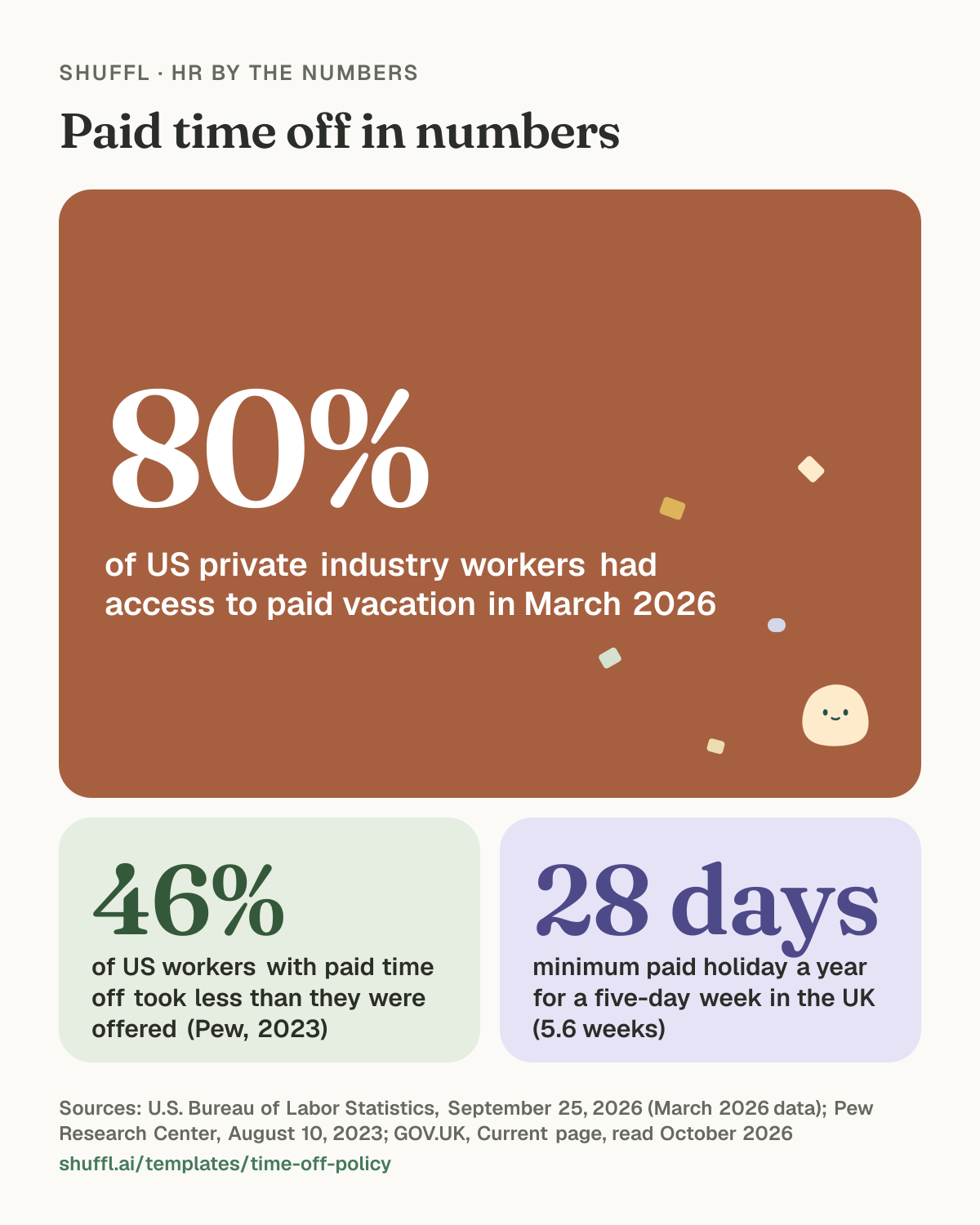
Paid time off in numbers. 80% of US private industry workers had access to paid vacation in March 2026 (U.S. Bureau of Labor Statistics, September 25, 2026 (March 2026 data)). 46% of US workers with paid time off took less than they were offered (Pew, 2023) (Pew Research Center, August 10, 2023). 28 days minimum paid holiday a year for a five-day week in the UK (5.6 weeks) (GOV.UK, Current page, read October 2026).
Paid time off
Words in [square brackets] are for you to fill in. The policy has every section a real handbook policy has, but no allowances, dates or amounts of its own.
# Paid time off

## Purpose
This policy explains how much paid time off you get, how it builds up and how to take it, so you can plan rest without guessing.

## Who this covers
[Which employees this applies to, for example all full-time employees after their first month.]
- Part-time employees get time off [in proportion to their hours, or another rule].
- Contractors and agency workers are not covered.

## Definitions
- **Paid time off:** paid days away from work for rest or personal matters. Sick time is [included, or covered by the Sick leave policy].
- **Leave year:** [the calendar year, your work anniversary or another period].

## How much time off you get
- Annual allowance: [number of days] per year
- Accrual: [how and when time accrues, or "granted at the start of the year"]
- Most you can hold at once: [a cap, or "no cap"]
- Carry-over: [how many days can carry into the next year, and by when they must be used]
- Public holidays: [Whether public holidays are counted separately, and where the list is kept.]

## How to request time off
1. [Where to request it, for example the HR system or your manager]
2. [How far in advance to ask]
3. [Who approves it and how long approval usually takes]

If a request is declined, your manager will say why and suggest other dates. For time off you could not plan, tell your manager as soon as you can.

## Responsibilities
- **You:** plan time off with your team, record it and hand over urgent work before you go.
- **Your manager:** approve requests fairly and consistently, and make sure everyone on the team gets to use their time.
- **HR:** keep balances accurate and answer questions about this policy.

## When you leave
[Whether unused time off is paid out when you leave, and what happens if you have taken more than you have built up.]

## Where local law differs
If the law where you work gives you more time off or other rights, the law applies. These places have their own rules: [list them, or "none"].

## Related policies
Sick leave, Company holidays and Parental leave.

## About this policy
Owned by [team or person]. Applies in [countries or states]. Time off you have already built up is not taken away by a change. We may update this policy and will tell you at least [number] days before a change takes effect. This policy is not part of your employment contract.

## Questions
Contact [team or person] at [email or channel].
Check before you publish
Rules that often catch teams out, by place. They are not part of the policy, and not legal advice.
United States
- Some states, including California, Colorado, Montana and Nebraska, treat earned vacation as wages: it cannot expire under a use-it-or-lose-it rule and must be paid out when someone leaves. A cap on how much someone can hold is usually allowed.
- Many states and cities require separate paid sick time. If this allowance also covers sickness, check it meets every sick leave law where you have people.
United Kingdom
- The legal minimum is 5.6 weeks a year, which can include bank holidays, pro rata for part-time staff. Holiday is a term the written statement of employment must cover, so check whether your contracts already set it.
European Union
- Everyone gets at least four weeks of paid annual leave. Countries add their own rules on carry-over, payout when someone leaves and public holidays.
Everywhere
- Check the minimum allowance, whether unused time must be paid out on leaving, and whether your carry-over limit is allowed.
How to adapt it
- Say how many days in a plain number, and whether public holidays are counted separately.
- Name the person or system that approves requests, and how long that usually takes.
- If different countries or teams get different allowances, say which applies to whom.
What the research says
Paid vacation is close to standard in the US, but not universal. In March 2026, 80% of private industry workers had access to it.1 Access was 71% at private establishments with fewer than 50 people, against 91% at those with 500 or more.2 After one year of service, the most common allowance was 10 to 14 days, received by 32% of private industry workers.2
Offering time off is half of it. In a 2023 Pew Research Center survey, 46% of US workers with paid time off said they take less than they are offered.3 Of those, 49% would worry about falling behind and 43% would feel bad about co-workers picking up the extra work.3 Cover plans and managers who take their own leave help.
What the law requires
US federal law doesn’t require paid vacation. The Department of Labor says the Fair Labor Standards Act does not require pay for time not worked, such as vacations or holidays, which are a matter of agreement between employer and employee.4 Some states regulate how accrued vacation is paid out when someone leaves, so check where each person works.
In the UK, almost all workers are entitled to 5.6 weeks’ paid holiday a year, which is 28 days for someone working five days a week. Employers can choose to count bank holidays within that 28 days, and part-time workers get the same 5.6 weeks pro rata.5 When someone leaves, the employer must pay for statutory leave they haven’t taken.6
Across the EU, the Working Time Directive gives every worker at least four weeks’ paid annual leave, and that minimum can’t be swapped for pay except when employment ends.7 Many member states set a higher minimum in national law, so check each country.
Common mistakes
- Calling time off “unlimited” without saying how requests are approved or what a normal amount looks like, so people take less.
- Leaving public holidays ambiguous, so nobody knows whether they come out of the annual allowance.
- Setting a use-it-or-lose-it rule without checking local law on carryover and payout when someone leaves.
- Applying one allowance everywhere, when part of the team works in a country with a higher legal minimum.
Common questions
- How many days of paid time off is normal in the US?
- There is no legal minimum, so it varies by employer. Government data for March 2026 shows the most common allowance after one year of service was 10 to 14 days of paid vacation, usually with public holidays given separately.
- Do employers have to pay out unused vacation when someone leaves?
- Federal law doesn’t require it, but some US states treat earned vacation as wages that must be paid out. In the UK and EU, statutory holiday that’s been earned but not taken is paid when employment ends. Check the rules where the person works and say what you do in the policy.
- Can bank holidays count towards annual leave in the UK?
- Yes. UK employers can include bank holidays in the 5.6 weeks of statutory paid holiday, or give them on top. Say which you do in your policy so people can plan.
Sources
Read on . Laws change, so check the source before you act. This page is general information, not legal advice.
- U.S. Bureau of Labor Statistics, Employee Benefits in the United States Summary, September 25, 2026 (March 2026 data). National Compensation Survey; about 16,020 sampled establishments in private industry and state and local government.
- U.S. Bureau of Labor Statistics, Who receives paid vacations?, September 2026 (2026 data). National Compensation Survey estimates.
- Pew Research Center, More than 4 in 10 U.S. workers don’t take all their paid time off, August 10, 2023. Survey of 5,188 U.S. adults who work full or part time and are not self-employed, conducted Feb. 6 to 12, 2023, on the American Trends Panel.
- U.S. Department of Labor, Vacation Leave, Current page, read October 2026.
- GOV.UK, Holiday entitlement, Current page, read October 2026.
- GOV.UK, Holiday entitlement: Taking holiday before leaving a job, Current page, read October 2026. Employers must pay for untaken statutory leave when a worker leaves.
- EUR-Lex, Directive 2003/88/EC of the European Parliament and of the Council of 4 November 2003 concerning certain aspects of the organisation of working time, 4 November 2003. Article 7: annual leave.