
Pulse question sets
Workload pulse questions
Is the work doable, and is time spent on what matters? 4 pulse survey questions to copy.
Pulse questions. Opens this set in Pulse questions. Nothing is added until you choose Add questions.
Do people have enough time, know what can wait and get a say in what they take on?
Use this set when deadlines pile up or a team has lost people and not replaced them.
Shuffl · HR by the numbers
Workload and its toll

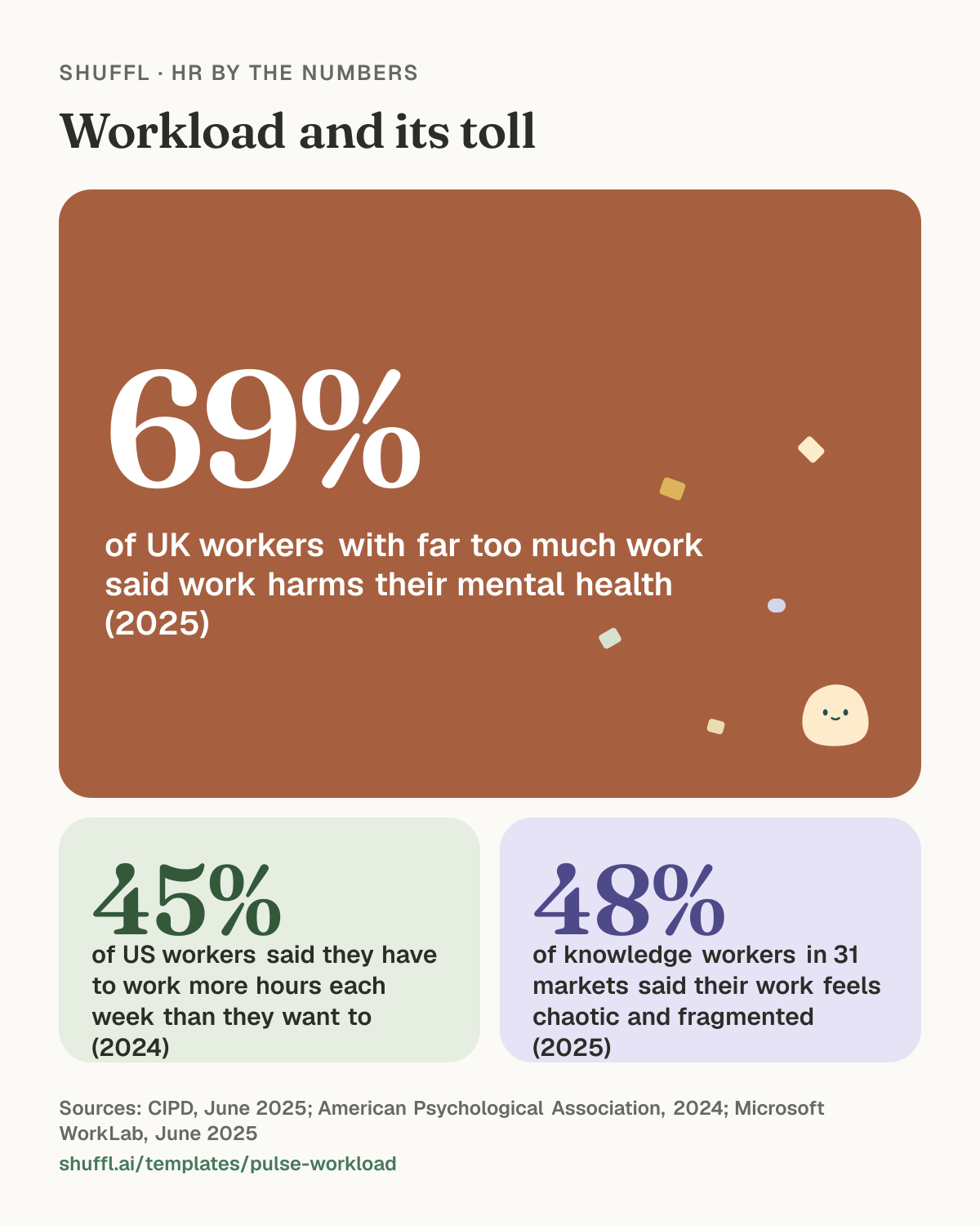
Workload and its toll. 69% of UK workers with far too much work said work harms their mental health (2025) (CIPD, June 2025). 45% of US workers said they have to work more hours each week than they want to (2024) (American Psychological Association, 2024). 48% of knowledge workers in 31 markets said their work feels chaotic and fragmented (2025) (Microsoft WorkLab, June 2025).
Workload questions
Each line shows the answer scale and what the question measures.
1. I had enough time to do my work well this week. (strongly disagree to strongly agree; Workload)
2. When new work arrives, it is clear what can wait. (strongly disagree to strongly agree; Workload)
3. I had a say in how I organised my work this week. (strongly disagree to strongly agree; Workload)
4. Most of what I worked on this week was worth the time it took. (strongly disagree to strongly agree; Workload)
How to adapt it
- Ask one question at a time, a few times a week, rather than all of them at once.
- Keep the wording about the last week or two, so people answer about now.
- Ask the same question again later to see whether something you changed helped.
What the research says
Workload sits near the top of most lists of what makes work unhealthy. In the UK, 69% of workers who said their workload was far too much reported that work harms their mental health, compared with 14% of those whose workload was about right.1 In the US, 45% of workers said they have to work more hours each week than they want to.2
Gallup names unmanageable workload and unreasonable time pressure among the five main causes of burnout. Employees who often or always have enough time to do all their work were 70% less likely to experience high burnout.3
A 2025 survey of about 31,000 knowledge workers in 31 markets found that 48% said their work feels chaotic and fragmented, and 1 in 3 said the pace of work over the past five years has made it impossible to keep up.4
How to read the results
Read the question on time together with the question on what can wait. Low scores on both mean too much work and no way to drop any of it, which is the pattern to act on first. Low scores on time alone, with good scores on priorities and having a say, often mean a short peak people can manage.
Workload moves with deadlines and staffing, so compare a team with its own scores over several weeks and with the months when it was fully staffed. Report only groups with five or more answers. Two or three weeks of falling scores after someone leaves and isn’t replaced is an early warning, well before sick days and resignations show up.
Common mistakes
- Asking about workload and then adding work without saying what can be dropped.
- Reading long hours as commitment. Long hours over several weeks usually mean the plan is bigger than the team.
- Offering time management training when the backlog comes from too many priorities.
- Comparing teams with very different work, such as support and engineering, as if the scores meant the same thing.
Common questions
- How do you know if a team’s workload is too high?
- Look for several signs at once: low scores on having enough time, rising overtime, time off going unused and deadlines slipping. One busy week is normal. The same signs lasting a month or more call for a change in scope, deadlines or staffing.
- How do you ask employees about workload?
- Ask about the last week in plain statements people can agree or disagree with, such as having enough time to do the work well and knowing what can wait. Ask the same questions regularly so you can see whether workload is rising or easing.
- What can managers do about unmanageable workload?
- Agree with the team what can stop, wait or be done to a simpler standard, and write it down. Give people a say in how they organise their work, and raise staffing gaps with leadership early so the team isn’t quietly absorbing them.
Sources
Read on . Numbers change as new studies come out, so check the source before you quote it.
- CIPD, CIPD Good Work Index 2025, June 2025. Eighth wave of the CIPD/YouGov UK Working Lives survey: 5,017 UK workers (unweighted), January and February 2025, weighted to be representative of UK working adults.
- American Psychological Association, 2024 Work in America Survey: Psychological Safety in the Changing Workplace, 2024. Online survey by The Harris Poll of 2,027 employed U.S. adults, March 25 to April 3, 2024. Psychological safety measured with seven items adapted from Edmondson’s scale and split at the median.
- Gallup, Employee Burnout, Part 1: The 5 Main Causes, July 2018. Gallup study of nearly 7,500 full-time U.S. employees. No fieldwork dates given.
- Microsoft WorkLab, Breaking down the infinite workday, June 2025. Work Trend Index survey by Edelman Data x Intelligence of about 31,000 full-time knowledge workers in 31 markets, February 6 to March 24, 2025, plus anonymized Microsoft 365 telemetry.