
Pulse question sets
Psychological safety pulse questions
Can people raise problems, admit mistakes and ask for help? 4 pulse survey questions to copy.
Pulse questions. Opens this set in Pulse questions. Nothing is added until you choose Add questions.
Can people raise problems, admit mistakes, ask for help and take a sensible risk without fear?
Use this set when teams seem quiet in meetings or problems come to light late.
Shuffl · HR by the numbers
Psychological safety and stress

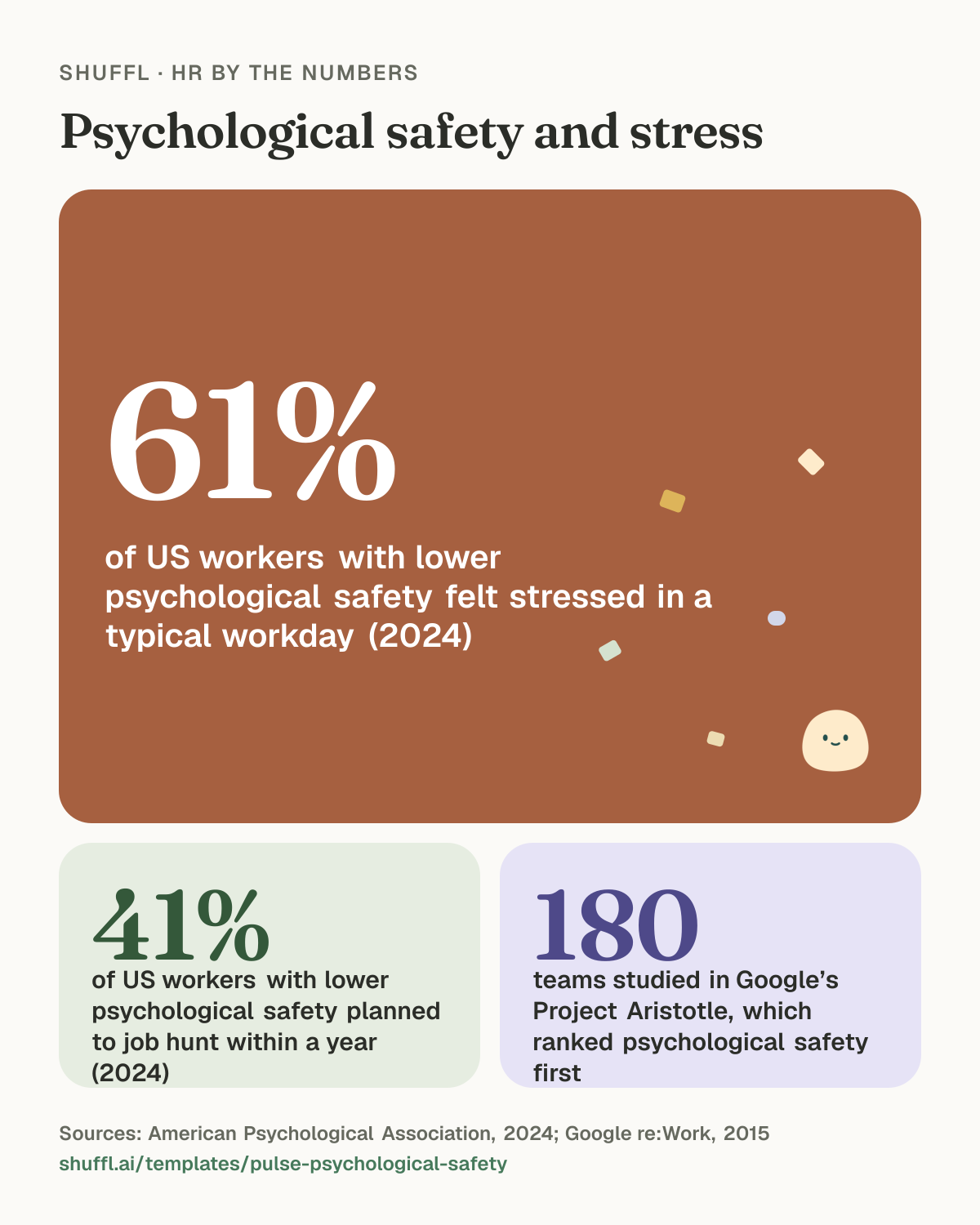
Psychological safety and stress. 61% of US workers with lower psychological safety felt stressed in a typical workday (2024) (American Psychological Association, 2024). 41% of US workers with lower psychological safety planned to job hunt within a year (2024) (American Psychological Association, 2024). 180 teams studied in Google’s Project Aristotle, which ranked psychological safety first (Google re:Work, 2015).
Psychological safety questions
Each line shows the answer scale and what the question measures.
1. On my team, people can bring up problems and tough issues. (strongly disagree to strongly agree; Psychological safety)
2. If I make a mistake on my team, it is not held against me. (strongly disagree to strongly agree; Psychological safety)
3. It is easy to ask people on my team for help. (strongly disagree to strongly agree; Psychological safety)
4. It is safe to try something new on my team, even if it might not work. (strongly disagree to strongly agree; Psychological safety)
How to adapt it
- Ask one question at a time, a few times a week, rather than all of them at once.
- Keep the wording about the last week or two, so people answer about now.
- Ask the same question again later to see whether something you changed helped.
What the research says
Amy Edmondson defined team psychological safety as a shared belief that the team is safe for interpersonal risk taking. In her study of 51 work teams in a manufacturing company, psychological safety was linked to learning behavior, such as seeking feedback, asking for help and discussing errors, and learning behavior was linked to team performance.1
APA’s 2024 survey split US workers at the median of a seven-item psychological safety score. Those below it were more than twice as likely to feel tense or stressed out in a typical workday (61% vs. 27%) and to plan to look for a new job within a year (41% vs. 19%).2
Google’s Project Aristotle studied 180 teams and named psychological safety the most important of five dynamics of effective teams. Team size, seniority and whether people sat together did not significantly relate to effectiveness there.3
How to read the results
Psychological safety belongs to a team, so read it by team. Look at the spread as well as the average: a team where most agree but a few strongly disagree may feel safe for some members and not others. Use a minimum of five answers per team, and never break results down further inside a small team.
Each question points to a different fix. Low scores on raising problems call for changes in how meetings run, low scores on mistakes call for a different response to errors, and low scores on asking for help often point to workload or unclear ownership. Compare each team with itself over a quarter before ranking teams against each other.
Common mistakes
- Sharing a team’s low score in a way that leaves the manager defensive or the team feeling blamed.
- Reacting to bad news with irritation after asking for it, which teaches people to stay quiet.
- Ranking managers in a league table, which creates pressure for good scores over honest ones.
- Expecting scores to rise right after a training session. Trust changes through repeated experience.
Common questions
- What is psychological safety at work?
- It’s a shared belief on a team that it’s safe to take interpersonal risks, such as speaking up, admitting a mistake or asking for help, without being embarrassed or punished. Amy Edmondson introduced the idea for work teams in 1999.
- How do you measure psychological safety?
- Use a few agree-or-disagree statements about raising problems, mistakes, asking for help and trying new things, answered confidentially and reported by team. Many surveys adapt items from Edmondson’s original seven-item scale.
- What should a manager do when psychological safety scores are low?
- Talk about it with the team without asking who answered what. Ask what makes it hard to raise problems, respond to bad news with thanks and a question, and share a recent mistake of your own. Ask again in a month to see whether anything moved.
Sources
Read on . Numbers change as new studies come out, so check the source before you quote it.
- Administrative Science Quarterly, Psychological Safety and Learning Behavior in Work Teams (Amy Edmondson), vol. 44, no. 2, pp. 350-383, June 1999. Peer-reviewed multimethod field study of 51 work teams in a manufacturing company.
- American Psychological Association, 2024 Work in America Survey: Psychological Safety in the Changing Workplace, 2024. Online survey by The Harris Poll of 2,027 employed U.S. adults, March 25 to April 3, 2024. Psychological safety measured with seven items adapted from Edmondson’s scale and split at the median.
- Google re:Work, Guide: Understand team effectiveness, 2015. Project Aristotle studied 180 Google teams (115 engineering project teams and 65 sales pods), with more than 35 statistical models run on hundreds of variables.