
Policies
Code of conduct template
Expected behaviour, conflicts of interest, gifts, confidentiality and speaking up. A complete policy to adapt with your own rules.
A starting point, not legal advice. Leave, pay and expense rules differ by country, state and city. Use the checks on this page to see what to look up where your people work, and have someone qualified review your policy before you publish it.
Knowledge draft. Opens a Knowledge draft with this policy, its checks and what Shuffl already knows, like your HR contact and countries. Draft with Mello can write the rest and show where each value came from. Nothing is published until you choose Publish.
A code of conduct sets the standard everyone is held to: how people treat each other, conflicts of interest, gifts and company information.
Keep it short and specific, and point to the policies that cover each topic in full.
Shuffl · HR by the numbers
Codes of conduct in numbers

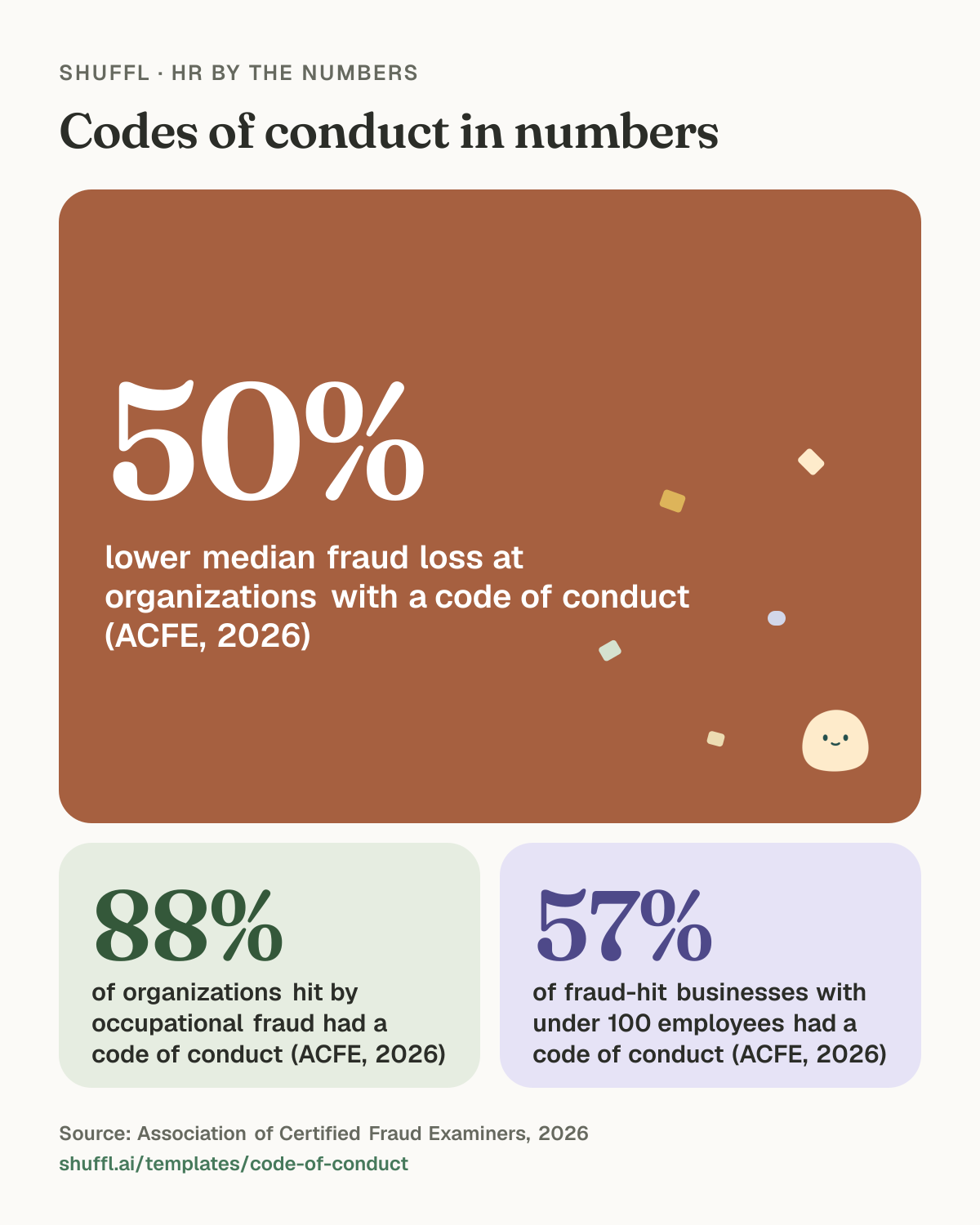
Codes of conduct in numbers. 50% lower median fraud loss at organizations with a code of conduct (ACFE, 2026) (Association of Certified Fraud Examiners, 2026). 88% of organizations hit by occupational fraud had a code of conduct (ACFE, 2026) (Association of Certified Fraud Examiners, 2026). 57% of fraud-hit businesses with under 100 employees had a code of conduct (ACFE, 2026) (Association of Certified Fraud Examiners, 2026).
Code of conduct
Words in [square brackets] are for you to fill in. The policy has every section a real handbook policy has, but no allowances, dates or amounts of its own.
# Code of conduct

## Purpose
This code sets out how we work with each other, our customers and partners, so everyone knows what is expected and what to do when something seems wrong.

## Who this covers
Everyone who works here, including [contractors, interns and board members], wherever and whenever they are working, including at company events and online.

## What we expect of everyone
[The behaviour the company expects, in a few short points, for example honesty, respect and following the law.]

## Treating people with respect
We do not tolerate harassment, bullying or discrimination. The Equal opportunity and anti-harassment policy explains this in full.

## Conflicts of interest
Tell [who] about anything that could affect, or look like it affects, your judgement at work, for example [a second job, an investment in a supplier, or a relative you would manage or hire].

## Gifts, hospitality and bribery
- You can accept or give gifts and hospitality worth up to [limit], and must record anything above it with [who].
- Never offer, give, ask for or accept anything to win business or influence a decision.

## Company information and property
[How to handle confidential information, customer data and company equipment, and what to return when you leave.]

## Talking about work in public
[Who can speak for the company to the press or on social media.] Nothing in this code stops you from talking about your pay or working conditions, or from reporting a concern to a regulator.

## If something goes wrong
Raise it using the Raising a concern policy. Breaking this code can lead to action up to and including dismissal, under [the disciplinary process].

## Where local law differs
If the law where you work gives you more protection, the law applies. These places have their own rules: [list them, or "none"].

## Related policies
Raising a concern, Equal opportunity and anti-harassment, Acceptable use of company systems and Expenses.

## About this policy
Owned by [team or person]. Applies in [countries or states]. We may update this policy and will tell you at least [number] days before a change takes effect. This policy is not part of your employment contract.

## Questions
Contact [team or person] at [email or channel].
Check before you publish
Rules that often catch teams out, by place. They are not part of the policy, and not legal advice.
United States
- The NLRA protects employees, union or not, who discuss pay and working conditions. Broad rules on civility, confidentiality or criticising the company can be unlawful, so keep the line saying the code does not stop this.
- Public companies must disclose whether they have a code of ethics for senior financial officers (Sarbanes-Oxley section 406).
United Kingdom
- Under the Bribery Act a company can be liable for failing to prevent bribery unless it has adequate procedures. Gift limits and a register help show you do. Large organisations also have a failure to prevent fraud offence since September 2025.
European Union
- In Germany, France and other countries a works council may need to agree conduct rules before they apply. Check before you publish.
How to adapt it
- Give a gift limit as a number, and say where gifts above it are recorded.
- Keep the line saying people can talk about pay and report to a regulator.
- Name the process that applies when the code is broken.
What the research says
A code of conduct is the most common control against misconduct. In the Association of Certified Fraud Examiners’ 2026 study of 2,402 fraud cases, 88% of the organizations affected had one.1 With a code, the median loss was $100,000, half the $200,000 without one, and it was one of four controls linked to the largest drops in losses and time to detection.1
Smaller companies are much less likely to have one. Among businesses with fewer than 100 employees in the study, 57% had a code of conduct, compared with 95% of organizations with 100 or more employees.1 A short code that people have read, backed by a way to report concerns, is within reach of any size of company.
What the law requires
Most private companies don’t legally need a code of conduct, but some are expected to have one. US public companies must disclose whether their principal executive and financial officers have a code of ethics, or explain why not.2 Prosecutors assessing a compliance program check for a code of conduct that is accessible and applies to all employees.3
A code can’t take away legal rights. In the US, the National Labor Relations Board says policies that specifically ban employees from discussing their wages are unlawful.4 In the UK, the Acas Code of Practice says disciplinary rules should be written down, specific and clear, and employment tribunals take the Code into account.5
Common mistakes
- Writing it in legal language nobody reads, instead of plain examples of what good and bad look like.
- Including confidentiality rules so broad they seem to stop people talking about pay or reporting to a regulator.
- Publishing it once at onboarding and never asking people to read it again after it changes.
- Applying it unevenly, so senior people seem to be held to a different standard.
Common questions
- What is the difference between a code of conduct and a code of ethics?
- A code of ethics usually sets out values and principles, while a code of conduct turns them into specific rules, like gift limits and conflicts of interest. Many companies combine the two in one document.
- Is a code of conduct legally binding?
- It depends on how it’s written and where you are. Many companies make following it a condition of employment and link breaches to the disciplinary process. Check with a lawyer before saying it forms part of the contract.
- Can a code of conduct ban employees from discussing pay?
- In the US, the National Labor Relations Board says policies that specifically prohibit employees from discussing their wages are unlawful. Keep pay discussions and reports to regulators explicitly allowed in your code.
Sources
Read on . Laws change, so check the source before you act. This page is general information, not legal advice.
- Association of Certified Fraud Examiners, Occupational Fraud 2026: A Report to the Nations, 2026. 2,402 occupational fraud cases from 143 countries and territories, reported by Certified Fraud Examiners in a survey run from July to September 2025. Small businesses are those with fewer than 100 employees.
- Legal Information Institute, Cornell Law School, 17 CFR § 229.406 - (Item 406) Code of ethics, Current page, read October 2026.
- U.S. Department of Justice, Criminal Division, Evaluation of Corporate Compliance Programs, Updated September 2024.
- National Labor Relations Board, Your Right to Discuss Wages, Current page, read October 2026.
- Acas, Acas Code of Practice on disciplinary and grievance procedures, Current page, read October 2026.