
HR playbook
Handle a leaver well
How to handle a leaver well: a checklist with owners, a real handover, access removed on the last day, an exit interview you act on and a door left open.
For HR leads and people managers at startups and mid-size companies
How someone leaves shapes what they say about you afterwards, whether they’d come back, and whether a former login turns into a security problem. Fewer than half of people who left a job by choice were satisfied with how their employer handled the exit1.
This playbook covers the checklist, the handover, the exit interview, removing access and keeping in touch. It isn’t legal advice; final pay, benefits and notice rules depend on where the person works.
Why it matters
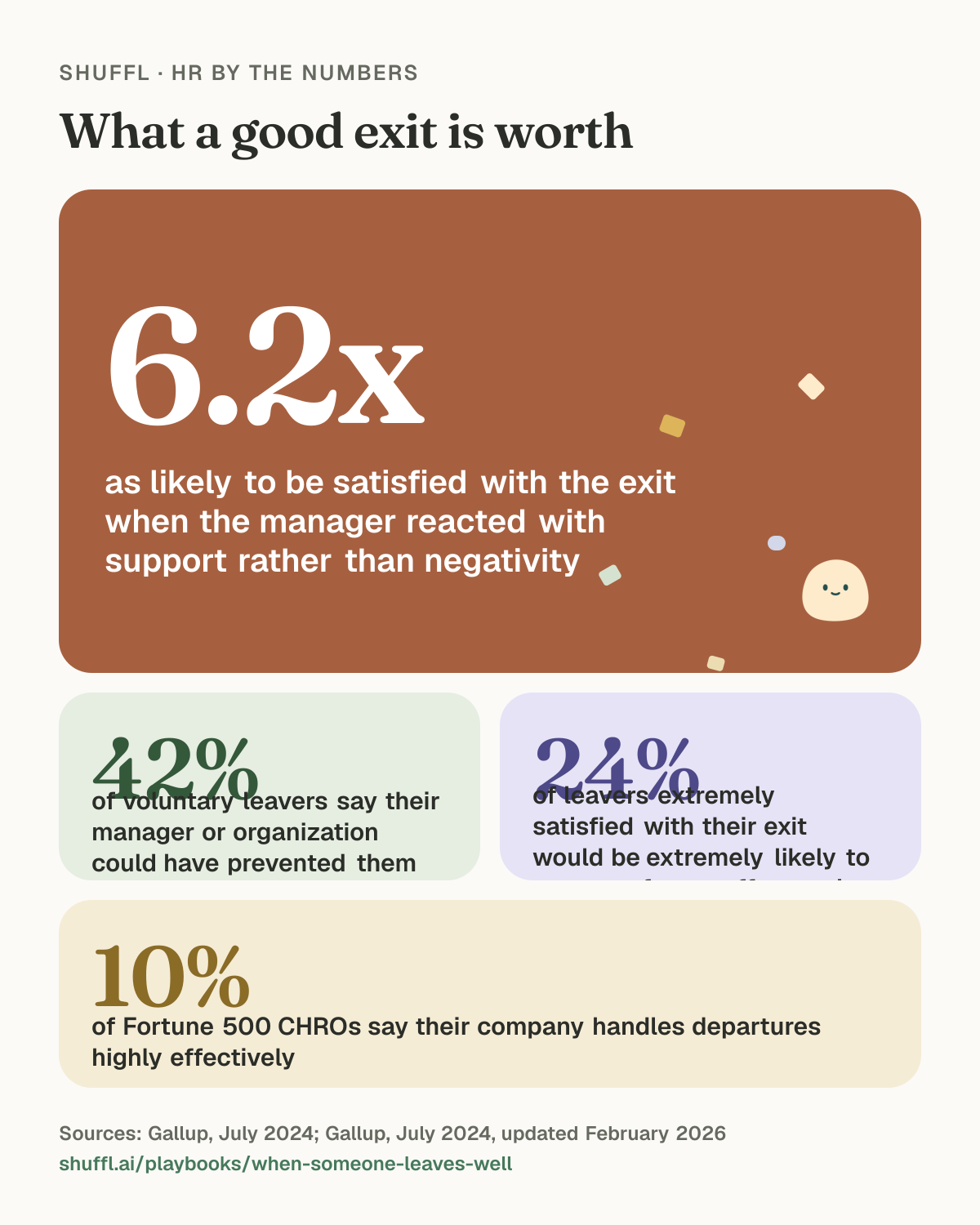
Gallup surveyed 716 U.S. adults who left an employer by choice in the past year. Only 22% were extremely satisfied and 21% satisfied with how the exit was handled. Just 17% said their manager actively supported them, and those leavers were 6.2 times as likely to be satisfied. Extremely satisfied leavers were far likelier to take a future offer: 24%, against 4% of everyone else1.
Many departures could have gone another way. 42% of voluntary leavers say their manager or organization could have done something to keep them, and 45% say no manager or leader talked with them about their satisfaction or future in the three months before they left2. That’s what an exit interview is for: finding the next one before it happens.
Then there’s access. The SEI CERT guide, based on more than 3,000 insider threat cases, describes former staff using accounts that were never revoked, shared passwords that were never changed and equipment that was never returned3.
Shuffl · HR by the numbers
What a good exit is worth

What a good exit is worth. 6.2x as likely to be satisfied with the exit when the manager reacted with support rather than negativity (Gallup, July 2024). 42% of voluntary leavers say their manager or organization could have prevented them leaving (Gallup, July 2024, updated February 2026). 24% of leavers extremely satisfied with their exit would be extremely likely to accept a future offer, against 4% of the rest (Gallup, July 2024). 10% of Fortune 500 CHROs say their company handles departures highly effectively (Gallup, July 2024).
The plan, from resignation to alumni
The SEI CERT guide recommends that a termination checklist lists each task, who does it, who verifies it and when it must be done, and goes back to HR before the person leaves3. Start from that and add your own systems.
- The day they tell you: the manager thanks them, agrees the last day and tells HR the same day.
- Within two days: HR opens the checklist and shares it with the manager, IT and payroll. Each task has an owner, a date and someone who checks it.
- First half of the notice period: the manager lists their projects, documents and relationships and names who takes each one.
- Second half: the leaver walks their successor through each item and writes down what isn’t written anywhere.
- Last day: equipment back, every account closed, shared passwords changed, final pay and benefits explained.
- A week later: the exit interview, then an invitation to stay in touch.
Remove access, all of it
Access removal goes wrong at the edges: the tool one team bought on a card, the shared login for a supplier portal, the admin role nobody remembers granting. These items come from the SEI CERT termination checklist3.
- Every system with a login: email, single sign-on, VPN, cloud services, specialised apps and company social media accounts.
- Shared accounts, service accounts and vendor portals. Change the passwords.
- Company equipment, badges, keys, access cards and two-factor tokens.
- Distribution lists, automated alerts and calendar invitations.
- Roles they held in HR tools: approvals, request queues, policy ownership and channel admin rights.
The exit interview and keeping in touch
Read exit interviews in batches. One complaint about a manager is a story; four from the same team is a pattern. In a case Harvard Business Review describes, a department of 17 had only eight left a year after a new manager arrived, and the exit interviews pointed at the same cause4.
Then keep the door open. A short note after they leave, an alumni channel or list, and a real welcome if they apply again.
- What made you start looking, or say yes to the other offer?
- What would have needed to be different for you to stay?
- How well did your manager support your growth?
- What should we keep doing?
- Would you consider coming back one day?
An example
An account manager at an 80-person company resigns with four weeks’ notice. Her manager thanks her and agrees the last day. HR opens the checklist that afternoon with 22 tasks across HR, IT, payroll and her manager.
In week one, her manager lists 14 client accounts and names who takes each. In weeks two and three she introduces each new owner on a call. IT runs a report of every app she has signed into in the last 90 days and finds two supplier portals that aren’t on the list.
On her last afternoon she returns her laptop, and IT closes every account by 5 p.m. HR sends the exit interview a week later. Her answers match two other leavers from the same team, so HR raises workload with the team’s director. She joins the alumni list, and 18 months later she comes back as a team lead.
Common mistakes
- Reacting badly when someone resigns, then expecting a warm exit.
- Running offboarding from memory instead of a checklist with owners and dates.
- Removing email and single sign-on but forgetting shared passwords and vendor portals.
- Leaving the handover to the last two days of the notice period.
- Collecting exit interviews and never reading them for patterns.
Offboarding checklist
For each task: owner, due date, checked by.

HR
[ ] Confirm the last day in writing
[ ] Share this checklist with the manager, IT and payroll
[ ] Explain final pay, unused leave and when benefits end
[ ] Send the exit interview a week after the last day
[ ] Record that their employment ended in your HR tools

Manager
[ ] List projects, documents, clients and recurring meetings
[ ] Name who takes each one
[ ] Tell the team the last day and who picks up their work
[ ] Reassign their direct reports, if any

IT
[ ] List every app they signed into in the last 90 days
[ ] Close every account at the end of the last day
[ ] Change shared and service account passwords
[ ] Collect laptop, phone, badge, keys and tokens
[ ] Remove them from distribution lists and alerts

Payroll
[ ] Process final pay by the local deadline
[ ] Collect company cards
In Shuffl
Do this in Shuffl
- Open People, choose the person and expand Employment and access. Set Employment to Employment ended, write the last day under Reason for change, and choose Save access.
- Reassign their reports: open People, then Org chart, and choose Set managers.
- For HR requests they owned, another responder opens each one from the Inbox and chooses Take ownership. In Request settings, give each category they owned a new owner.
- If they owned a community, an owner or moderator opens it, chooses Manage under Members and removes them, after making someone else an owner.
- If they belonged to the company, open Settings → Company → Members and choose Remove from company, and revoke any company API keys they created.
- With Sync from your HR system, Shuffl sets Employment ended when the provider reports them terminated. Handing on their roles, requests and communities is still yours to do.
The guide: When someone leaves
Read the guideHave your agent do thisPaste the prompt into Claude Code, Cursor or another agent. It reads this playbook and the guide, works over MCP and asks before it changes anything others will see.Show the promptHide the prompt
Help me with "Handle a leaver well" in my Shuffl workspace.

1. Read the playbook: https://shuffl.ai/playbooks/markdown/when-someone-leaves-well
2. Read the Shuffl guide it uses: https://shuffl.ai/docs/markdown/when-someone-leaves
3. Add Shuffl's MCP server: https://shuffl.ai/api/mcp
   Claude Code: claude mcp add --transport http shuffl https://shuffl.ai/api/mcp
   When the browser opens, choose my workspace and allow the access the guide needs.
4. Work through the playbook's Shuffl steps in order (6 of them). Do what you can over MCP and tell me which steps only I can do in the browser or in Slack.

Ask me about our company first where the playbook needs it, like our values, policies or dates. Show me what you will change and who it affects, and wait for my yes before publishing, inviting or sending anything.
Common questions
- When should access be removed?
- On their last working day, at the end of the day, for every system. For a privileged user or a dismissal, earlier. The SEI CERT guide also says to change shared account passwords when a privileged user leaves[^sei-insider-guide].
- Who should run the exit interview, and when?
- Someone other than their manager, ideally HR, about a week after they leave, when they’re likely to be more candid. Read the answers in batches for patterns rather than reacting to each one.
- When is the final paycheck due?
- It depends on the state or country, and this playbook is not legal advice. Federal law in the U.S. doesn’t require the final paycheck immediately, but some states do[^dol-last-paycheck]. Check the local rule before the last day.
- What do we tell the team?
- Say that they’re leaving, their last day and who picks up their work. You don’t need to say why. Once they’ve gone, the SEI CERT guide suggests a plain note that the person no longer works for the organization[^sei-insider-guide].
Sources
Read on . Numbers change as new studies come out, so check the source before you quote it. This page is general guidance, not legal advice.
- Gallup, Enhancing the Employee Exit Experience Is Worth It, July 2024. Gallup article by Corey Tatel and Ben Wigert. Main study: web survey of 716 U.S. adults who voluntarily left an employer in the past year, fielded November 8 to 20, 2023, margin of error ±5 points. CHRO figure from 150 Fortune 500 CHROs, February to March 2024, margin of error ±12 points.
- Gallup, 42% of Employee Turnover Is Preventable but Often Ignored, July 2024, updated February 2026. Gallup article by Corey Tatel and Ben Wigert. Web survey of 717 U.S. adults who voluntarily left an employer in the past year, fielded November 8 to 20, 2023, from Gallup’s probability-based panel, margin of error ±5 points.
- Software Engineering Institute, Carnegie Mellon University, Common Sense Guide to Mitigating Insider Threats, Seventh Edition, September 2022. Software Engineering Institute (Carnegie Mellon University) guide with 22 best practices, based on the CERT Insider Threat Incident Repository of more than 3,000 cases. Best Practice 20 covers termination procedures and a termination checklist.
- Harvard Business Review, Making Exit Interviews Count, April 2016. Article by Everett Spain and Boris Groysberg. The figures cited are from one case the article describes, not a survey.
- US Department of Labor, Last Paycheck, Current guidance. Federal regulator guidance on final pay.