· Shuffl team
Confidential HR requests: who reads them and what you keep
How to handle a confidential HR request: who should read it, what to write down, how to route and close it, and what never belongs in a shared Slack channel.
Short answer
Keep a private HR request to a few named readers, and show the employee who they are before they send it. Route it to the owner of its category, write down facts, dates and decisions where only those readers can look, and close it by telling the employee the outcome, then checking on them weeks later.
What should a private HR request look like?
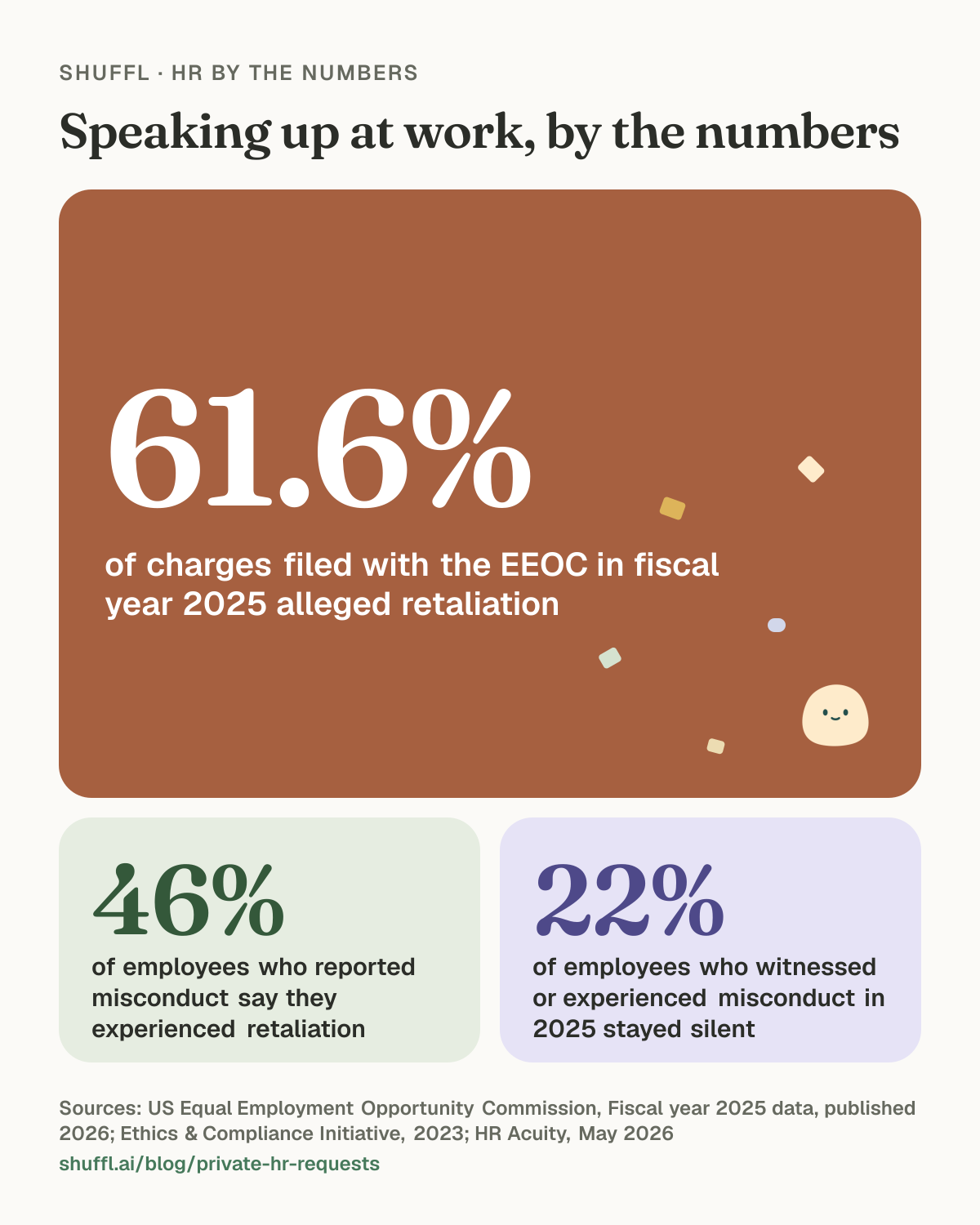
In fiscal year 2025, 54,350 of the 88,201 charges filed with the US Equal Employment Opportunity Commission alleged retaliation, often alongside another claim. That is 61.6% of all charges, more than any other basis.1
Retaliation means punishing someone for asserting their rights, for example after they complained to a manager about harassment or acted as a witness in an investigation, and it only happens once someone knows who spoke up.2 The Ethics & Compliance Initiative’s 2023 survey, which covered employees in 42 countries, found that 72% of employees who observed misconduct reported it, and 46% of those who reported said they experienced retaliation.3
So a private HR request is built to keep the number of people who know small, from the first message to a check-in weeks after it closes. Each part below works the same in a shared mailbox, a ticketing tool or an HR app.
Shuffl · HR by the numbers
Speaking up at work, by the numbers
Speaking up at work, by the numbers. 61.6% of charges filed with the EEOC in fiscal year 2025 alleged retaliation (US Equal Employment Opportunity Commission, Fiscal year 2025 data, published 2026). 46% of employees who reported misconduct say they experienced retaliation (Ethics & Compliance Initiative, 2023). 22% of employees who witnessed or experienced misconduct in 2025 stayed silent (HR Acuity, May 2026).
Name the readers before anyone writes in
Decide who can open each kind of request before the first one arrives. For most topics that is the person who asked and the HR people who handle the topic. For complaints, medical leave and accommodations, make it a named shortlist of one or two people. A manager, an IT admin or an HR colleague who handles payroll gets no access by default.
Then tell the employee who will read their request, by name, before they send it. Someone thinking about raising a concern about their manager needs to know that the manager’s friend in HR won’t see it.
Be exact about what confidential means. HR knows who asked, so the request isn’t anonymous. If a complaint leads to an investigation, the person complained about is usually told it has started. Acas guidance says an investigation should usually be kept confidential, and that it’s important to explain the need for confidentiality to the people involved.5
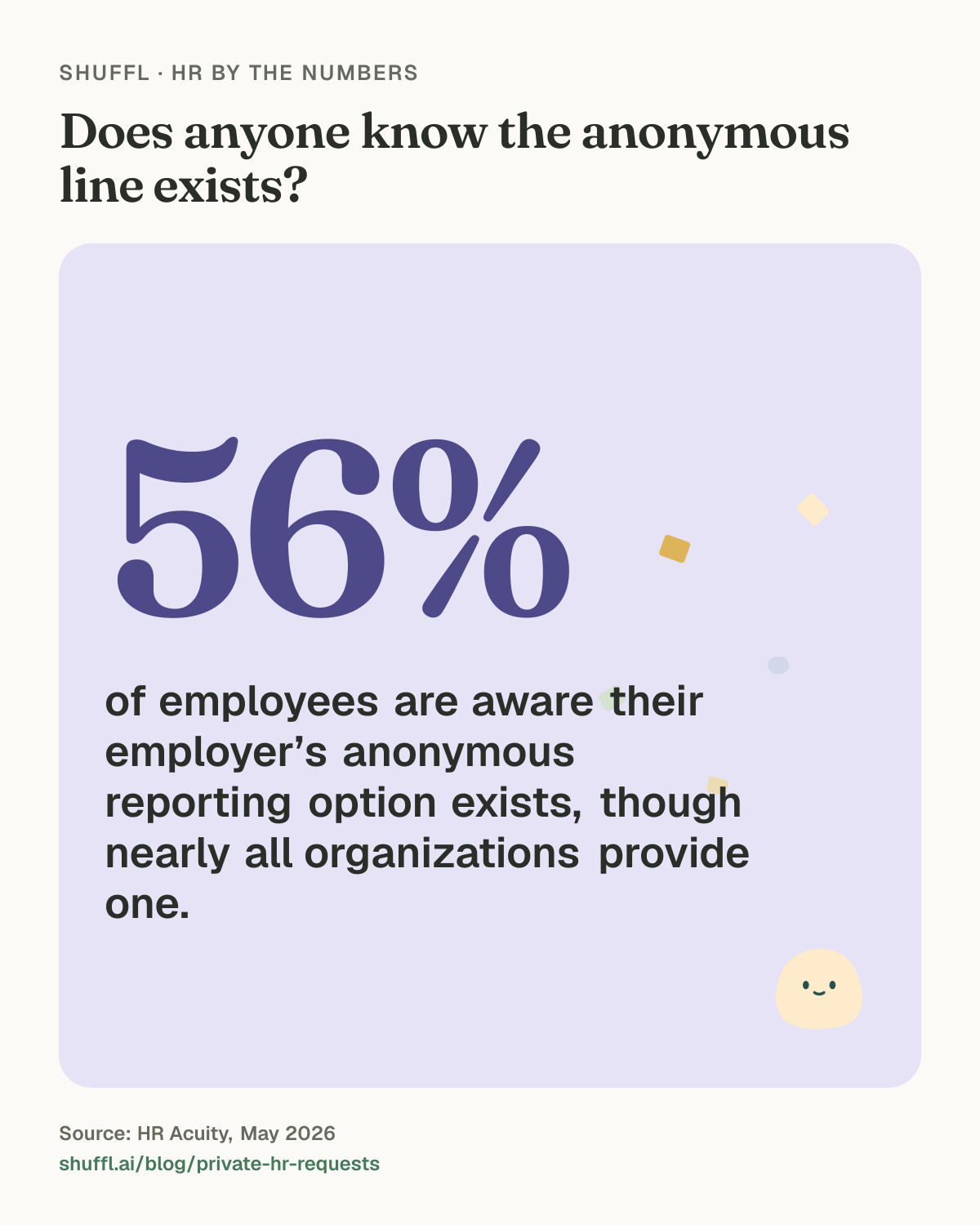
If your company also runs an anonymous line, say so where people ask, and say how it differs. HR Acuity’s 2026 survey of US employees found that nearly all organizations provided anonymous reporting tools, yet only 56% of employees were aware the option existed. Nearly 1 in 4 who witnessed or experienced misconduct in 2025 stayed silent.4
Shuffl · HR by the numbers
Does anyone know the anonymous line exists?
Does anyone know the anonymous line exists?: 56% of employees are aware their employer’s anonymous reporting option exists, though nearly all organizations provide one.. Source: HR Acuity, May 2026.
Write down facts, dates and decisions
The record is how HR shows later that a concern was handled properly, and it’s often read by people it wasn’t written for, from a new HR lead to a tribunal. Acas advises employers to keep a written record of all grievance cases, whatever the outcome, and says that under UK GDPR those records should be confidential and kept only for as long as necessary.6
Keep the record in one place with the same readers as the request, rather than a shared drive folder or a spreadsheet the whole HR team can open. Set how long you keep it, and apply that to every copy, email threads included. Leave out opinions about the people involved, medical detail a decision doesn’t need, and anything pasted from an unrelated chat. What goes in is short and factual:
- Who asked, when, and through which channel.
- What they said, in their own words, and what they asked for.
- Who else was told, when and why.
- Each action HR took, with its date: a reply, a meeting, an investigation opened.
- The outcome, and what the employee was told.
Send each request straight to its owner
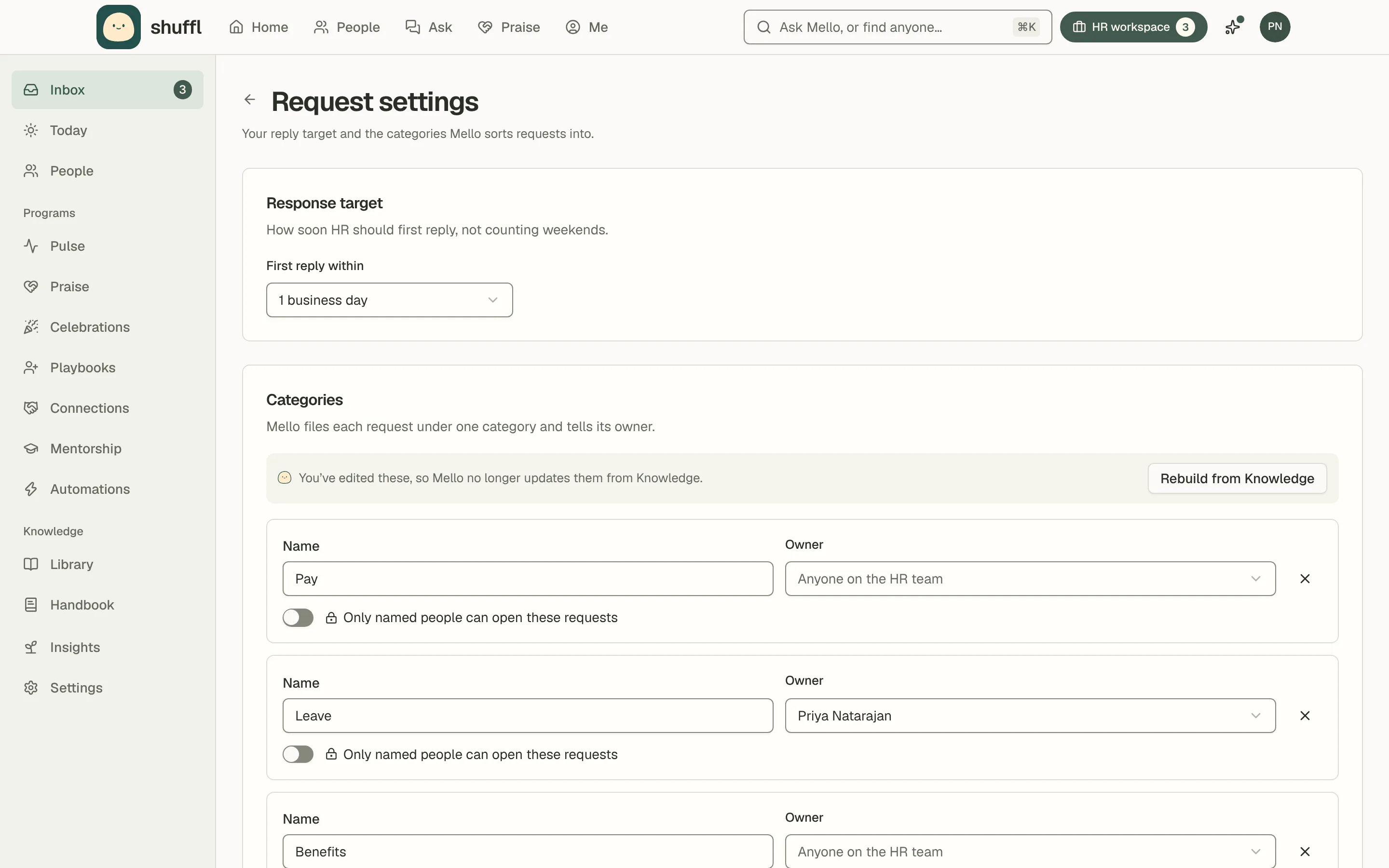
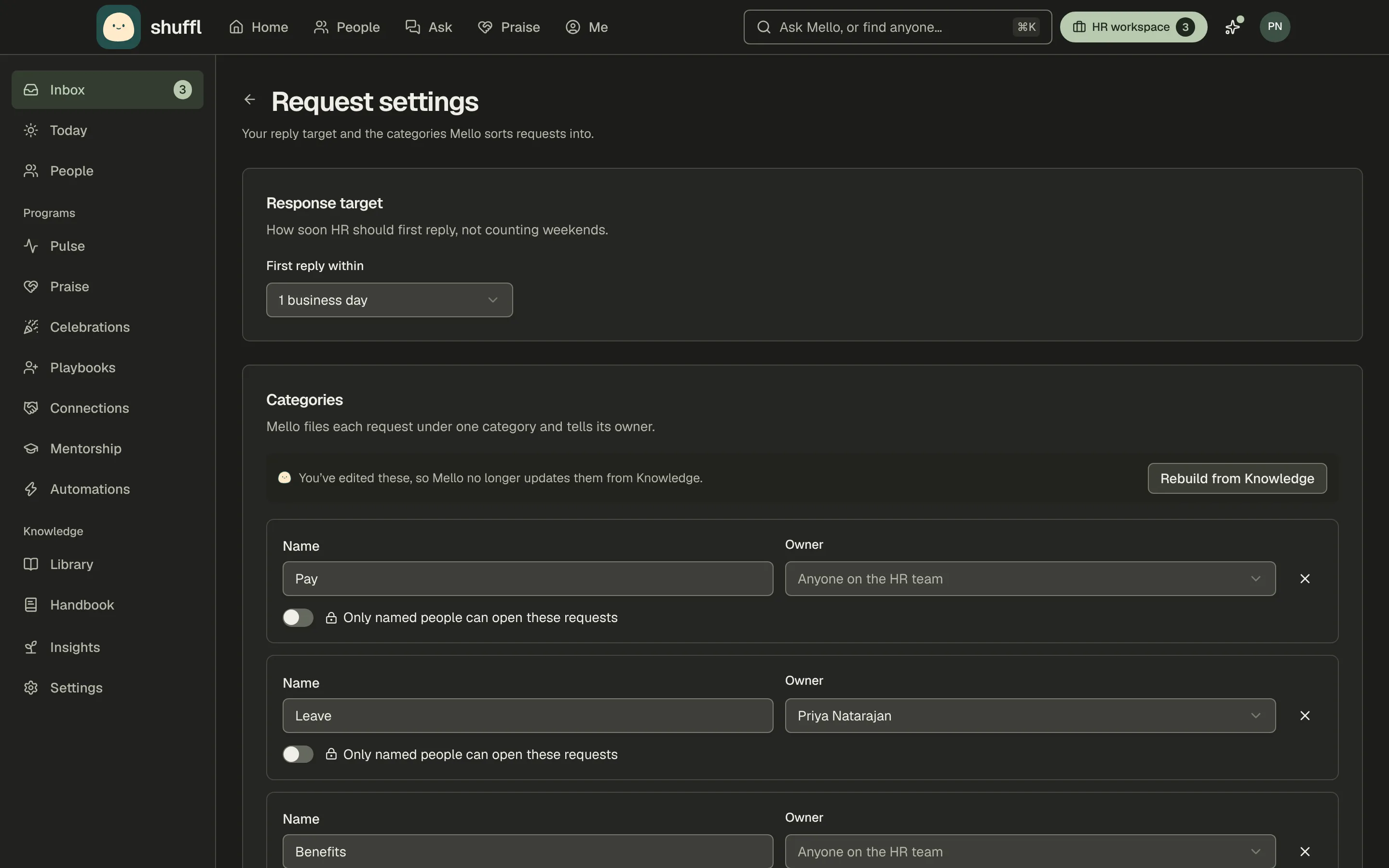
Give every category an owner: pay, leave, benefits, personal details, employee relations. A request goes straight to the owner of its category. The notification about it carries the category and a link, never the employee’s words, because an email preview on a shared screen counts as a reader too.
Check what sits between the employee and the owner. A helpdesk queue that IT agents can also open, or an HR channel where the team triages requests together, adds readers nobody chose. Keep sensitive categories out of both.
Some reports follow their own rules. Under the EU Whistleblowing Directive, internal reporting channels must protect the confidentiality of the reporter’s identity and keep unauthorised staff out, acknowledge a report within seven days, and give feedback within three months.7 In the UK, personal grievances aren’t covered by whistleblowing law unless the case is in the public interest.8 Ask your legal adviser which process applies to which category, and build the routing to match.
Close with an outcome, then check back
Tell the employee what happened, as far as you can, and what they can do if they’re still unhappy. The outcome and its details stay confidential: the employee hears it from HR, and colleagues don’t hear it from HR at all.6
Then put a check-in four to six weeks out. The EEOC lists what retaliation can look like: a performance review lower than it should be, a transfer to a less desirable position, increased scrutiny, false rumors.2 None of that shows up in the request record, so ask the employee directly how things have been.
Keep these out of shared HR channels
A public HR channel suits questions with one answer for everyone, like the holiday calendar or the expense limit. People still post personal matters there, usually because the channel is the quickest place to ask. When a complaint lands in a public HR channel, reply once, move it to a private request, and offer to delete the original. Don’t answer the substance in the thread, even briefly.
Anything about one person belongs in a private request from the start:
Shuffl · Worth quoting
On private HR requests
On private HR requests: “When a complaint lands in a public HR channel, reply once, move it to a private request, and offer to delete the original.”
- A complaint about a manager or colleague, or anything that names the people involved.
- Health, pregnancy, disability, accommodations and medical leave.
- One person’s pay, a pay error or a salary negotiation.
- Visa or immigration status.
- Performance concerns, warnings and investigations, including who was interviewed.
When a complaint lands in a public HR channel, reply once, move it to a private request, and offer to delete the original.
Set up private requests with any tool
Write these down once, and go through them again whenever someone joins or leaves the HR team.
Shuffl · HR by the numbers
A private HR request in six steps
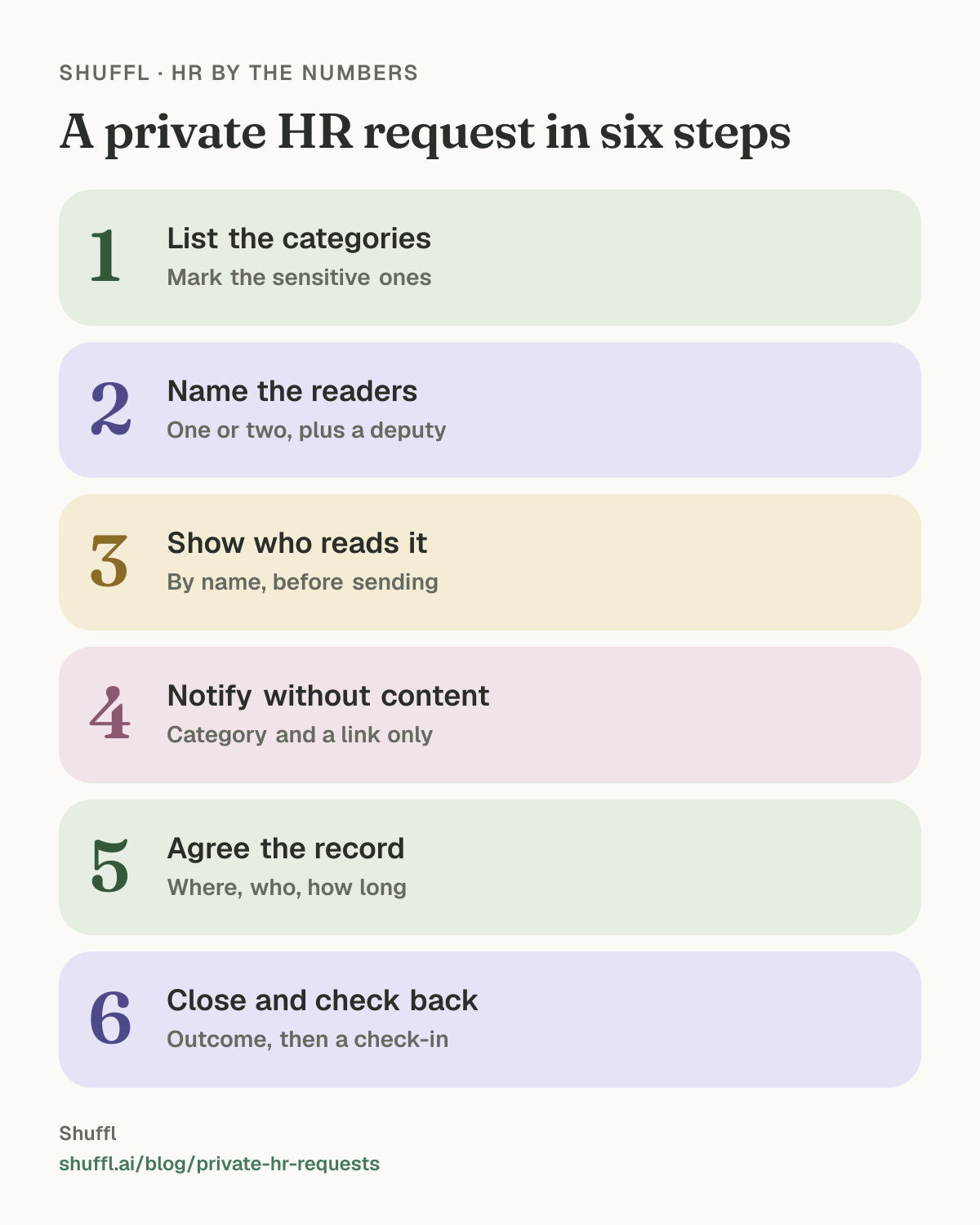
A private HR request in six steps. 1. List the categories: Mark the sensitive ones 2. Name the readers: One or two, plus a deputy 3. Show who reads it: By name, before sending 4. Notify without content: Category and a link only 5. Agree the record: Where, who, how long 6. Close and check back: Outcome, then a check-in
- List your categories. Five or six is enough, such as pay, leave, benefits, letters, personal details and employee relations. Mark the sensitive ones.
- Name the readers for each category. For a sensitive one, name one or two people, plus someone to cover when they’re away.
- Write what the employee sees before they send: who will read the request, by name, and how soon HR usually replies.
- Set a first reply target in working days, and decide what the notification says. The category and a link are enough.
- Agree the record: what HR writes down, where it lives, who can open it and how long it’s kept.
- Close every request with an outcome for the employee and, for sensitive ones, a check-in date a few weeks later.
How this works in Shuffl
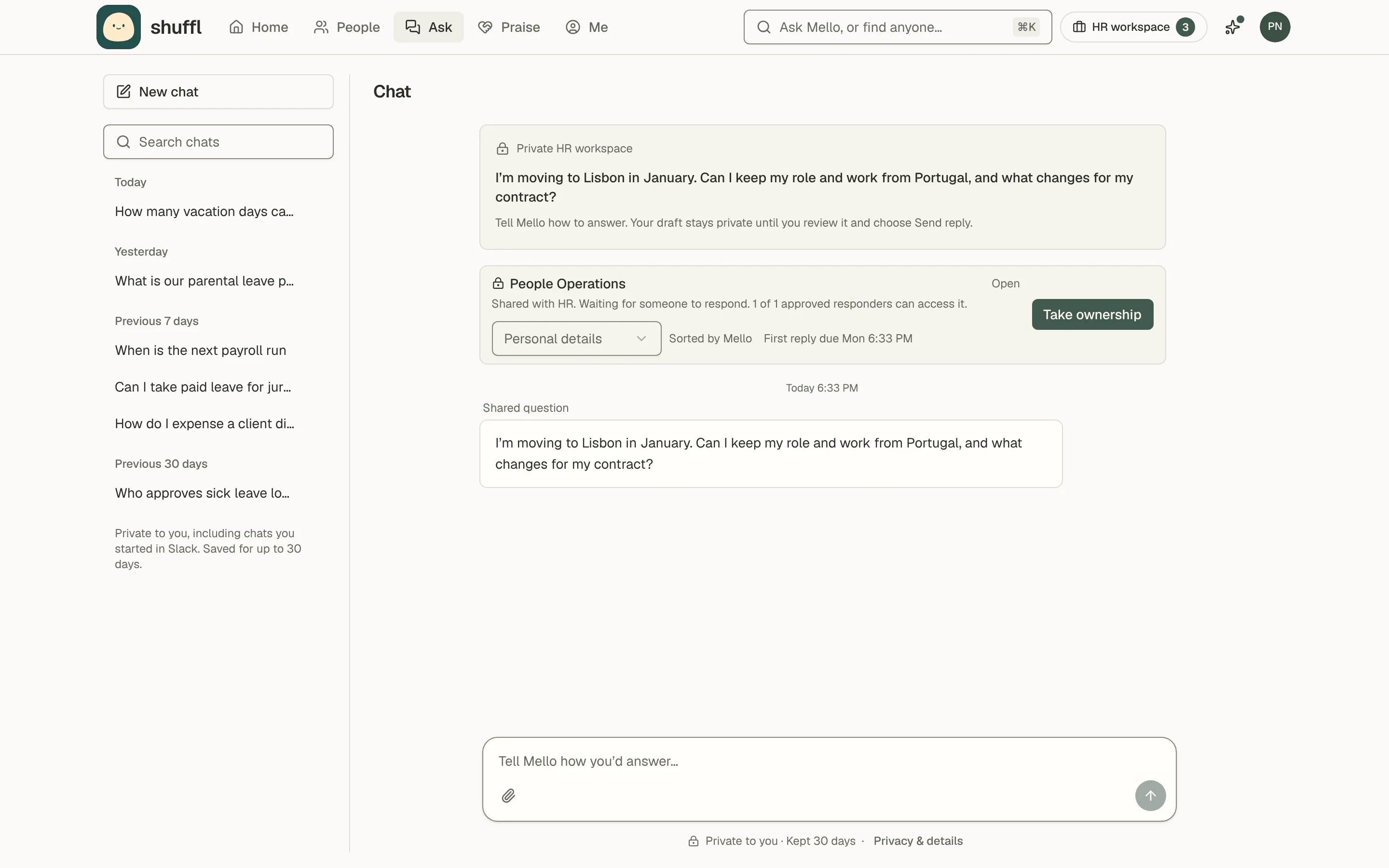
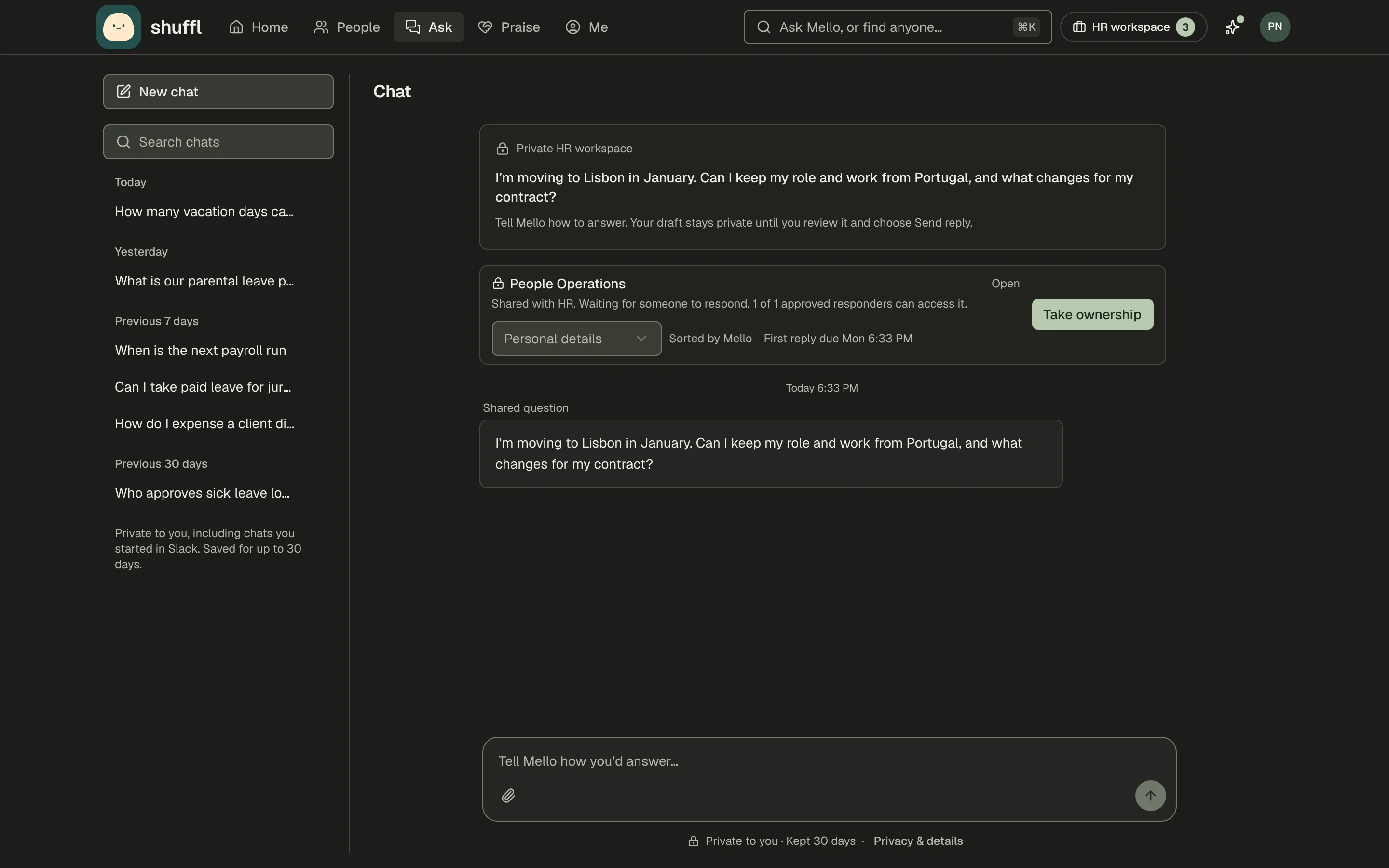
In Shuffl, employees ask Mello, Shuffl’s assistant, in Slack or on the web. When a person needs to help, Mello prepares a short message and names the HR responders who would receive it. The employee can edit the message, and it goes to HR only when they choose to send it. HR sees that message alone, without the conversation around it.
Only the employee and the responders on a request can read it, and being a workspace administrator gives no access. A sensitive category, such as employee relations, opens only for the people HR named; other responders can’t list or open those requests, even with a link. The email that announces a new request leaves out what the employee wrote.
When a category goes to a connected helpdesk such as Zendesk or Jira Service Management, a sensitive one stays in Shuffl until an administrator confirms that everyone with access to that queue may read it. Closing a request records how it was answered, and the company keeps its requests as the record of how each one was handled.
Tell employees who reads their requests
Write the short note employees will see wherever they ask HR: which topics are private, who reads each one by name, and how soon they can expect a reply. Before you post it, check who can read employee relations requests today, including anyone who sees them through a shared inbox, a channel or a helpdesk queue, and make the note true.
Frequently asked questions
Is a confidential HR request the same as an anonymous one?
No. With a confidential request, HR knows who asked and limits who else finds out. An anonymous report hides the name, which also makes it harder for HR to ask follow-up questions.
Can HR keep a complaint completely confidential?
Rarely. An investigation usually means telling the person complained about and speaking to witnesses. HR can promise to share only what the process needs, with only the people who need it, and to say who they are.
How long should HR keep records of employee complaints?
Only as long as you need them, under a retention period your legal adviser agrees. Acas advises a written record of every grievance case, kept confidential and for no longer than necessary.
Should employees raise HR issues in a Slack channel?
General questions with one answer for everyone, yes. Anything about one person, such as a complaint, their health, their pay or their visa, belongs in a private request.
Sources
- US Equal Employment Opportunity Commission, Enforcement and Litigation Statistics, Fiscal year 2025 data, published 2026. Table E1a, Charge Receipts by Basis or Statute (All Statutes), FY 1997 to FY 2025: 88,201 charges filed with the EEOC in fiscal year 2025, 54,350 of them alleging retaliation under any statute. A charge can allege more than one basis. Charges filed with state or local agencies are not included.
- US Equal Employment Opportunity Commission, Retaliation, Undated web page, read November 2026. Agency guidance on protected activity and examples of retaliation. Read November 2026.
- Ethics & Compliance Initiative, The Global Business Ethics Survey, 2023. Survey of employees in 42 countries between August 2022 and January 2023, with 75,495 employee responses in the dataset.
- HR Acuity, 2025 Workplace Harassment and Misconduct Statistics: Four Gaps that Prevent Employees from Speaking Up, May 2026. Survey of 2,043 US employees in January 2026, run with Isurus Market Research and Consulting; margin of error plus or minus 2.1 percentage points.
- Acas, Step 2: Preparing to investigate, Investigations at work, Undated web page, read November 2026. Acas guidance for employers in Great Britain. Read November 2026.
- Acas, Step 6: After the grievance, Formal grievance procedure, Undated web page, read November 2026. Acas guidance for employers in Great Britain. Read November 2026.
- European Parliament and Council of the European Union, Directive (EU) 2019/1937, Article 9, October 23, 2019. Article 9, procedures for internal reporting and follow-up, of Directive (EU) 2019/1937 on the protection of persons who report breaches of Union law, as published on legislation.gov.uk.
- GOV.UK, Whistleblowing for employees, Undated web page, read November 2026. UK government guidance for workers. Read November 2026.

Try Shuffl
Answer your team's HR questions in Slack
Mello answers from the policies HR approves and hands the rest to HR. Free at any company size, with every feature included.