
Onboarding and playbooks
Reorganization communication plan
A plan for a reorganization: managers prepare before the announcement, everyone hears on the day, one-to-ones that week and a check-in.
New playbook. Opens a new playbook with these steps and timings. Each person’s steps wait for your approval before they send.
People judge a reorganization by how they hear about it. Managers who know what changes for each person, before the announcement, turn rumours into conversations.
This plan counts from the announcement date. Managers prepare two days before, everyone hears on the day, and an anonymous check-in follows after two weeks.
Shuffl · HR by the numbers
How change lands

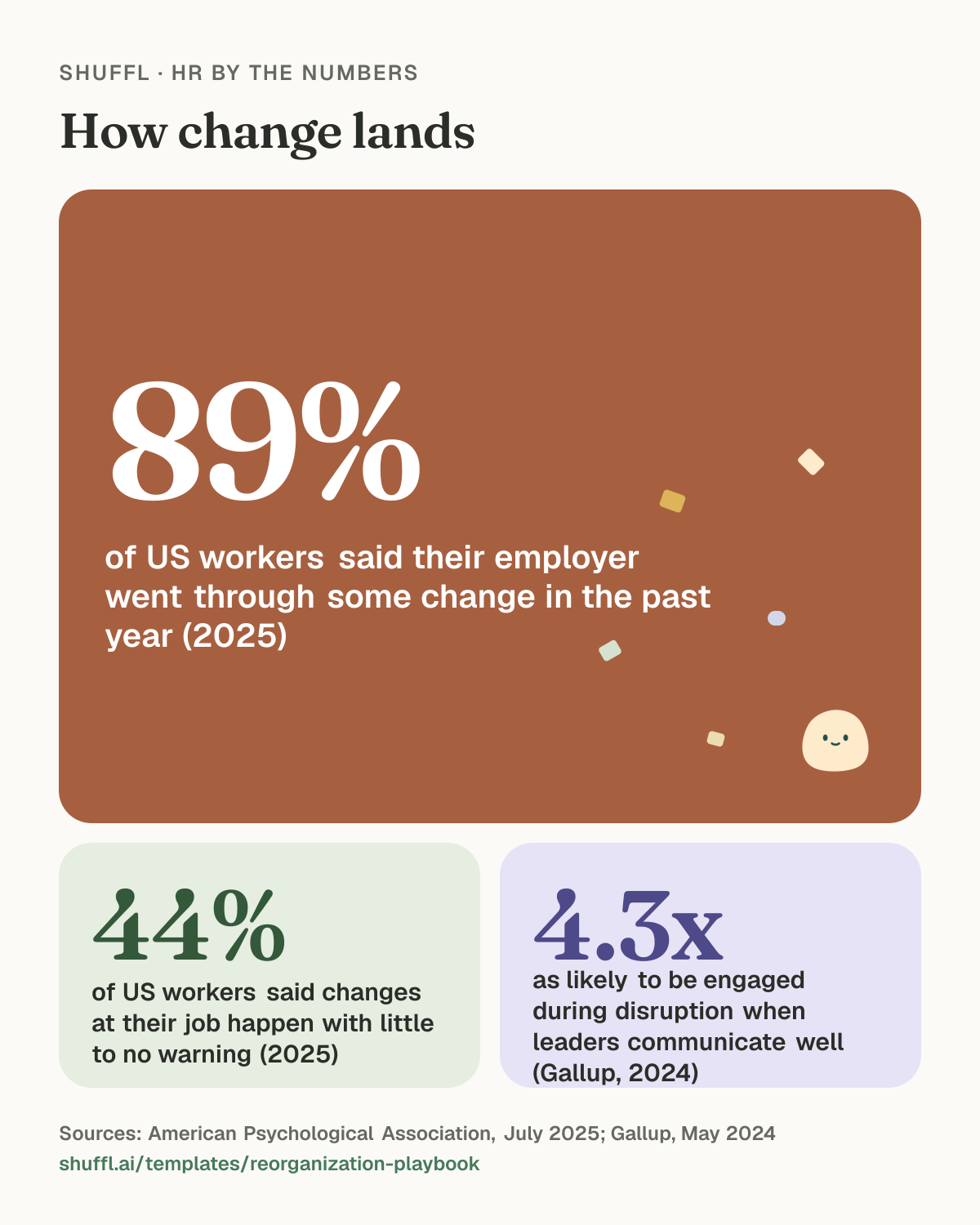
How change lands. 89% of US workers said their employer went through some change in the past year (2025) (American Psychological Association, July 2025). 44% of US workers said changes at their job happen with little to no warning (2025) (American Psychological Association, July 2025). 4.3x as likely to be engaged during disruption when leaders communicate well (Gallup, 2024) (Gallup, May 2024).
Get ready to talk to each person affected about the change
To their manager, 2 days before the date you pick.
**Get ready to talk to {{hire}} about the change**

Your team will hear about the reorganization in two days. Know what changes for each person before they ask.

- [ ] Read the briefing
- [ ] Note what changes for {{hire}}
- [ ] Prepare for the questions they will ask
A change to how we are organized
To each person affected, on the date you pick.
**A change to how we are organized**

Today we shared a change to how the company is organized. {{manager}} will talk to you this week about what it means for you. Ask anything, here or in the conversation.
Talk to each person affected about the change
To their manager, 1 day after the date you pick.
**Talk to {{hire}} about the change**

- [ ] Explain what changes for them, and what does not
- [ ] Answer their questions, or find out
Two weeks after the change
To each person affected, 14 days after the date you pick.
**Two weeks after the change**

Answered anonymously:
- I understand why the change was made.
- I know what it means for my work.
- What is still unclear?
Follow up with each person affected on the change
To their manager, 30 days after the date you pick.
**Follow up with {{hire}} on the change**

- [ ] Ask what is still unclear or not working
How to adapt it
- Shuffl fills in {{hire}} and {{manager}} for each person. Replace them by hand if you send the message yourself.
- Brief managers before anyone else, with what changes for each person.
- Share what the check-in found, and what you will do about it.
What the research says
Change is now routine. In APA’s 2025 survey, 89% of US workers said their organization had gone through at least some change in the past year.1 Gallup found seven in 10 US workers reported disruptive change in the past year.2
How it is told matters. 44% of workers said changes happen with little to no warning, and they were far more likely to say their work environment harms their mental health (52% vs. 17%).1 In significant disruption, employees who strongly agreed their leaders communicate effectively were 4.3 times as likely to be engaged.2
Common mistakes
- Letting people hear it before their manager can explain it.
- Announcing without knowing what changes for each person.
- Asking once and never again how people are doing.
- Keeping what the check-in found from the people who answered.
Common questions
- How should you announce a reorganization?
- Brief managers first, with what changes for each person on their team. Announce it to everyone on one day, then have each manager talk to each person that week.
- Why do people resist change at work?
- Most often because they don’t understand the reason, can’t see what it means for them, or feel they had no say. Surprises make it worse.
- How do you know if the change is landing?
- Ask a few anonymous questions a couple of weeks after the announcement: whether people understand why, and know what it means for their work. Compare affected teams with the rest.
Sources
Read on . Numbers change as new studies come out, so check the source before you quote it.
- American Psychological Association, 2025 Work in America Survey: The Experience of Working in America During Times of Change, July 2025. Online survey by The Harris Poll of 2,017 employed U.S. adults, March 26 to April 4, 2025. Weighted; ±3.2 points at 95% confidence.
- Gallup, Disruptive Change Is Hitting Leaders and Managers Hardest, May 2024. Gallup Panel web surveys of U.S. employees in Q1 to Q3 2023, about 18,700 per wave (Q3: 18,665). Margin of error ±1.1 points at 95% confidence.