
Onboarding and playbooks
Open enrollment reminders
Messages for benefits open enrollment: what changed and the deadline on the first day, a reminder after a week and a last call before it closes.
New playbook. Opens a new playbook with these steps and timings. Each person’s steps wait for your approval before they send.
Most benefit changes happen once a year, in a window people forget. Three short messages, timed to the window, cover most questions before they reach HR.
This plan counts from the day enrollment opens, for a two-week window. Move the last call to the day before your window closes.
Shuffl · HR by the numbers
One window a year

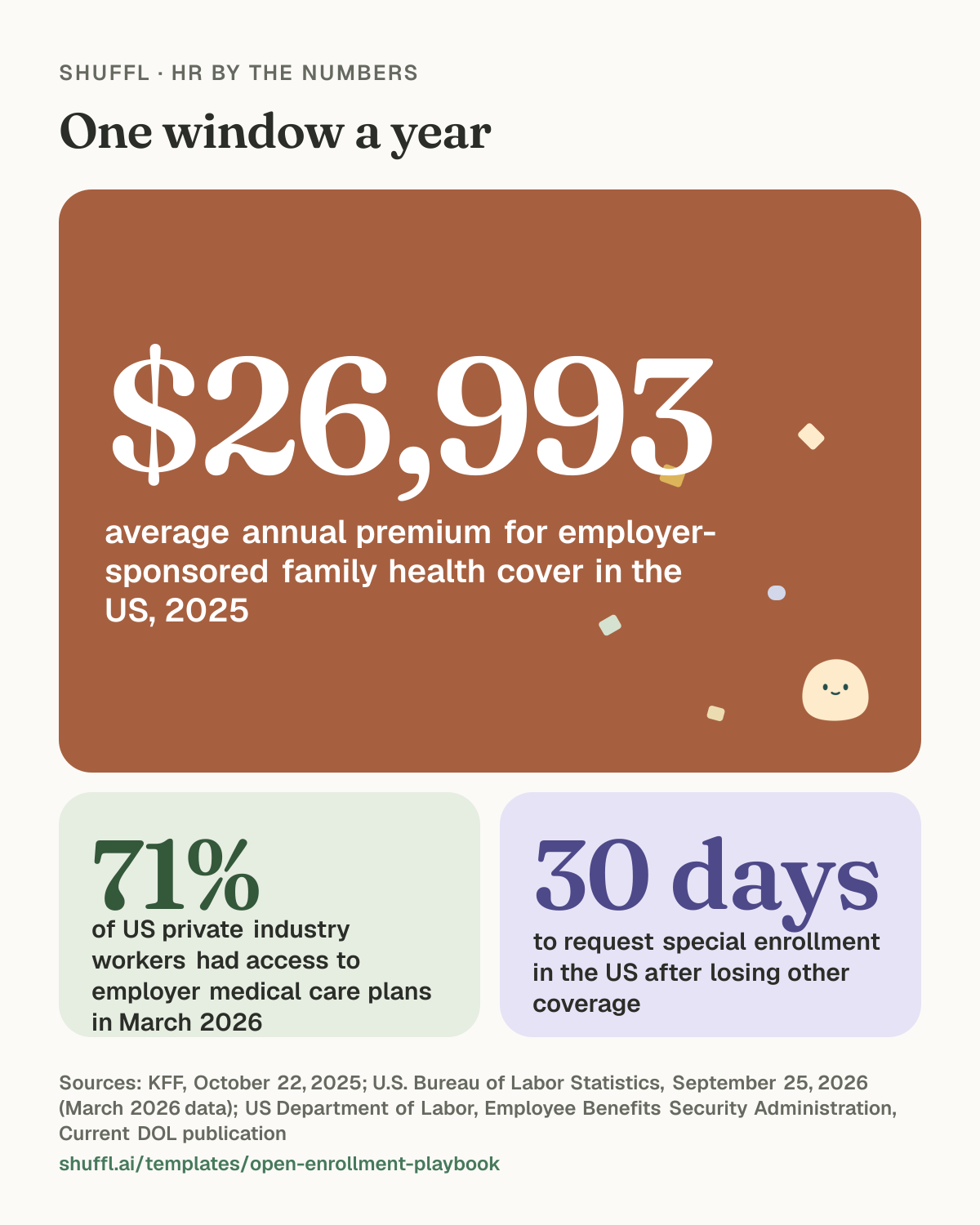
One window a year. $26,993 average annual premium for employer-sponsored family health cover in the US, 2025 (KFF, October 22, 2025). 71% of US private industry workers had access to employer medical care plans in March 2026 (U.S. Bureau of Labor Statistics, September 25, 2026 (March 2026 data)). 30 days to request special enrollment in the US after losing other coverage (US Department of Labor, Employee Benefits Security Administration, Current DOL publication).
Open enrollment is open, each person
To each person, on the date you pick.
**Open enrollment is open, {{hire}}**

For the next two weeks you can change your benefits for next year. Check what changed, then confirm or change your choices before the deadline.

- [ ] Read what changed this year
- [ ] Confirm or change your benefits
One week left to choose your benefits
To each person, 7 days after the date you pick.
**One week left to choose your benefits**

If you have already chosen, there is nothing more to do. Questions go to HR.
Open enrollment closes tomorrow
To each person, 13 days after the date you pick.
**Open enrollment closes tomorrow**

After tomorrow, most changes wait until next year or a qualifying life event.

- [ ] Confirm your benefits today
How to adapt it
- Shuffl fills in {{hire}} and {{manager}} for each person. Replace them by hand if you send the message yourself.
- Say what changed this year in the first message, in plain words.
- Link the plan documents, so the messages never replace them.
What the research says
For most people, open enrollment is mainly a health insurance decision. KFF’s 2025 survey found average annual premiums of $9,325 for single coverage and $26,993 for family coverage, and workers paid an average of $6,850 toward family coverage.1
Access isn’t the same as use. In March 2026, 71% of US private industry workers had access to medical care plans, but 46% took part.2 Some of the gap is people covered elsewhere, and some is people who never understood the offer.
What the law requires
In the US, federal special enrollment rules let employees join a group health plan midyear after losing other coverage, marriage, birth, adoption or placement for adoption. After a loss of coverage, the employee must request enrollment within 30 days.3
Common mistakes
- Sending one message and hoping it is read.
- Not saying what happens if someone does nothing.
- Leaving out what changed since last year.
- Replacing the plan documents with a summary.
Common questions
- What should an open enrollment message include?
- What changed this year, the deadline, what happens if someone does nothing, and where to find the plan documents and ask questions.
- Can employees change benefits outside open enrollment?
- In the US, special enrollment rules let employees join a group health plan midyear after events like losing other coverage, marriage, birth or adoption. After a loss of coverage, they must ask within 30 days.
- How many reminders should you send?
- Three works for most windows: one when it opens, one halfway and a last call the day before it closes.
Sources
Read on . Laws change, so check the source before you act. This page is general information, not legal advice.
- KFF, 2025 Employer Health Benefits Survey, October 22, 2025. 1,862 interviews with non-federal public and private employers with 10 or more workers, fielded January to July 2025.
- U.S. Bureau of Labor Statistics, Employee Benefits in the United States Summary, September 25, 2026 (March 2026 data). National Compensation Survey; about 16,020 sampled establishments in private industry and state and local government.
- US Department of Labor, Employee Benefits Security Administration, Retirement and Health Care Coverage: Questions and Answers for Dislocated Workers, Current DOL publication. Federal regulator guidance on special enrollment rights in group health plans.