
Onboarding and playbooks
Quarterly goal setting plan
A plan for a quarter’s goals: everyone drafts two or three, agrees them with their manager, updates them mid-quarter and closes them out.
New playbook. Opens a new playbook with these steps and timings. Each person’s steps wait for your approval before they send.
Goals set in a meeting and never seen again do little. A draft, an agreement, a midpoint and a close turn them into a habit.
This plan counts from the first day of the quarter, for everyone you add. Each person drafts, their manager agrees, and both look again halfway through.
Shuffl · HR by the numbers
Goals people own

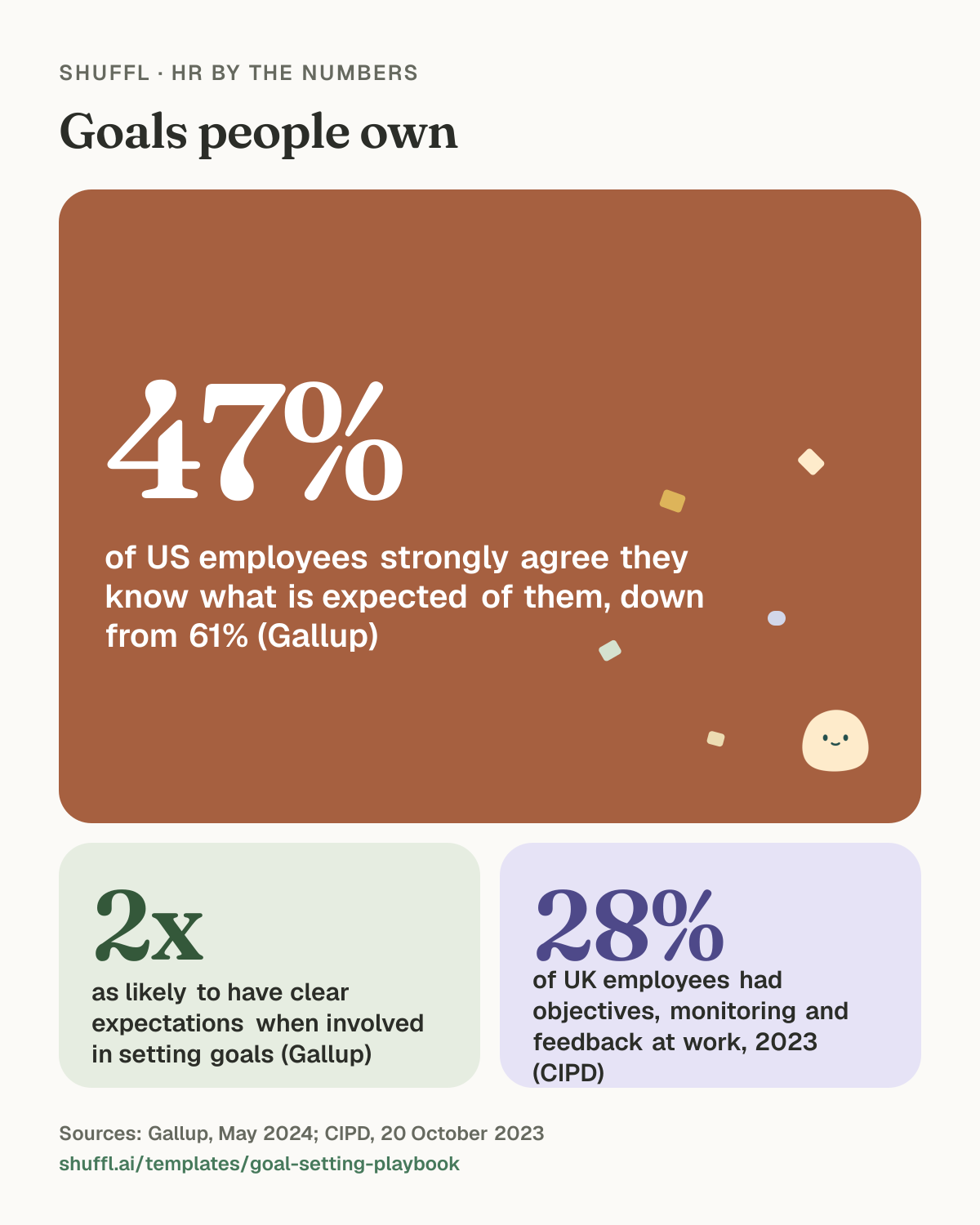
Goals people own. 47% of US employees strongly agree they know what is expected of them, down from 61% (Gallup) (Gallup, May 2024). 2x as likely to have clear expectations when involved in setting goals (Gallup) (Gallup, May 2024). 28% of UK employees had objectives, monitoring and feedback at work, 2023 (CIPD) (CIPD, 20 October 2023).
Draft your goals for the quarter
To each person, on the date you pick.
**Draft your goals for the quarter**

Two or three goals you can finish this quarter, each tied to something your team is working toward.

- [ ] Write two or three goals
- [ ] Link each to a team goal
Agree goals with each person
To their manager, 5 days after the date you pick.
**Agree goals with {{hire}}**

- [ ] Read their draft
- [ ] Agree the goals and how you will know they are done
Halfway through the quarter
To each person, 45 days after the date you pick.
**Halfway through the quarter**

A quick look at your goals now leaves time to change course, or to change a goal that no longer makes sense.

- [ ] Update progress on each goal
Mid-quarter check with each person
To their manager, 45 days after the date you pick.
**Mid-quarter check with {{hire}}**

- [ ] Ask what is in the way
Close out each person’s goals
To their manager, 85 days after the date you pick.
**Close out {{hire}}’s goals**

- [ ] Note which goals were met
- [ ] Start the next quarter’s draft
How to adapt it
- Shuffl fills in {{hire}} and {{manager}} for each person. Replace them by hand if you send the message yourself.
- Keep it to two or three goals each, linked to a team goal.
- Let people change a goal at the midpoint when the work changed.
What the research says
Clear expectations are in short supply. In a 2023 Gallup panel of 18,665 US employees, only 47% strongly agreed they know what is expected of them at work, down from 61% in 2015. Employees actively involved in setting their goals are two times as likely to have clear expectations.1
Goals need follow-through. The CIPD found 48% of UK workers had specific objectives, but only 28% had objectives, monitoring, feedback and accountability together.2
Common mistakes
- Handing down goals no one helped write.
- Setting goals and never looking at them again until the review.
- Too many goals, so none of them gets attention.
- Refusing to change a goal when the work changed.
Common questions
- How many goals should each person have?
- Two or three for a quarter is plenty. Each should be something they can finish, tied to a team goal.
- Should employees write their own goals?
- Yes, then agree them with their manager. Gallup found employees actively involved in setting their goals are two times as likely to have clear expectations.
- What is the difference between goals and OKRs?
- OKRs pair an objective with two to five measurable key results and are meant to be ambitious. Plain goals can be simpler. Either works when they are written, agreed and revisited.
Sources
Read on . Numbers change as new studies come out, so check the source before you quote it.
- Gallup, 2% of CHROs Think Their Performance Management System Works, May 2024. Gallup CHRO Roundtable survey of 135 Fortune 500 CHROs (June 26 to July 8, 2023) and Gallup Panel study of 18,665 US full- and part-time employees (August 9 to 24, 2023), margin of error ±1.1 points at 95% confidence.
- CIPD, Impact of performance management on employees, 20 October 2023. Analysis by Mark Beatson of the CIPD Good Work Index 2023 survey of about 5,000 UK workers, run with YouGov; employees only.