
Onboarding and playbooks
Performance review cycle plan
A plan for a review cycle: self-reviews, manager reviews, calibration and the conversation, each with a deadline, then a check-in on fairness.
New playbook. Opens a new playbook with these steps and timings. Each person’s steps wait for your approval before they send.
A review cycle is a run of deadlines across the whole company. When each step reaches the right person on the right day, HR spends less time chasing.
This plan counts from the day the cycle opens. Each person writes a self-review, their manager reviews and calibrates, and an anonymous check-in asks whether it was fair.
Shuffl · HR by the numbers
Reviews people trust

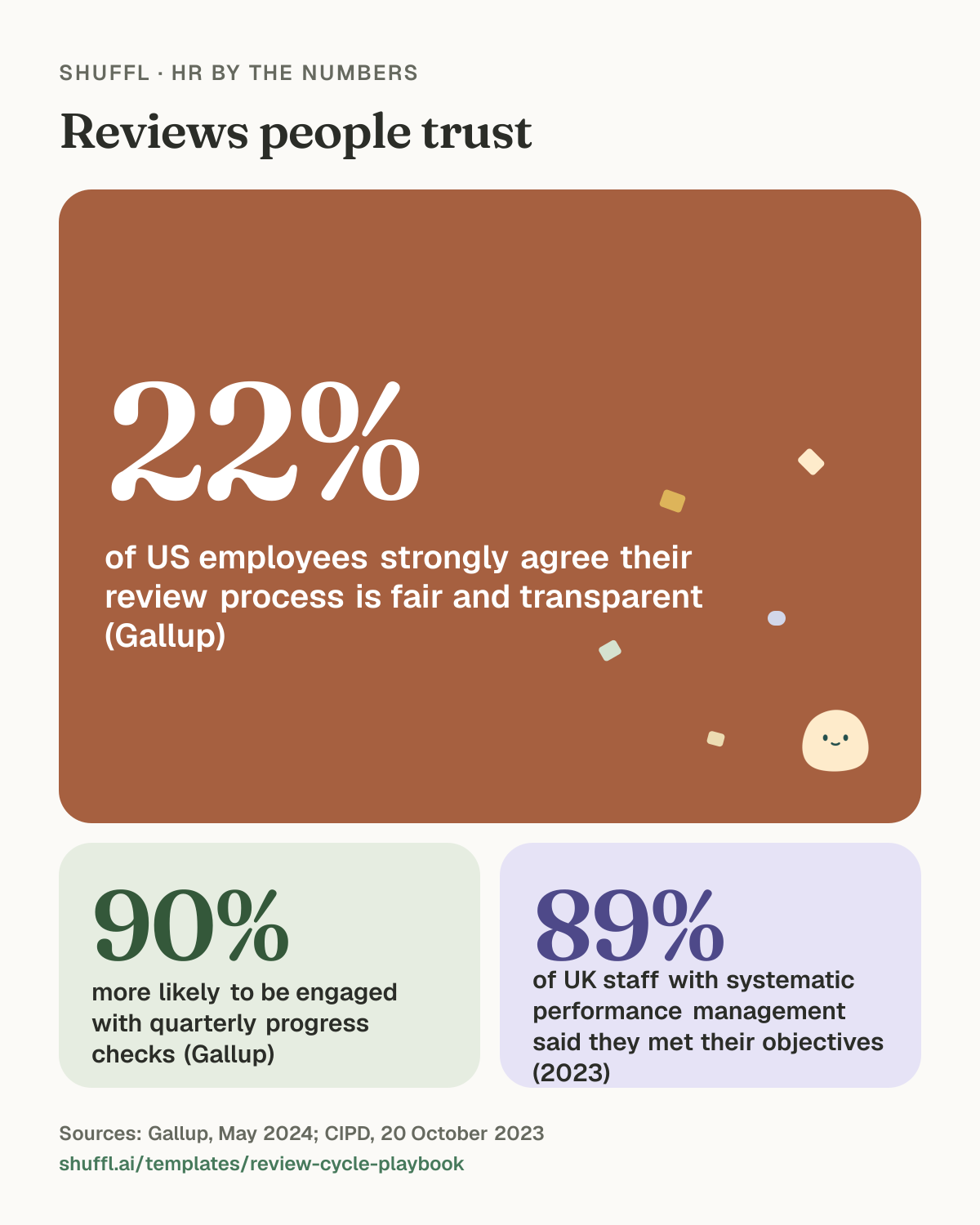
Reviews people trust. 22% of US employees strongly agree their review process is fair and transparent (Gallup) (Gallup, May 2024). 90% more likely to be engaged with quarterly progress checks (Gallup) (Gallup, May 2024). 89% of UK staff with systematic performance management said they met their objectives (2023) (CIPD, 20 October 2023).
Reviews have started: write your self-review
To each person, on the date you pick.
**Reviews have started: write your self-review**

Your self-review is due in a week. Specific examples help {{manager}} more than adjectives.

- [ ] List what you achieved, with examples
- [ ] Name one thing you want to grow in
Your self-review is due in two days
To each person, 5 days after the date you pick.
**Your self-review is due in two days**

If you have already sent it, there is nothing more to do.
Write each person’s review
To their manager, 7 days after the date you pick.
**Write {{hire}}’s review**

- [ ] Read their self-review
- [ ] Write the review with examples
- [ ] Propose a rating against the expectations for their level
Bring each person’s review to calibration
To their manager, 14 days after the date you pick.
**Bring {{hire}}’s review to calibration**

Calibration compares proposed ratings across teams, so the same work gets the same rating whoever the manager is.
Hold each person’s review conversation
To their manager, 21 days after the date you pick.
**Hold {{hire}}’s review conversation**

- [ ] Share the review and rating
- [ ] Agree goals for the next period
How was your review?
To each person, 28 days after the date you pick.
**How was your review?**

Answered anonymously:
- My review was fair.
- I know what to work on next.
- What would make reviews more useful?
How to adapt it
- Shuffl fills in {{hire}} and {{manager}} for each person. Replace them by hand if you send the message yourself.
- Write the expectations for each level down before the cycle opens.
- Hold calibration before any rating is shared.
What the research says
Few people trust their reviews. Gallup found only 2% of Fortune 500 CHROs strongly agreed their performance management system inspires employees to improve, and just 22% of US employees strongly agree their review process is fair and transparent.1
Frequency helps. In the same research, employees with quarterly progress checks were 90% more likely to be engaged and 2.1 times as likely to feel the process was fair and transparent.1 The CIPD found UK staff with systematic performance management were more likely to say they meet their objectives (89% against 76%).2
Common mistakes
- Saving all feedback for the review, so the rating is a surprise.
- Sharing ratings before calibration.
- Rating against vague traits instead of written expectations.
- Never asking people whether the process felt fair.
Common questions
- What are the steps of a performance review cycle?
- Usually a self-review, a manager review, calibration across teams, and a conversation where the review is shared and new goals are agreed.
- What is calibration?
- A meeting where managers compare proposed ratings across teams before they are final, so the same work gets the same rating whoever the manager is.
- How often should reviews happen?
- Many companies hold a formal review once or twice a year. Gallup found employees with quarterly progress checks were 90% more likely to be engaged.
Sources
Read on . Numbers change as new studies come out, so check the source before you quote it.
- Gallup, 2% of CHROs Think Their Performance Management System Works, May 2024. Gallup CHRO Roundtable survey of 135 Fortune 500 CHROs (June 26 to July 8, 2023) and Gallup Panel study of 18,665 US full- and part-time employees (August 9 to 24, 2023), margin of error ±1.1 points at 95% confidence.
- CIPD, Impact of performance management on employees, 20 October 2023. Analysis by Mark Beatson of the CIPD Good Work Index 2023 survey of about 5,000 UK workers, run with YouGov; employees only.