
Onboarding and playbooks
New hire first-week checklist
What to do before day one, on day one and by the end of the first week, so a new hire is set up and knows who to ask.
Playbooks, in the HR workspace. Add each line as a to-do step in an onboarding playbook. Each hire, manager or buddy gets their to-dos on their checklist and Home, with the messages and check-ins, after you approve them.
A short list for HR and the hiring manager to share. It covers setup, introductions and the first conversations.
Most of it happens before the start date. A hire whose laptop, accounts and buddy are ready on day one can spend the week meeting people instead of waiting.
Shuffl · HR by the numbers
Most onboarding falls short

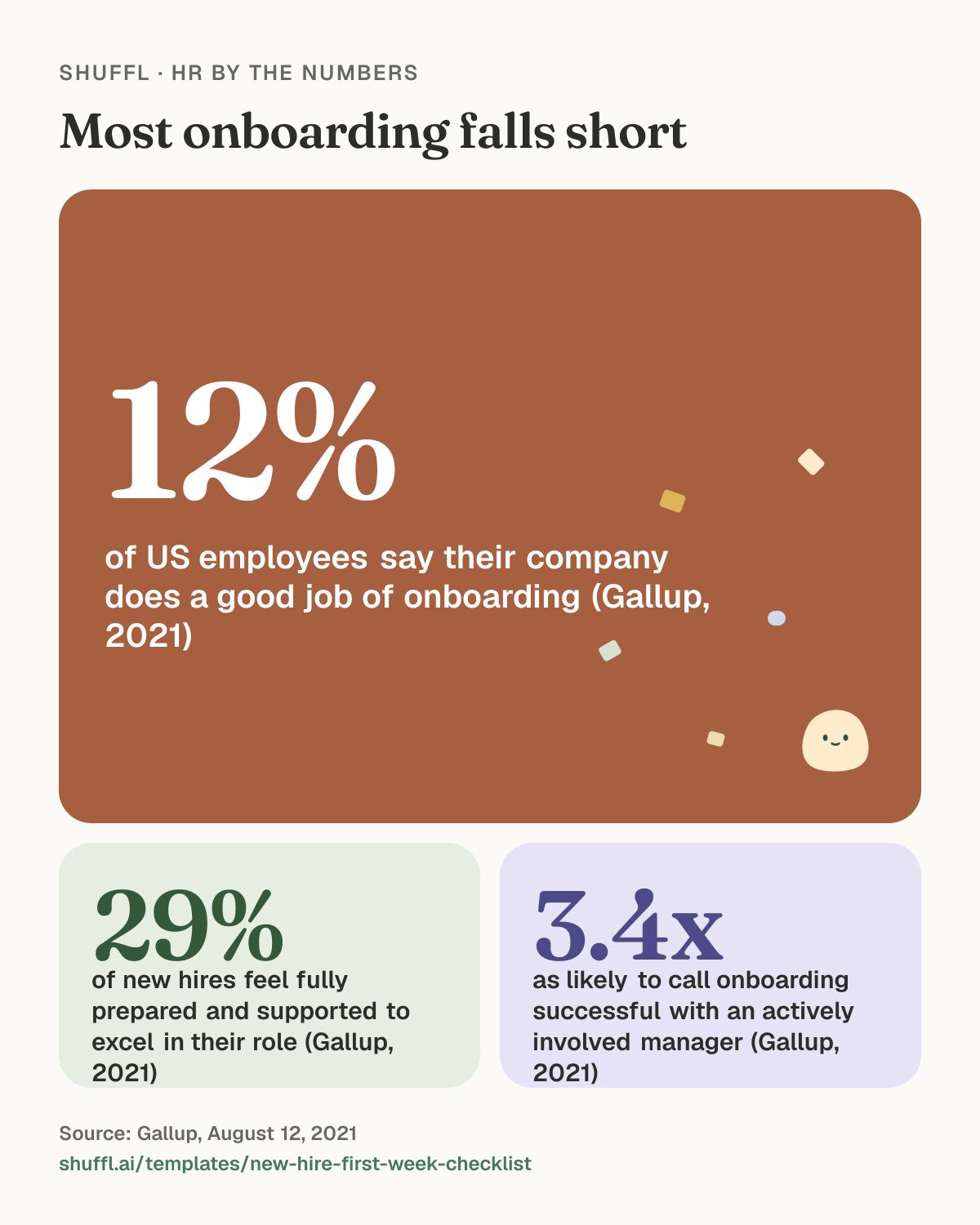
Most onboarding falls short. 12% of US employees say their company does a good job of onboarding (Gallup, 2021) (Gallup, August 12, 2021). 29% of new hires feel fully prepared and supported to excel in their role (Gallup, 2021) (Gallup, August 12, 2021). 3.4x as likely to call onboarding successful with an actively involved manager (Gallup, 2021) (Gallup, August 12, 2021).
First-week checklist
Copy it into your onboarding doc or task tool and add your own steps.
# New hire first-week checklist

## Before day one
- [ ] Send the offer details, start date, start time and where to go
- [ ] Order their laptop and any other equipment
- [ ] Create their accounts: email, chat, HR system and the tools their role needs
- [ ] Ask someone to be their buddy, and tell their team who is joining
- [ ] Put a welcome meeting and a first one-on-one with their manager in the calendar

## Day one
- [ ] Welcome them in person or on a video call at the start of the day
- [ ] Check that every login works
- [ ] Introduce them to their team and their buddy
- [ ] Show them where policies live and who to ask about HR, IT and pay
- [ ] Complete the paperwork your country requires

## By the end of week one
- [ ] Agree what they will work on in their first month
- [ ] Have at least one coffee or call with their buddy
- [ ] Meet the people they will work with most, outside their own team too
- [ ] Ask how the week went, and fix anything that is stuck
How to adapt it
- Give each line an owner: HR, IT, the manager or the buddy.
- Add the steps that are specific to your company, like security training or a team handbook.
- Keep the same list for every hire, and improve it when a new hire tells you what was missing.
What the research says
Most people don’t rate their onboarding highly. Only 12% of US employees say their company does a good job of onboarding, and nearly one in five say their most recent onboarding was poor or that they had none.1
It shows in how ready people feel. Only 29% of new hires say they feel fully prepared and supported to excel in their role. Employees with exceptional onboarding are 2.6 times as likely to be extremely satisfied with their workplace.1
The manager makes the biggest difference. When managers take an active role, employees are 3.4 times as likely to feel their onboarding was successful. Gallup also finds new employees typically take around 12 months to reach their peak performance, so the first week is a start, not the whole job.1
Common mistakes
- Filling day one with forms and slides. Save some of it for later in the week and start with people.
- Handing the whole week to HR. The first one-on-one and first-month goals need the manager.
- Showing every system and policy at once. Spread it out so people remember what matters.
- Waiting for questions. New hires often don’t know what to ask, so schedule the conversations.
- Leaving paperwork until it’s overdue. In the US, Form I-9 Section 2 is due within 3 business days of the hire date.2 In the UK, right to work checks come before employment starts,3 and the principal written statement on day one.4
Common questions
- What paperwork is legally required in a new hire’s first week?
- In the US, employers must complete Section 2 of Form I-9 within 3 business days of the hire date. In the UK, you must check right to work before employment starts and give the principal written statement of employment particulars on the first day. Check the rules for each country you hire in.
- How long should onboarding last?
- Longer than a week. Gallup finds new employees typically take around 12 months to reach peak performance, so plan regular check-ins through at least the first few months, with the first week focused on setup and people.
- Who should own the new hire checklist?
- Usually HR owns the list and the hiring manager owns the experience. Give each step a named owner, such as IT for equipment, the manager for goals and the buddy for introductions, so nothing falls between them.
Sources
Read on . Numbers change as new studies come out, so check the source before you quote it.
- Gallup, 8 Practical Tips for Leaders for a Better Onboarding Process, August 12, 2021. By Emily Wetherell and Bailey Nelson, drawing on Gallup research with U.S. employees.
- U.S. Citizenship and Immigration Services, Completing Section 2, Employer Review and Attestation, No date stated; read October 2026.
- GOV.UK, Checking a job applicant’s right to work, No date stated; read October 2026.
- GOV.UK, Employment contracts: Written statement of employment particulars, No date stated; read October 2026.