
Onboarding and playbooks
Intern and early-career onboarding messages
Onboarding messages for interns and early-career hires, with a buddy and an early check-in.
New onboarding program. Opens a new onboarding program with these messages and timings. Every hire’s messages wait for your approval before they send.
People early in their career often have small questions they won’t ask a manager. A buddy gives them someone to ask.
These messages check in after the first few days, earlier than for experienced hires.
Shuffl · HR by the numbers
Early impressions shape early careers

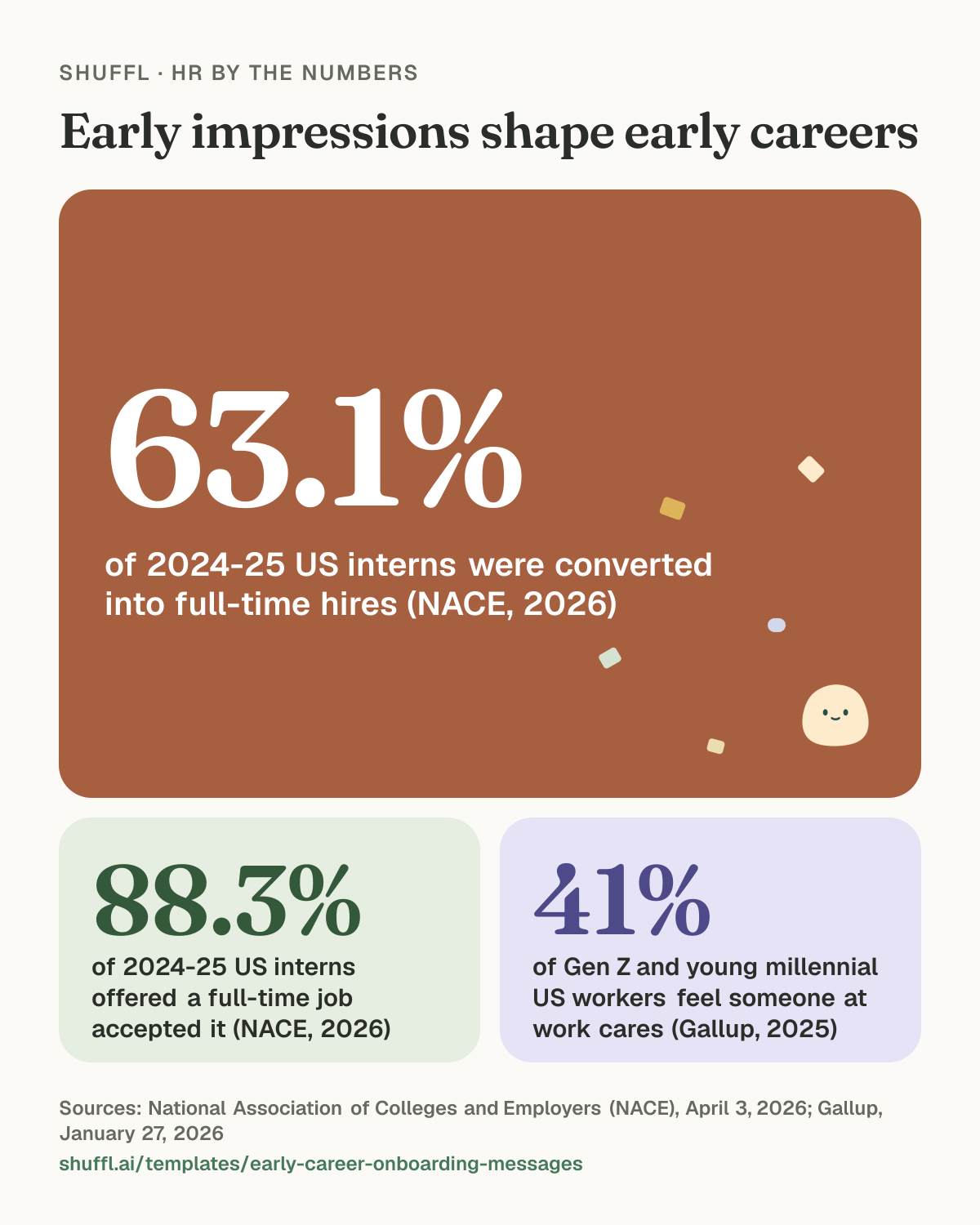
Early impressions shape early careers. 63.1% of 2024-25 US interns were converted into full-time hires (NACE, 2026) (National Association of Colleges and Employers (NACE), April 3, 2026). 88.3% of 2024-25 US interns offered a full-time job accepted it (NACE, 2026) (National Association of Colleges and Employers (NACE), April 3, 2026). 41% of Gen Z and young millennial US workers feel someone at work cares (Gallup, 2025) (Gallup, January 27, 2026).
Asking someone to be a buddy
To the person you ask to be a buddy, 5 days before the start date.
**Would you be {{hire}}’s buddy?** 👋

{{hire}} joins on {{start_date}}, early in their career. A buddy answers the small questions they might not ask a manager. About an hour a week while they settle in.
Introducing the hire and their buddy
To the new hire and their buddy together, on the start date.
**Meet your buddy** 👋

{{hire}} starts on {{start_date}}. {{buddy}} is their buddy: someone to ask anything, from tools to where lunch is. Say hello on day one.
Checking in with the new hire
To the new hire, 5 days after the start date.
**How are your first days going, {{hire}}?**

No question is too small. If anything is stuck, say so and a named person from HR will follow up with you directly.
How to adapt it
- Shuffl fills in {{hire}}, {{buddy}} and {{start_date}} for each new hire. Replace them by hand if you send the message yourself.
- Ask the buddy before the start date, so they have time to say no.
- Name a real person in the check-in, so the new hire knows who will follow up.
What the research says
Internships are a real hiring channel. Employers surveyed by NACE converted 63.1% of their 2024-25 interns into full-time hires, and 88.3% of interns offered a job accepted, up from 82.8% the year before.1
Those hires tend to stay. More than three-quarters of new hires who interned with the employer are still there after a year, compared with less than half of hires with no internship experience.2
Younger employees feel less cared for than they used to. In 2025, 41% of Gen Z and younger millennial employees strongly agreed that their supervisor or someone at work cares about them as a person, down from 54% in 2020, and their engagement fell eight points over the same period.3 A buddy and an early check-in are simple ways to close that gap.
Common mistakes
- Assuming they know workplace basics, like how to book a meeting or how fast to reply. Spell them out.
- Saving all feedback for the end of the internship. Give some every week.
- Handing out only busywork. Real work with a clear owner is what makes people want to come back.
- Leaving them out of team meetings and social events because they’re temporary.
- Offering unpaid placements without checking the rules. US courts use the primary beneficiary test to decide whether an intern is an employee,4 and in the UK an intern who counts as a worker is entitled to the National Minimum Wage.5
Common questions
- Do interns have to be paid?
- In the US, courts use the primary beneficiary test to decide whether an intern is really an employee, and if so they are owed minimum wage and overtime. In the UK, an intern who counts as a worker is entitled to the National Minimum Wage. Check the rules before you offer an unpaid placement.
- How do you onboard an intern?
- Give them a named buddy, a clear first project and a check-in within the first few days. Explain the basics experienced hires take for granted, and introduce them to people beyond their own team.
- How often should you check in with an early-career hire?
- More often than with experienced hires, especially at first. A short check-in after the first few days, then weekly feedback, catches small worries before they grow.
Sources
Read on . Numbers change as new studies come out, so check the source before you quote it.
- National Association of Colleges and Employers (NACE), Intern Conversion Rate Hits Highest Mark in Five Years, April 3, 2026. NACE 2026 Internship & Co-op Survey, October 15, 2025 to January 4, 2026; 284 organizations.
- National Association of Colleges and Employers (NACE), Internship Program Retention Rates Underscore Long-term ROI, May 14, 2026. By Kevin Gray. From the NACE 2026 Internship & Co-op Report; 284 organizations.
- Gallup, U.S. Employee Engagement Declines From 2020 Peak, January 27, 2026. By Jim Harter. Random sample of 78,945 U.S. adults, margin of error ±0.5 points.
- U.S. Department of Labor, Wage and Hour Division, Fact Sheet #71: Internship Programs Under The Fair Labor Standards Act, Updated January 2018.
- GOV.UK, Employment rights and pay for interns, No date stated; read October 2026.