
Onboarding and playbooks
New manager playbook
A playbook for someone who becomes a manager: first conversations with their team, a talk with their own manager and a check-in after a month.
New playbook. Opens a new playbook with these steps and timings. Each person’s steps wait for your approval before they send.
A new manager needs to learn how one-on-ones, reviews and hiring really work here, whether they were hired as a manager or promoted from the team.
This playbook starts the day someone gets their first direct report. It puts listening first, then a regular rhythm of one-on-ones, with their own manager checking in along the way.
Shuffl · HR by the numbers
Managers shape every team

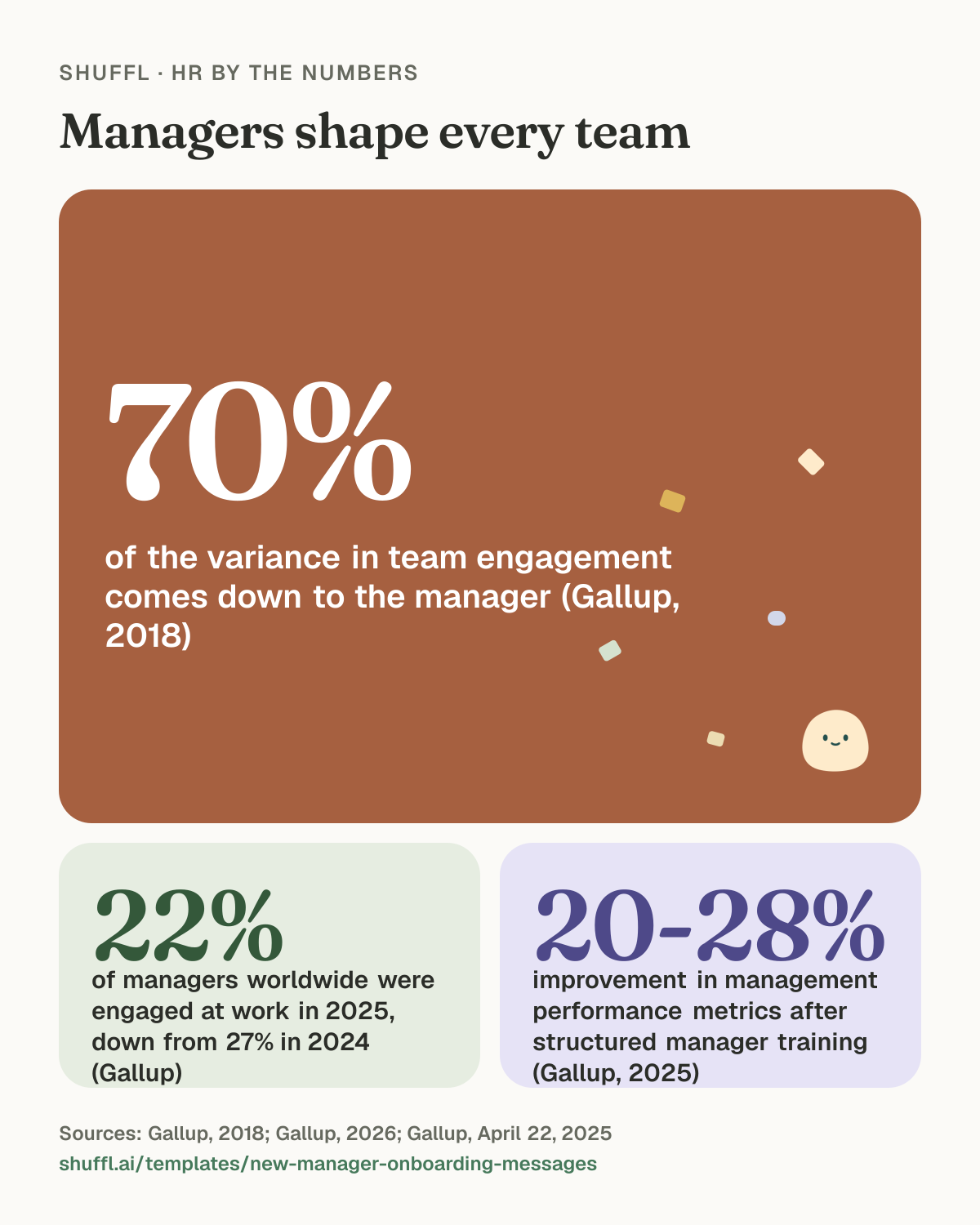
Managers shape every team. 70% of the variance in team engagement comes down to the manager (Gallup, 2018) (Gallup, 2018). 22% of managers worldwide were engaged at work in 2025, down from 27% in 2024 (Gallup) (Gallup, 2026). 20-28% improvement in management performance metrics after structured manager training (Gallup, 2025) (Gallup, April 22, 2025).
You’re a manager now, new manager
To the new manager, on the day they join.
**You’re a manager now, {{hire}}**

Congratulations. Your first weeks are about listening: meet each person on your team and learn what they need from you.

- [ ] Hold a one-to-one with each person on your team
- [ ] Read your team’s last review notes
Talk new manager through managing here
To their manager, on the day they join.
**Talk {{hire}} through managing here**

- [ ] Share how one-to-ones, reviews and hiring work here
Two weeks in
To the new manager, 14 days after the day they join.
**Two weeks in**

Now is a good time to agree how often you meet each person, and to write down what each one is working toward.

- [ ] Set a regular one-to-one with each person
Checking in
To the new manager, 30 days after the day they join.
**How is managing going, {{hire}}?**

It has been a month. If anything about your team, tools or what is expected of you is unclear, say so and a named person from HR will follow up with you directly.
Ask new manager how managing is going
To their manager, 60 days after the day they join.
**Ask {{hire}} how managing is going**How to adapt it
- Shuffl fills in {{hire}} and {{manager}} for each person. Replace them by hand if you send the message yourself.
- Start it from a group of everyone with a direct report, so promotions are covered as well as hires.
- Space the advice out. The first review, first hire and first hard conversation are better moments than week one.
What the research says
Managers have an outsized effect on their teams. Gallup has found that 70% of the variance in team-level engagement is based on the manager.1
Managers themselves are struggling. Global manager engagement fell from 27% to 22% between 2024 and 2025, the largest one-year drop in Gallup’s manager data, and nine points since 2022.2
Support helps. Gallup reports that managers who get structured training in management practices see their own and their teams’ engagement improve substantially, that management performance metrics improved by 20% to 28%, and that even basic training shows benefits.3 A buddy who has done the job is one of the simplest forms of that support.
Common mistakes
- Assuming a strong individual contributor already knows how to manage.
- Making their own manager their buddy. A peer manager is easier to ask the basic questions.
- Cramming all the training into week one. Space it out as real moments come up: the first review, first hire and first hard conversation.
- Skipping onboarding for internal promotions. People who know the company still need to learn the role.
Common questions
- What should a new manager do in their first 90 days?
- Meet each person on the team one to one, learn how reviews, pay and hiring work at the company, and agree early priorities with their own manager. A buddy who has managed here can explain the parts no handbook covers.
- Do internally promoted managers need onboarding?
- Yes. They know the company, but managing is a different job with new processes and harder conversations. Treat the promotion as a new start, with a buddy and check-ins.
- What makes a good buddy for a new manager?
- Someone who has managed at the company for a while, is respected by their own team and is not in the new manager’s reporting line. That makes it easier to ask questions they might not ask their boss.
Sources
Read on . Numbers change as new studies come out, so check the source before you quote it.
- Gallup, Exit Programs That Retain Stars and Build Brand Ambassadors, 2018. Gallup perspective paper (PDF, copyright 2018).
- Gallup, State of the Global Workplace: 2026 Report, 2026. Data collected January to December 2025; 263,810 respondents, 141,444 of them employed.
- Gallup, Global Engagement Falls for the Second Time Since 2009, April 22, 2025. By Jim Harter and Ryan Pendell. The article does not name the study behind the 20% to 28% figure.