
Onboarding and playbooks
Remote onboarding messages
Onboarding messages for someone who starts remotely: an earlier buddy, a video call on day one and a check-in after the first week.
New onboarding program. Opens a new onboarding program with these messages and timings. Every hire’s messages wait for your approval before they send.
Starting remotely can be quiet. There is nobody at the next desk to ask, so the buddy matters more and the check-in comes sooner.
These messages ask the buddy a week ahead, suggest a video call on day one and check in after the first week.
Shuffl · HR by the numbers
Remote starts need more connection

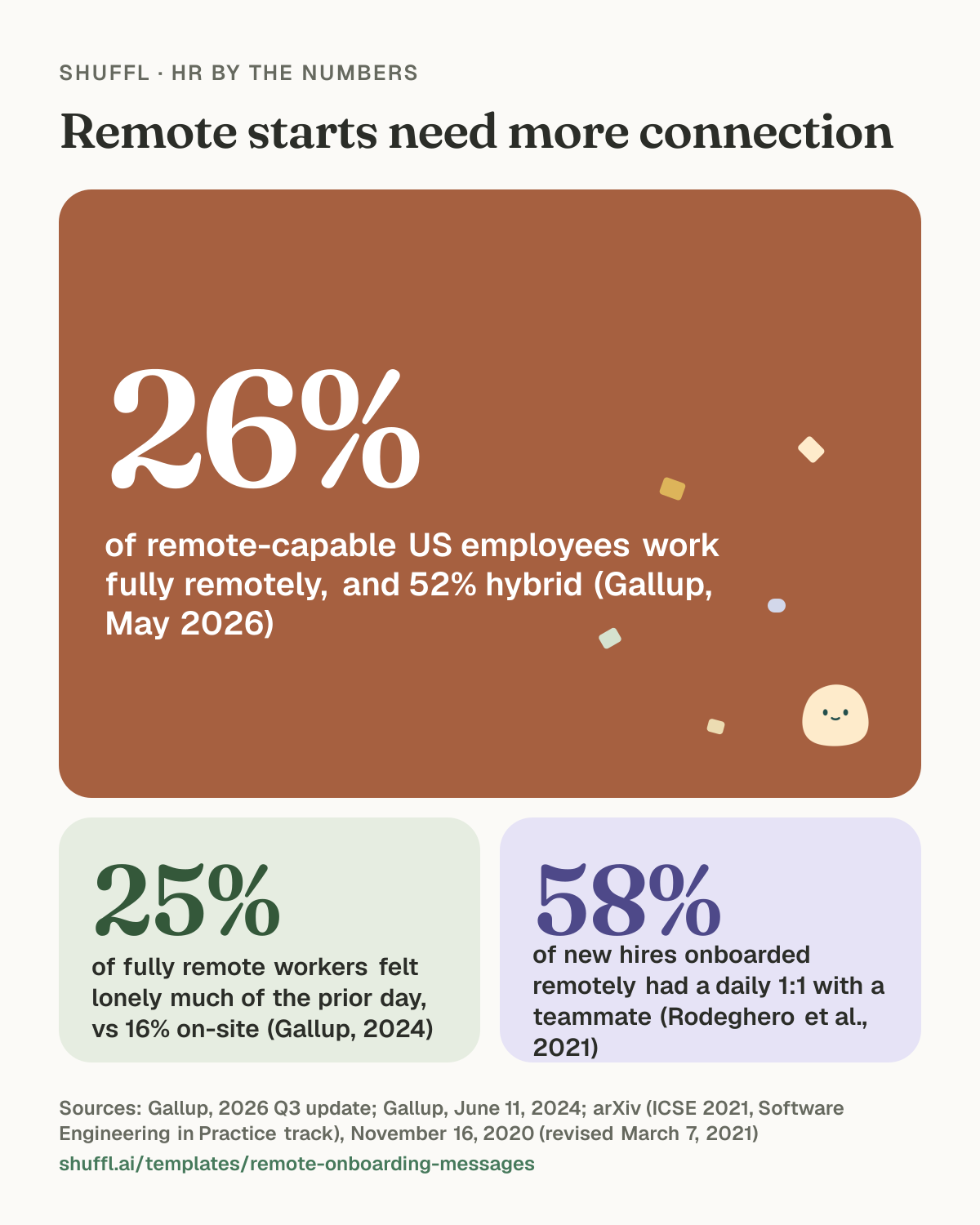
Remote starts need more connection. 26% of remote-capable US employees work fully remotely, and 52% hybrid (Gallup, May 2026) (Gallup, 2026 Q3 update). 25% of fully remote workers felt lonely much of the prior day, vs 16% on-site (Gallup, 2024) (Gallup, June 11, 2024). 58% of new hires onboarded remotely had a daily 1:1 with a teammate (Rodeghero et al., 2021) (arXiv (ICSE 2021, Software Engineering in Practice track), November 16, 2020 (revised March 7, 2021)).
Asking someone to be a buddy
To the person you ask to be a buddy, 7 days before the start date.
**Would you be {{hire}}’s onboarding buddy?** 👋

{{hire}} joins remotely on {{start_date}}. Without a desk nearby, a buddy is who they ask first. It takes about an hour a week for the first month, mostly short calls.
Introducing the hire and their buddy
To the new hire and their buddy together, on the start date.
**Meet your onboarding buddy** 👋

{{hire}} starts remotely on {{start_date}}. {{buddy}} is their buddy for the first weeks. Put a 30-minute video call in the calendar for day one.
Checking in with the new hire
To the new hire, 7 days after the start date.
**How is your first week going, {{hire}}?**

Starting remotely can be quiet. If anything is stuck, like access, tools or who to ask, say so and a named person from HR will follow up with you directly.
How to adapt it
- Shuffl fills in {{hire}}, {{buddy}} and {{start_date}} for each new hire. Replace them by hand if you send the message yourself.
- Ask the buddy before the start date, so they have time to say no.
- Name a real person in the check-in, so the new hire knows who will follow up.
What the research says
Remote and hybrid starts are now ordinary. As of May 2026, 52% of remote-capable US employees work hybrid and 26% work exclusively remotely, with 22% on-site.1
Connection is the hard part. In a study of 267 people who joined Microsoft software teams remotely during the pandemic, most never met their teammates in person, and building social connections with the team was among their biggest challenges. 58% had a daily one-on-one with a teammate, 68% were assigned a mentor, and 73% of their team conversations lasted under 30 minutes.2
Isolation is real for remote workers generally. In 2024, 25% of fully remote employees said they felt lonely a lot of the previous day, compared with 21% of hybrid workers and 16% of those fully on-site.3
Common mistakes
- Shipping equipment to arrive on day one. Aim for a few days early so there’s time to fix problems.
- Making every call about work. Book some time that is only for getting to know people.
- Taking silence as a sign things are fine. Remote hires often won’t say they’re stuck, so ask specific questions.
- Booking welcome calls at times that suit the team but not the new hire’s time zone.
Common questions
- How do you make a remote new hire feel welcome?
- Have everything working before day one, meet them on video at the start of their first day, and introduce a buddy they can message any time. Small social moments, like a team call with no agenda, help more than a long welcome deck.
- How often should you check in with a remote new hire?
- More often than with someone in the office, because you can’t see when they’re stuck. A short daily touchpoint in the first week and a proper check-in at the end of it is a good starting rhythm.
- Should remote new hires meet the team in person?
- If you can arrange it, an early in-person visit helps, especially for building relationships. If not, regular video calls and one-on-ones with teammates do a lot of the same work.
Sources
Read on . Numbers change as new studies come out, so check the source before you quote it.
- Gallup, Global Indicator: Hybrid Work, 2026 Q3 update. Remote-capable U.S. employees, measured May 2026.
- arXiv (ICSE 2021, Software Engineering in Practice track), Please Turn Your Cameras On: Remote Onboarding of Software Developers during a Pandemic, November 16, 2020 (revised March 7, 2021). By Paige Rodeghero, Thomas Zimmermann, Brian Houck and Denae Ford. Survey of 267 new hires who joined Microsoft software teams remotely during the pandemic (26.7% response rate).
- Gallup, 1 in 5 Employees Worldwide Feel Lonely, June 11, 2024. By Ryan Pendell. From Gallup’s State of the Global Workplace: 2024 Report.