
HR playbook
Build a recognition habit that lasts
How to make thanks specific, frequent and spread across every team, using what research says about recognition and retention.
For HR leads and managers at growing companies
Only 22% of US employees say they get the right amount of recognition, and that hasn’t moved since 2022.1 Most companies don’t need a bigger program to fix this. They need a habit: specific thanks, given often, by managers and peers alike.
This playbook covers what makes thanks land, how often to give it, and how to keep it going after the launch week.
Why it matters
Gallup followed nearly 3,500 employees from 2022 to 2024. Well-recognized employees were 45% less likely to have changed organizations two years later.1
Frequency matters. Among employees who got feedback and recognition from their manager at least once a week, 61% were engaged, against 38% for those who got weekly feedback but recognition less often.2
Thanks also changes what people do next. In a field study of 41 university fundraisers on fixed salaries, the half thanked in person by their director made more than 50% more calls that week. The others made about the same number as before.4
Shuffl · HR by the numbers
Recognition and staying

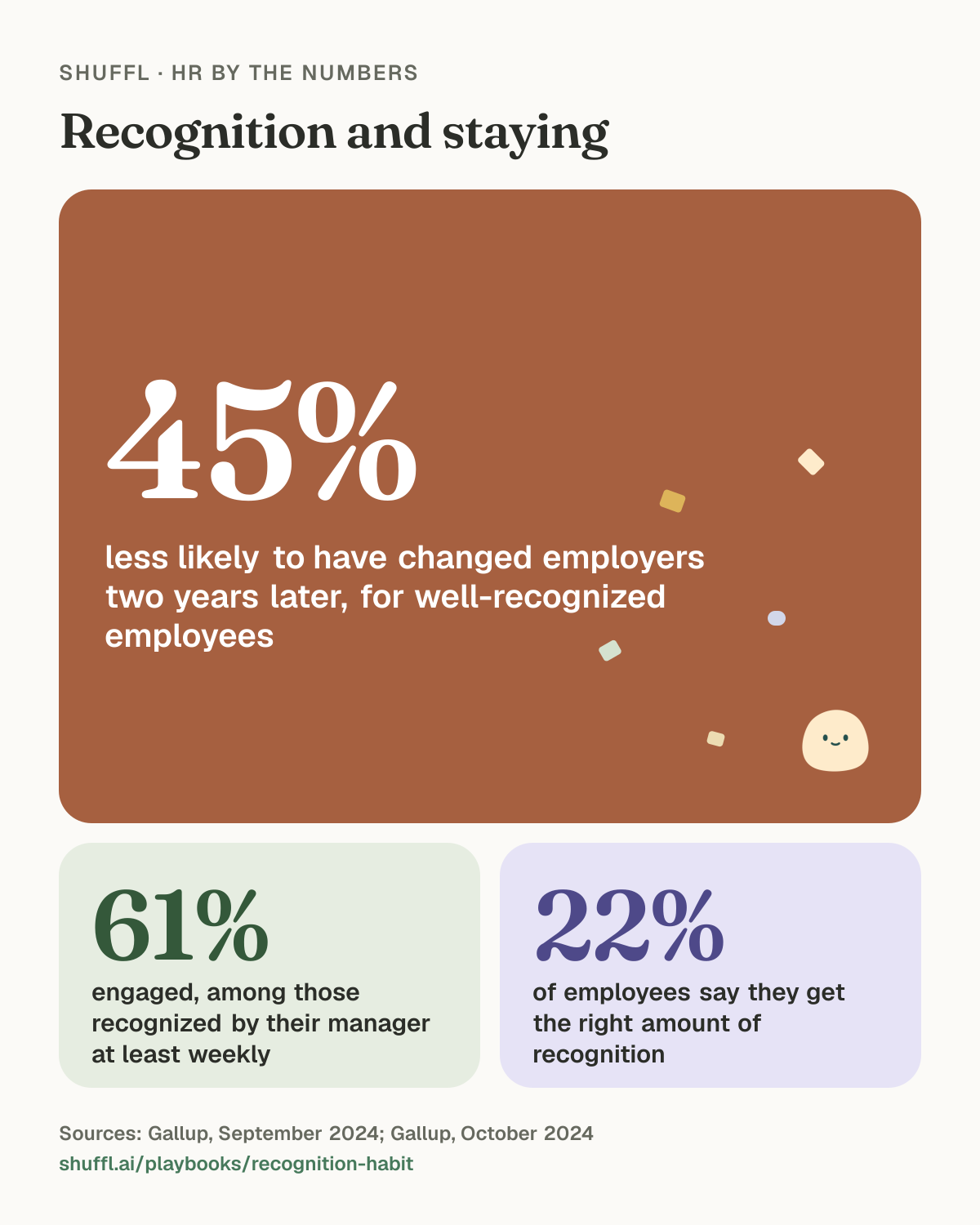
Recognition and staying. 45% less likely to have changed employers two years later, for well-recognized employees (Gallup, September 2024). 61% engaged, among those recognized by their manager at least weekly (Gallup, October 2024). 22% of employees say they get the right amount of recognition (Gallup, September 2024).
Make thanks specific
Gallup describes the most effective recognition as honest, authentic and individualized to how each person wants to be recognized.3 In practice, that means specific. Compare “thanks for your help” with “thanks for staying on the call with the Leeds customer until their payroll ran, you saved the account.”
When people recalled their most memorable recognition, 28% named their manager and 24% a senior leader or CEO. Peers came to 9%.3 Peer thanks fills the gaps between those moments. It doesn’t replace them, so managers need the habit too.
- Name the person.
- Say what they did, concretely: the bug, the call, the doc.
- Say what it made possible: the customer kept, the hour saved, the launch on time.
- Tie it to a value when it fits naturally, not every time.
Build the habit
Gallup recommends feedback every seven days.3 Not everyone wants that much from their manager, though: only 27% say they’d like manager feedback at least weekly.2 Ask people how they like to be thanked, and make the default frequent and light.
- Pick one public channel for thanks and say what belongs there. Don’t split it across tools.
- Write down your company values where people can find them, so thanks can point at them.
- Ask each manager to recognize every report by name at least every two weeks, in one-on-ones or in the channel.
- Open one team meeting a week with a minute of thanks.
- Send a gentle private reminder to people who haven’t thanked anyone in a while.
- Each month, look at who gives and gets thanks by department, not by person, and nudge the quiet teams.
An example
An 80-person company opens a #kudos channel. In the first month there are 120 posts, then 40 in the third. Half the company hasn’t been thanked at all, mostly in finance and operations.
HR asks managers to thank each report by name every two weeks and turns on monthly reminders for people who haven’t posted in a while. Team leads open Monday meetings with a minute of thanks.
By month six the channel holds steady at about 70 posts a month, and the share of people thanked at least once a quarter goes from half to about four in five. Finance shows up for the first time after the year-end close.
Common mistakes
- Launching a kudos channel with fanfare and never mentioning it again.
- Thanks so generic it could be about anyone: “great job, team!”
- Leaderboards that turn recognition into a contest.
- Leaving recognition entirely to peers, so managers stay quiet.
- Never checking which teams nobody thanks.
A specific thank you
Thanks @name for [what you did, concretely].
Because of it, [what it made possible].
[Optional: That’s [value] in action.]

Example: Thanks @Ana for rewriting the expenses guide on Friday. Three new hires filed their first claims this week without asking anyone. That’s “Make it easy” in action.
In Shuffl
Do this in Shuffl
- Open Praise → Settings and turn on Read praise channels.
- Under Company values, pick the Knowledge page that holds your values, or choose Create a company values page.
- Add the channel where people already thank each other, such as #kudos. For a public channel, choose Add Shuffl to it.
- Under Reminders, turn on Send praise reminders and choose how often. See the message shows what people get.
- Each month, check Insights for who is recognized and who gives praise by department. It shows totals for groups of 7 or more and has no leaderboards.
- For something bigger than a thank you, such as finishing a mentoring program, choose New badge under Praise.
The guide: Praise and badges
Read the guideHave your agent do thisPaste the prompt into Claude Code, Cursor or another agent. It reads this playbook and the guide, works over MCP and asks before it changes anything others will see.Show the promptHide the prompt
Help me with "Build a recognition habit that lasts" in my Shuffl workspace.

1. Read the playbook: https://shuffl.ai/playbooks/markdown/recognition-habit
2. Read the Shuffl guide it uses: https://shuffl.ai/docs/markdown/praise
3. Add Shuffl's MCP server: https://shuffl.ai/api/mcp
   Claude Code: claude mcp add --transport http shuffl https://shuffl.ai/api/mcp
   When the browser opens, choose my workspace and allow the access the guide needs.
4. Work through the playbook's Shuffl steps in order (6 of them). Do what you can over MCP and tell me which steps only I can do in the browser or in Slack.

Ask me about our company first where the playbook needs it, like our values, policies or dates. Show me what you will change and who it affects, and wait for my yes before publishing, inviting or sending anything.
Common questions
- How often should people be recognized?
- Aim for everyone being thanked by someone at least every couple of weeks, and managers recognizing each report regularly. Gallup found engagement was highest where people got feedback and recognition from their manager at least weekly.
- Peer recognition or manager recognition?
- Both. Peer thanks spreads recognition across the team and notices work a manager can’t see. Managers’ recognition is the kind people tend to remember most, so it shouldn’t be left to peers.
- Do we need points or rewards?
- Not to start. Thanks that is specific and public does most of the work. If you add rewards later, keep them small and avoid anything that turns thanks into a contest.
Sources
Read on . Numbers change as new studies come out, so check the source before you quote it. This page is general guidance, not legal advice.
- Gallup, Employee Retention Depends on Getting Recognition Right, September 2024. Rachael Yi. Joint research with a recognition company; Gallup tracked the careers of nearly 3,500 employees from 2022 to 2024.
- Gallup, Organizations Redefine Feedback, Including Recognition, October 2024. Andy Kemp. Preference figures from a Gallup web survey of 4,439 US employees, run with a recognition company, April 16 to 30, 2024 (±2.3 points). Engagement figures from Gallup’s Q3 2024 web survey of 20,721 working adults, August 13 to 27, 2024 (±1.2 points).
- Gallup, Employee Recognition: Low Cost, High Impact, June 2016, updated January 2024. Employees were asked to recall who gave them their most meaningful and memorable recognition. The page gives no sample size or dates for that survey.
- Harvard Gazette, The power of ‘thanks’, March 2013. News article by Chuck Leddy on Francesca Gino’s research. The fundraiser field study had 41 participants on fixed salaries; their director thanked half of them in person.