
· Shuffl team
47% of HR leaders spend 4+ hours a day on repeat questions
HR questions statistics from 2024–2026 research: how often employees ask HR for help, where they look first, how long they wait and what repeats cost HR.
Short answer
Employees ask HR for help often, and HR answers the same questions again and again. In recent surveys, 79% of UK employees sought HR help at least monthly and only 6% got instant help through AI or chat. 47% of US HR leaders spent four or more hours a day on repetitive employee questions.
How often do employees ask HR for help?
It’s Monday at 9:15, and three people have already asked how many vacation days carry over into next year. One asked in Slack, one by email, and one caught you at the coffee machine. The answer hasn’t changed since January.
This roundup collects recent published research on those questions and what they cost HR. Every number links to the survey behind it, with its sample and date.
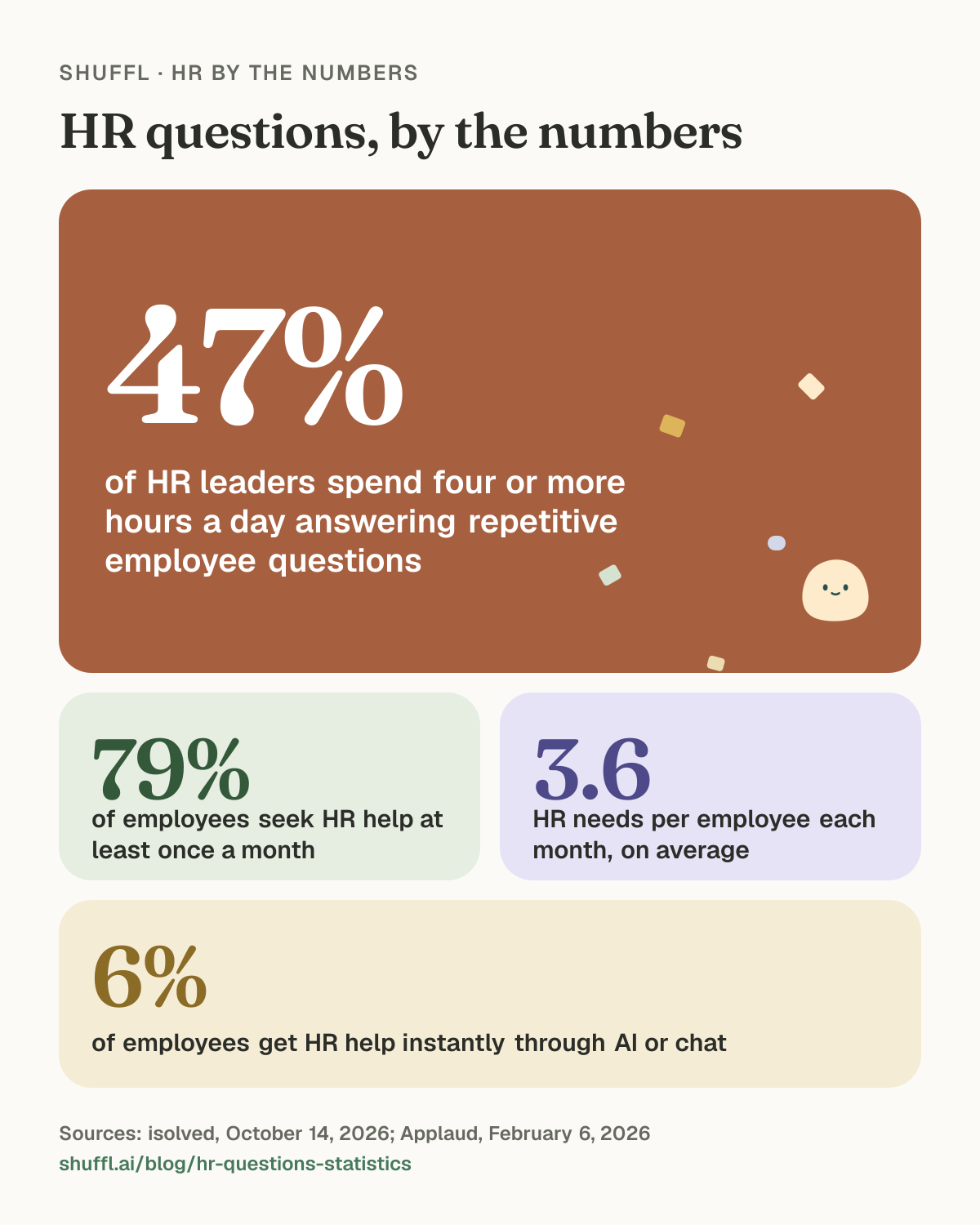
The questions come often. Applaud and Censuswide surveyed 1,000 UK employees at organizations with 2,000+ staff in late 2025. 79% of them sought HR help at least once a month, averaging 3.6 HR needs per person, per month.2
Shuffl · HR by the numbers
HR questions, by the numbers

HR questions, by the numbers. 47% of HR leaders spend four or more hours a day answering repetitive employee questions (isolved, October 14, 2026). 79% of employees seek HR help at least once a month (Applaud, February 6, 2026). 3.6 HR needs per employee each month, on average (Applaud, February 6, 2026). 6% of employees get HR help instantly through AI or chat (Applaud, February 6, 2026).
How much of HR’s day goes to repeat questions?
For nearly half of HR leaders, it’s four hours a day or more. In the second quarter of 2026, isolved surveyed 1,005 US HR decision makers in management roles or higher. 47% spend four or more hours a day answering repetitive employee questions, and 70% would spend that time on strategic initiatives if they got it back.1
Pay and benefits admin adds to it. In a 2024 Dynata survey for Payroll Integrations of 250 full-time employees and HR leaders, HR managers spent 12 hours on average on payroll and benefit-related administrative tasks, more than a quarter of their week. 27% spent 20 hours or more.4
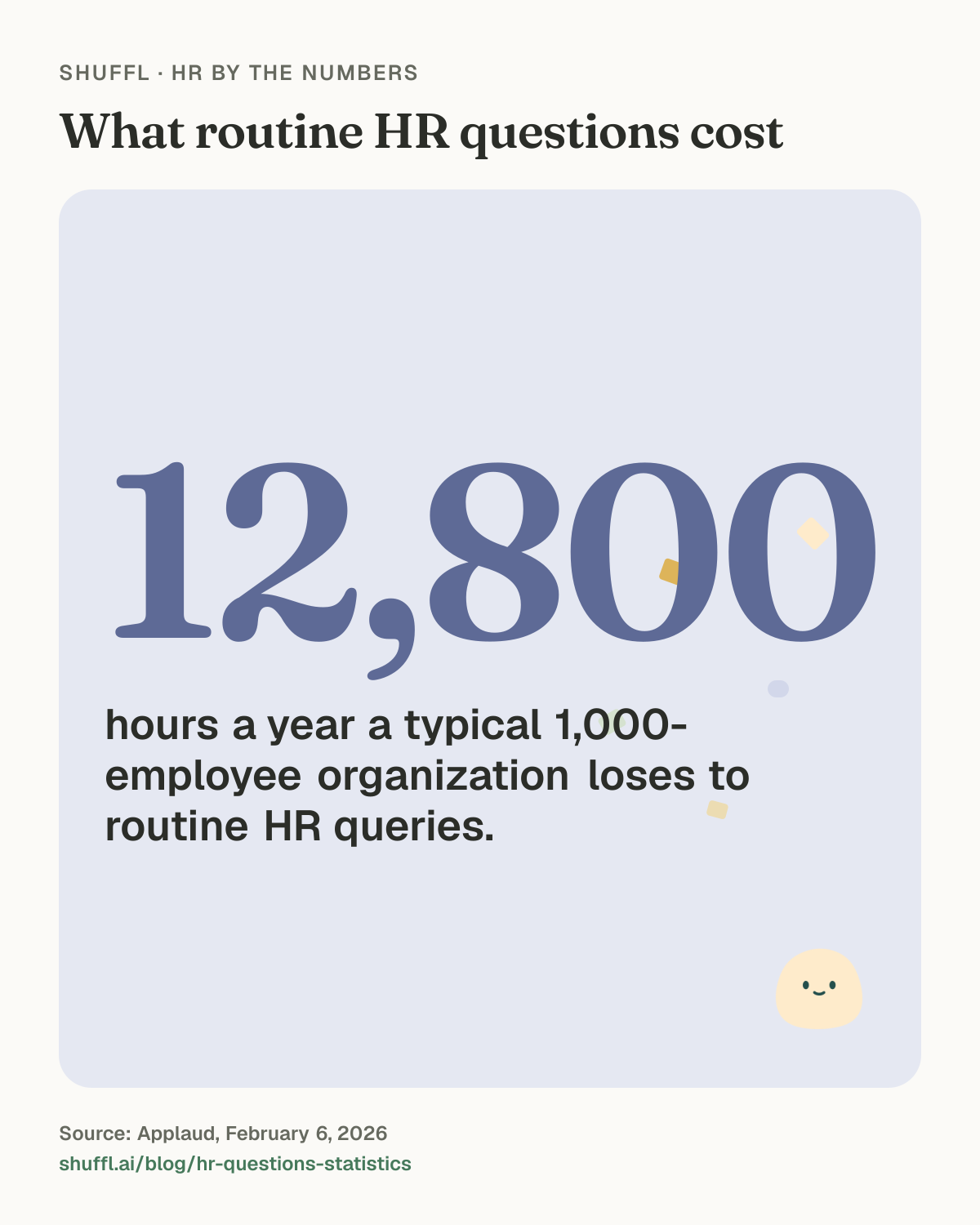
Applaud puts the whole bill in hours: a typical 1,000-employee organization loses around 12,800 hours per year to routine HR queries.2
Shuffl · HR by the numbers
What routine HR questions cost
What routine HR questions cost: 12,800 hours a year a typical 1,000-employee organization loses to routine HR queries.. Source: Applaud, February 6, 2026.
Where do employees look first?
In Applaud’s survey, only 26% of employees go to an HR system or portal first. 24% email, phone or message HR, and just 15% use knowledge bases or FAQs.3
Frontline workers are further from the portal still: 34% go to a colleague first, and only 20% use HR systems at all.2 A colleague answers fast, though sometimes from last year’s policy.
An answer kept only in the portal sits where 26% of employees look first. Put it where the others ask as well, in the chat tool people already use and with their managers.
How long do employees wait for an HR answer?
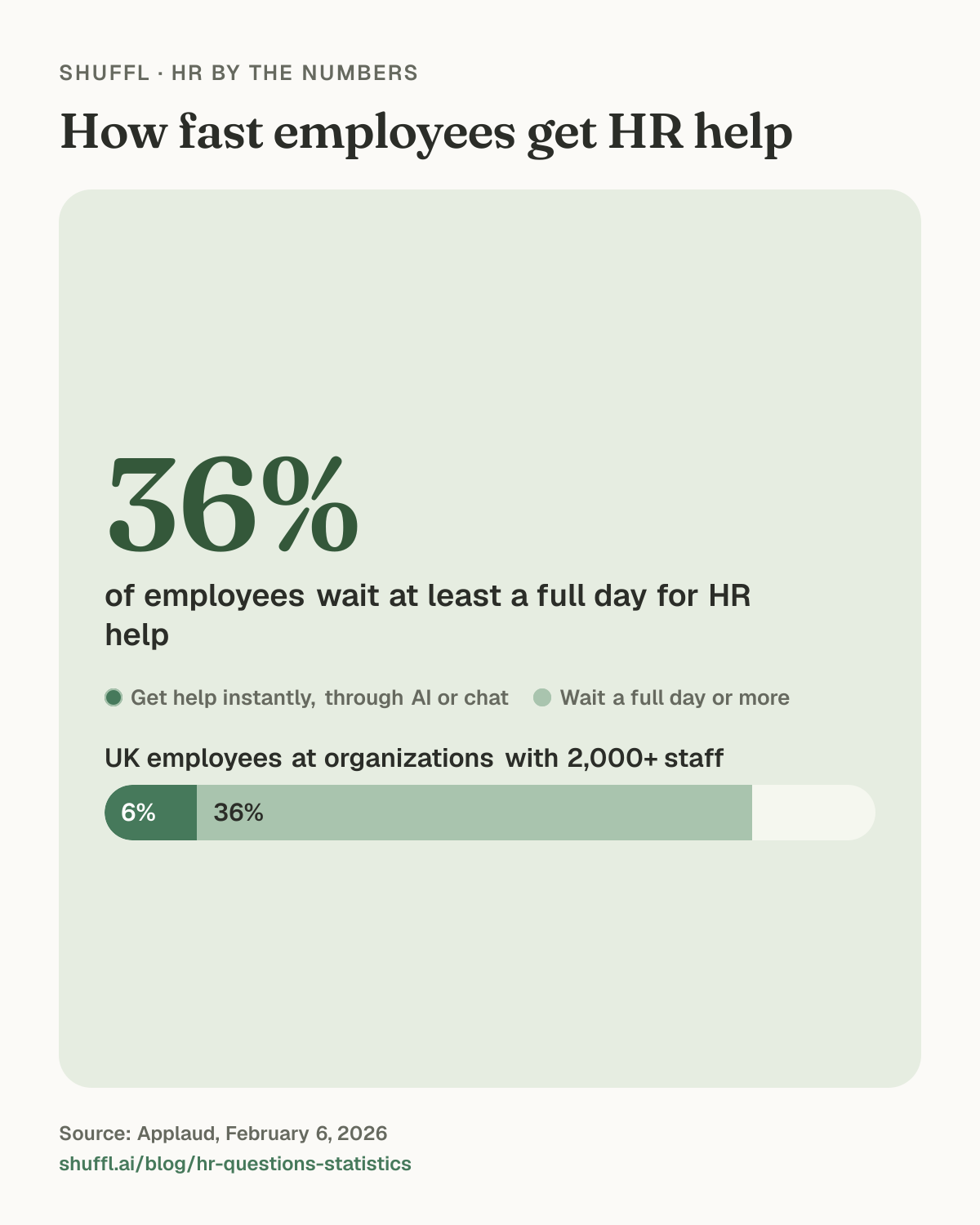
Only 6% of employees say they receive help instantly via AI or chat. 36% wait at least a full day, and around 22% often wait several days or a week or more.2
A day is a long wait when the question is whether this afternoon’s doctor’s appointment counts as sick leave. Someone who hears nothing by lunch may ask again by email, and now HR has two threads for one question.
Shuffl · HR by the numbers
How fast employees get HR help
How fast employees get HR help. 36% of employees wait at least a full day for HR help. UK employees at organizations with 2,000+ staff: 6% Get help instantly, through AI or chat, 36% Wait a full day or more. Source: Applaud, February 6, 2026.
How many HR questions can employees answer themselves?
Employees say they can resolve around 47% of their HR needs themselves; the rest still requires HR or a manager.2 Part of the rest needs a person, like a pay error or a complaint. Part of it is a written policy the employee couldn’t find.
Benefits are a common gap. In the Payroll Integrations survey, 73% of employees said they need more education on company benefits.4
More employees now prefer to ask an assistant. In TriNet’s research with over 1,000 people in the US small business community, preference for AI assistant support in general HR questions rose to 38% in 2025, up from 30% the year before.5
What should HR do with these numbers?
Start with your own count. Two weeks of tallies shows which questions your team answers most:
Shuffl · Worth quoting
On repeat HR questions
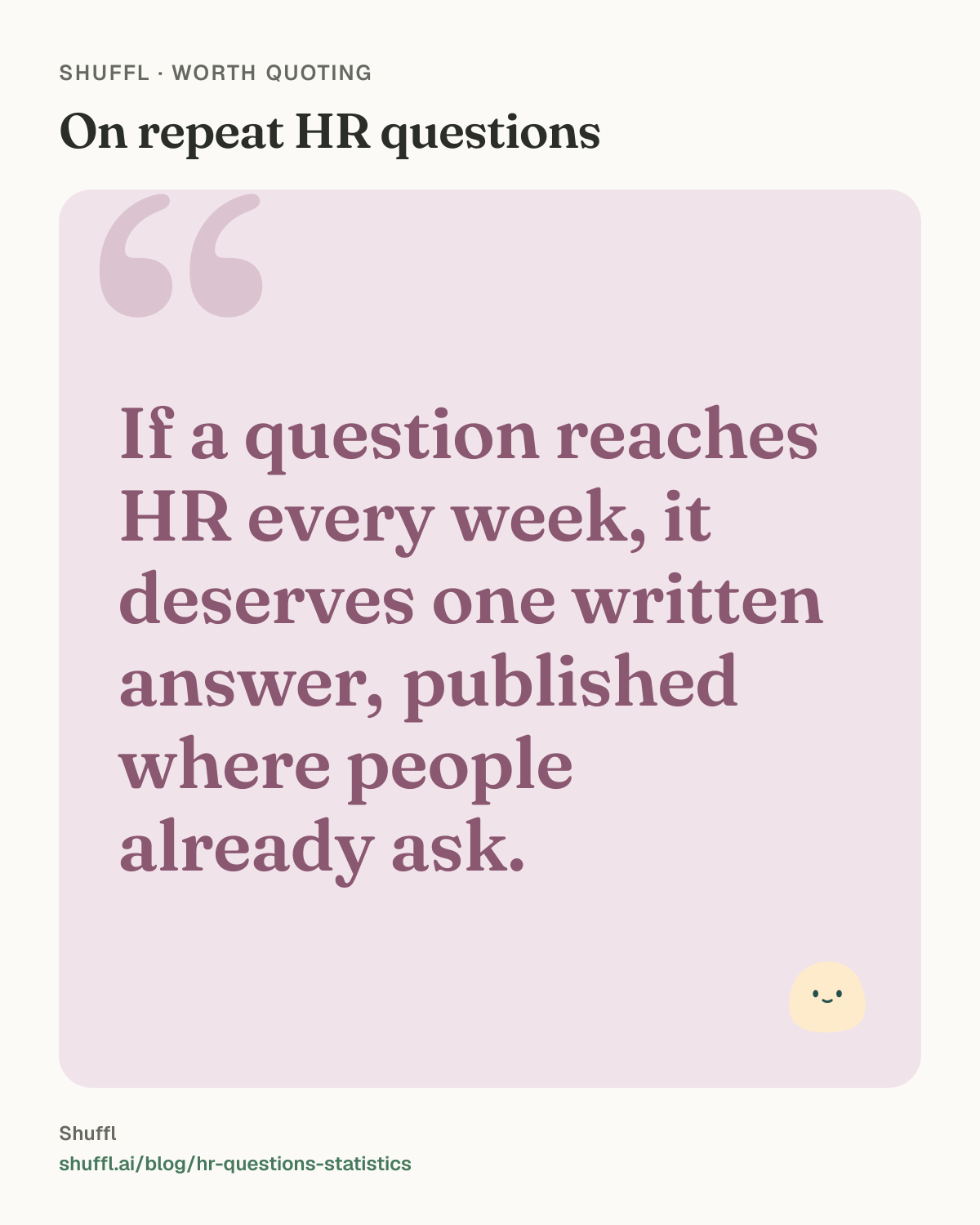
On repeat HR questions: “If a question reaches HR every week, it deserves one written answer, published where people already ask.”
- For two weeks, log every question that reaches HR by Slack, email, ticket or in person, in the words people used.
- Group the questions by topic and sort the topics by how often each came up.
- For each of the top ten, check that one current written answer exists, saying who it applies to and from when.
- Publish those answers where people already ask, and retire any older copies that disagree.
- Time the first reply on whatever still reaches HR, so you know whether the day-long wait applies to you.
- Run the same tally a month later and compare the top ten.
If a question reaches HR every week, it deserves one written answer, published where people already ask.
How does Shuffl handle repeat HR questions?
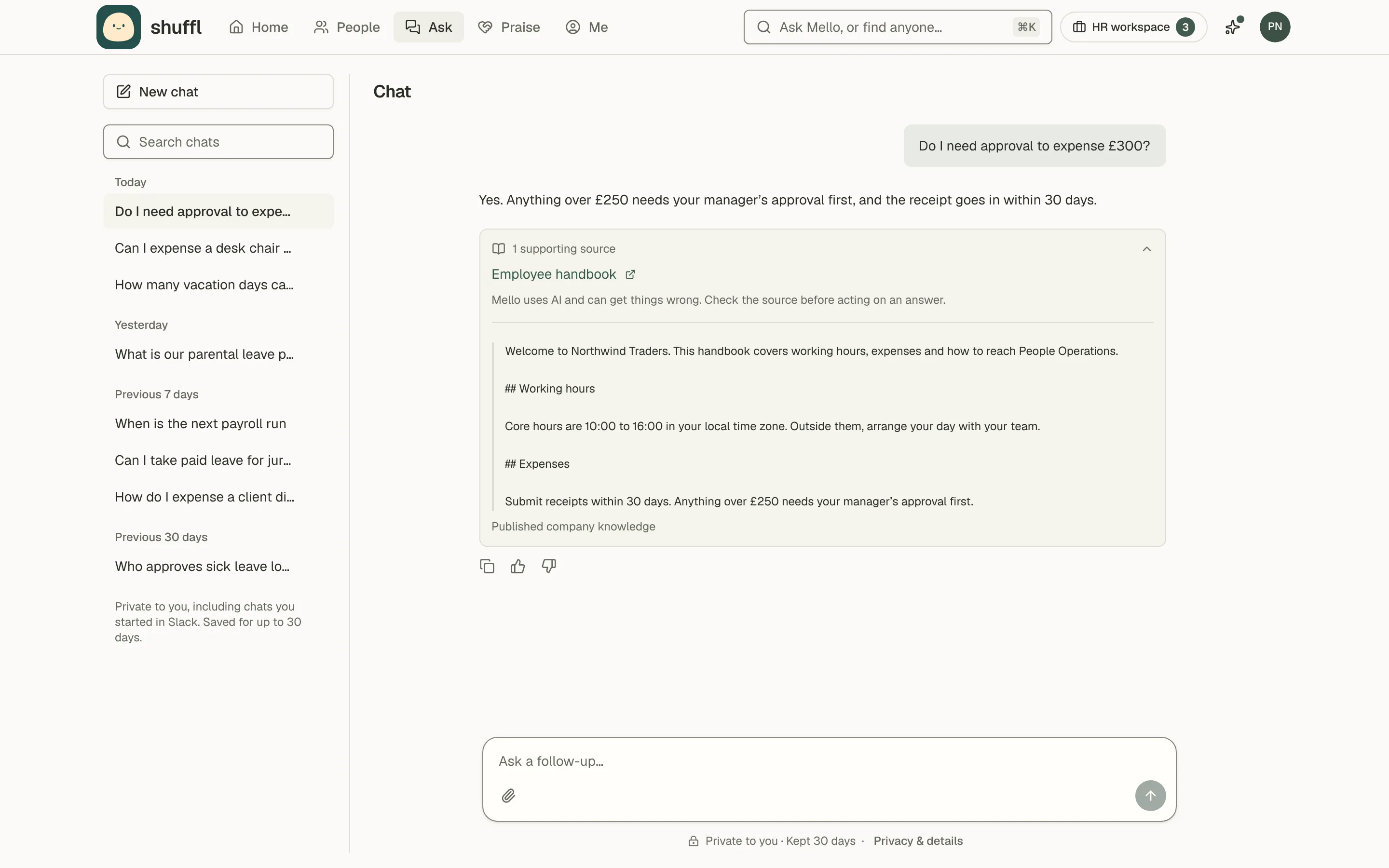
Employees ask Mello, Shuffl’s assistant, on the web or in a Slack direct message. Mello answers only from Knowledge your HR team published to an audience that includes the person, between its effective and review dates, and cites the passages it used.
When nothing published covers the question, Mello says so and prepares a short message for HR, showing who would receive it. Nothing is sent until the employee chooses Share with HR on the web or Send to HR in Slack, and HR gets that message, never the whole chat.
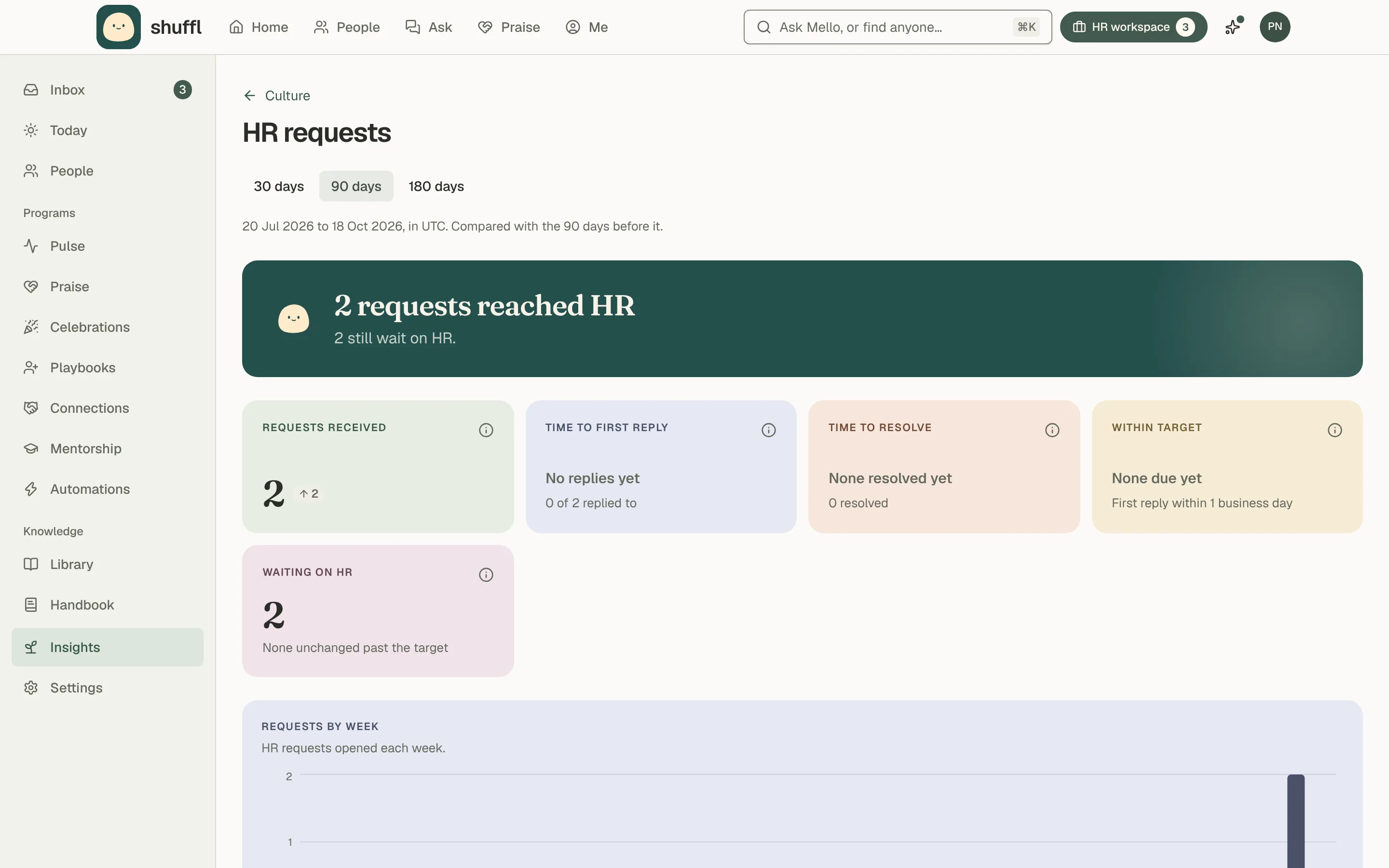
The gaps become your writing list. Knowledge → Insights counts Missing guidance, the answers where Mello found nothing to cite. For requests that reach HR, the HR requests figures show time to first reply and to resolve, and By category lists the busiest categories first, with how many need an article.
Where do you start?
Take the five questions you answered most last month and give each its own source in Knowledge, with the answer in the first line. Publish each one to the people it applies to, then check Missing guidance a week later for the next ones to write.
Shuffl, Mello included, is free for every team at any size.
Frequently asked questions
How often do employees ask HR questions?
In Applaud’s late-2025 survey of 1,000 UK employees at organizations with 2,000+ staff, 79% sought HR help at least once a month, with an average of 3.6 HR needs per person each month.
How much time does HR spend on repetitive questions?
In isolved’s 2026 survey of 1,005 US HR decision makers, 47% spent four or more hours a day answering repetitive employee questions. Asked what they would do with that time, 70% said strategic initiatives.
How long do employees wait for an answer from HR?
In Applaud’s survey, 36% of employees waited at least a full day and only 6% got help instantly through AI or chat. Track your own time to first reply to see where your team sits.
How many HR questions can employees answer on their own?
Employees in Applaud’s survey said they resolve around 47% of their HR needs themselves. The rest still went to HR or a manager.
Sources
- isolved, isolved Study: HR Leads with AI as Strategic Expectations Outpace Capacity, October 14, 2026. Survey by a third-party research firm in the second quarter of 2026 of 1,005 US-based HR decision makers in management roles or higher, for the report The Workforce Decisions Defining HR.
- Applaud, The 2026 State of HR Service Report: five shifts and the statistics behind them, February 6, 2026. Applaud and Censuswide surveyed 1,000 UK employees at organizations with 2,000+ staff in late 2025, for the 2026 State of HR Service Report.
- Applaud, New Research: 79% of Employees Seek HR Help Monthly, But Only 6% Get Instant Support, January 15, 2026. Press release for the 2026 State of HR Service Report: first-party research with Censuswide among 1,000 UK employees at organizations with 2,000+ staff.
- Payroll Integrations, 73% of Employees Want More Education on Company Benefits; Employers’ HR Administrative Burdens Are Getting in the Way, September 19, 2024. Research by Dynata for the 2024 State of Employee Financial Wellness Report, from 250 full-time employees and HR leaders aged 18 to 65.
- TriNet, AI Use in the Workplace Is Way Up Among US Employees, November 5, 2025. TriNet State of the Workplace 2025 report, survey data from over 1,000 participants in the US small business community.