
· Shuffl team
How does a cited answer from your handbook work?
A cited answer shows the handbook passage it came from, so employees can check it before acting. How citations work, where they fail and what to ask for.
Short answer
A cited answer quotes the handbook passage it was built from and links to that version, so an employee can check it before acting. It helps only when the answer comes from current, approved text the person may read, and when the assistant says plainly that nothing covers a question instead of guessing.
What happens when an AI answer gets a policy wrong?
In November 2022, after a death in the family, Jake Moffatt asked the chatbot on Air Canada’s website about bereavement fares. It said the discount could be claimed after travel. The words “bereavement fares” in its reply linked to the airline’s own policy page, which said the opposite.1
Air Canada argued it couldn’t be held liable for what the chatbot said. The tribunal called that “a remarkable submission” and wrote: “It should be obvious to Air Canada that it is responsible for all the information on its website. It makes no difference whether the information comes from a static page or a chatbot.”1
Now picture your own bereavement leave policy. An assistant tells someone they get five days, and the handbook says three. That answer is yours. The link under Air Canada’s reply didn’t help anyone, because nobody could see that the page disagreed with the answer.
Shuffl · HR by the numbers
Trusting AI answers, by the numbers

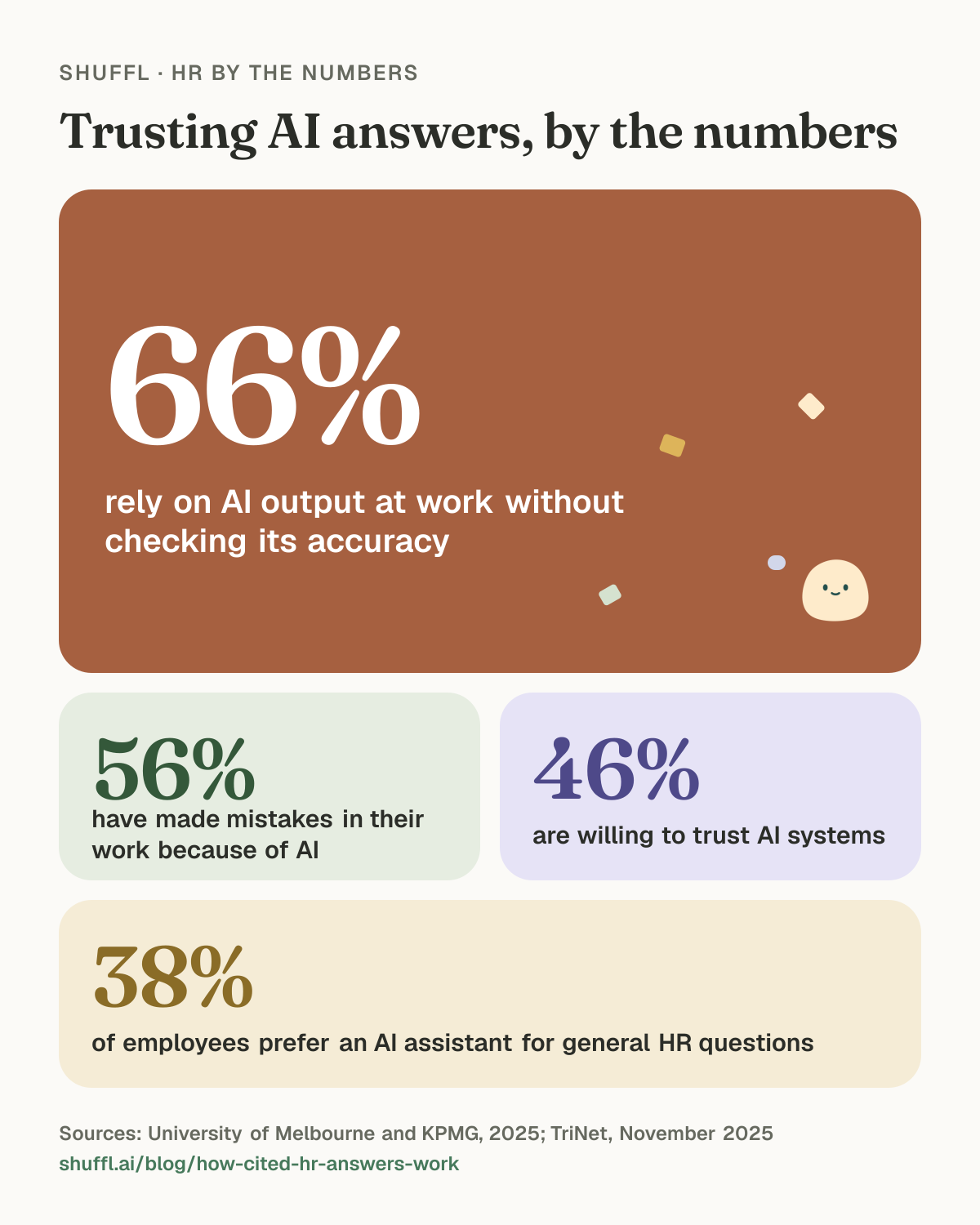
Trusting AI answers, by the numbers. 66% rely on AI output at work without checking its accuracy (University of Melbourne and KPMG, 2025). 56% have made mistakes in their work because of AI (University of Melbourne and KPMG, 2025). 46% are willing to trust AI systems (University of Melbourne and KPMG, 2025). 38% of employees prefer an AI assistant for general HR questions (TriNet, November 2025).
What is a cited answer?
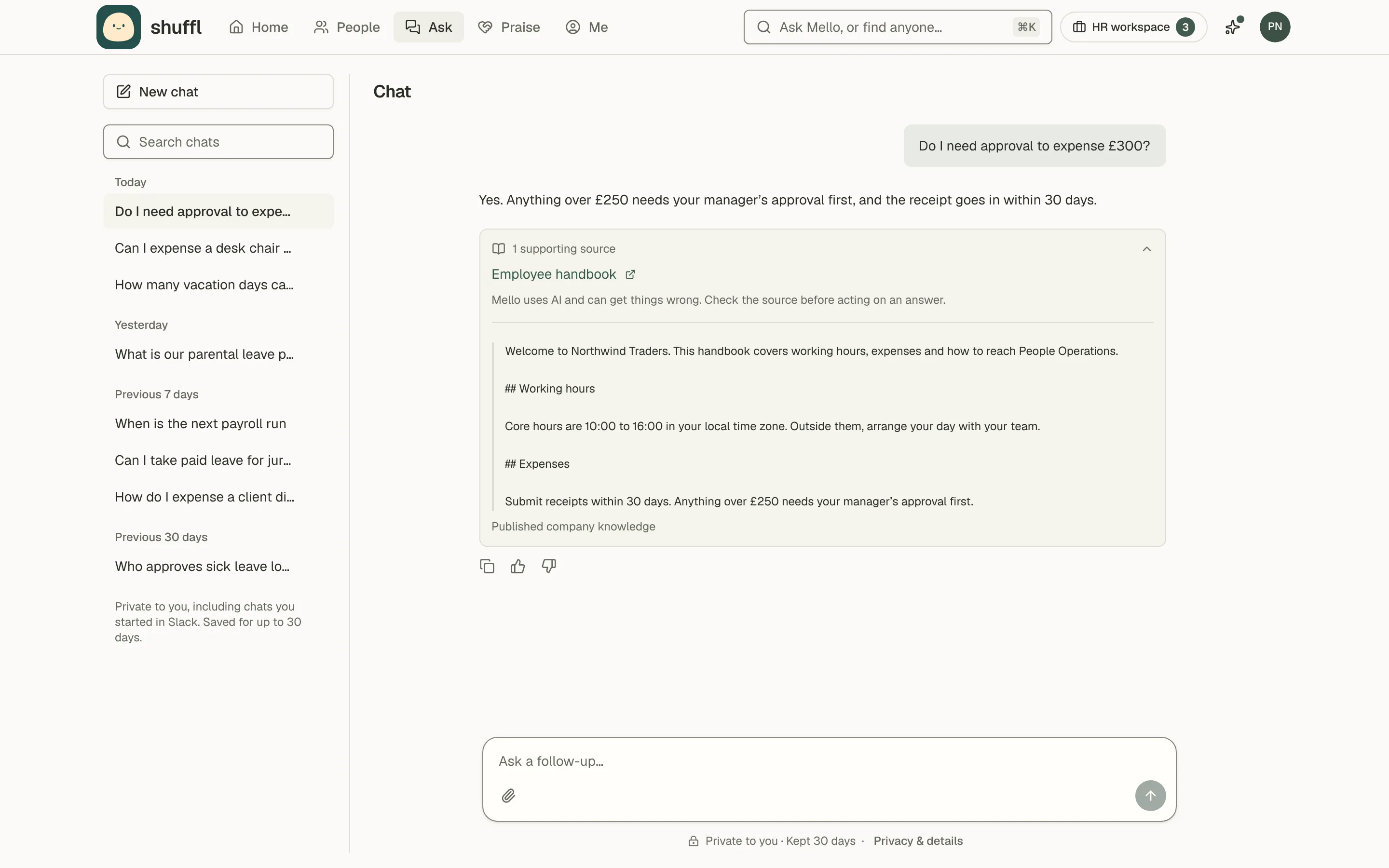
A cited answer gives the short answer and shows where it came from: the passage it used, quoted, with a link to the version of the source that passage belongs to. An employee can read the sentence the answer rests on in a few seconds, without opening a 60-page PDF.
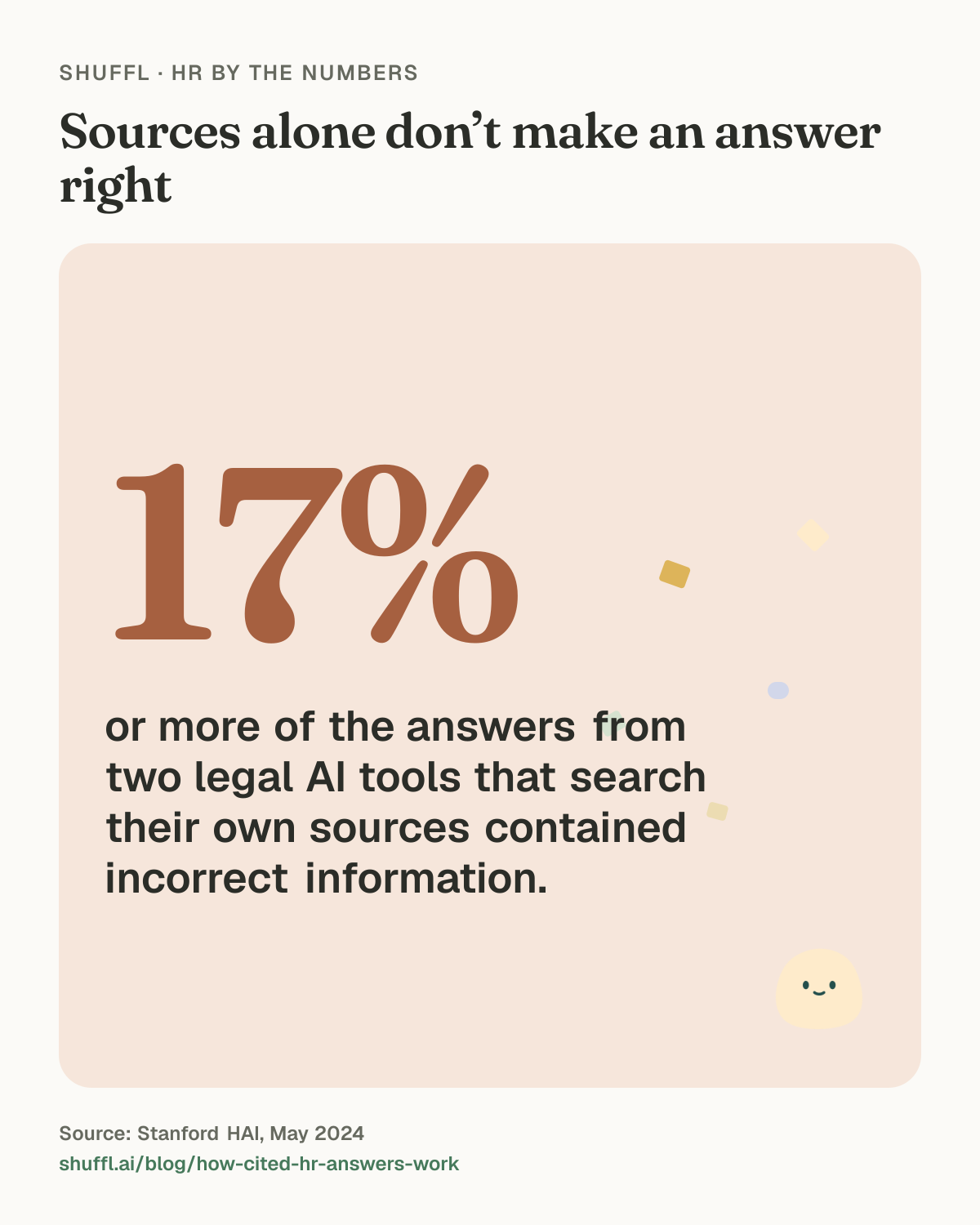
Citations can still be wrong. Stanford researchers ran over 200 legal questions through AI research tools that answer from their own case law databases. Lexis+ AI and Ask Practical Law AI produced incorrect information more than 17% of the time, and Westlaw’s AI-Assisted Research more than 34% of the time. Some answers cited a real source that didn’t support what they said.2
So a citation is worth as much as the check behind it. It should let the reader spot a mismatch on their own, and the system should run the same check before the answer appears.
Shuffl · HR by the numbers
Sources alone don’t make an answer right
Sources alone don’t make an answer right: 17% or more of the answers from two legal AI tools that search their own sources contained incorrect information.. Source: Stanford HAI, May 2024.
Why do employees need to see the source?
Most people won’t go looking for the policy. In the University of Melbourne and KPMG study of more than 48,000 people in 47 countries, 66% rely on AI output without evaluating its accuracy, and 56% have made mistakes in their work because of AI. Only 46% are willing to trust AI systems.3
They ask anyway. In TriNet’s research with US small businesses, preference for AI assistant support in general HR questions rose to 38% in 2025, up from 30% the year before.4
So put the evidence next to the answer. People read an excerpt sitting under the reply. Few will search the intranet for the policy it came from.
Shuffl · Worth quoting
On cited HR answers
On cited HR answers: “An HR answer is only as good as the sentence it came from. Show employees that sentence, and its date.”
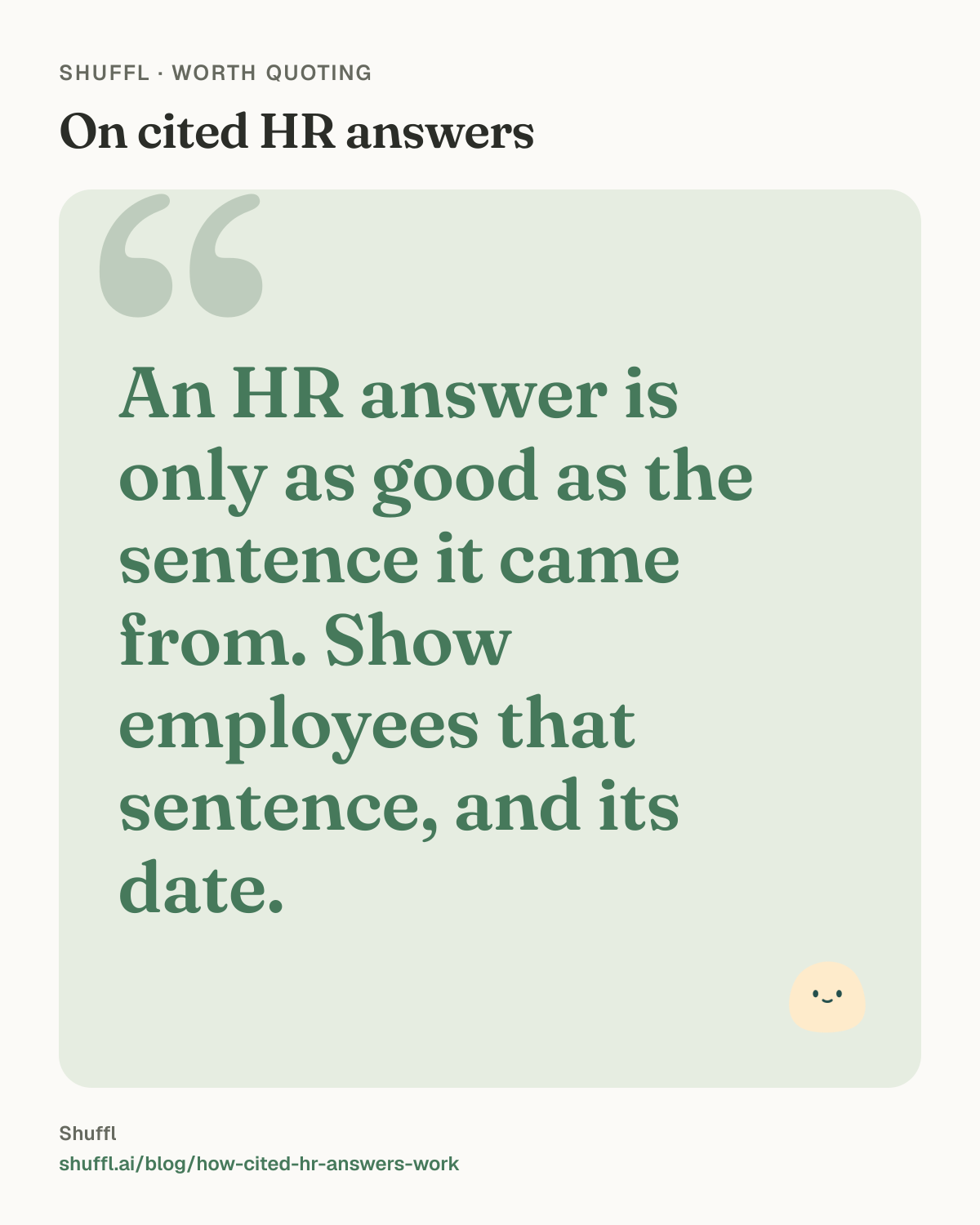
An HR answer is only as good as the sentence it came from. Show employees that sentence, and its date.
What should a cited HR answer show?
Use this list to test any assistant before you roll it out, ours included. Ask the ten questions HR hears most and open every source.
- The answer first, with the number and its unit: three days of bereavement leave, receipts within 30 days.
- The passage it used, quoted under the answer, so nobody has to open the whole handbook.
- A link that opens the published version the answer used, at that passage.
- Only approved text that is in effect and inside its review date.
- Only text the person asking is allowed to read. A guide for managers shouldn’t answer an intern.
- Which case applies, when a policy differs by country or employment type.
- A plain “nothing published covers this” when the handbook is silent, with a way to reach a person.
How do you get your handbook ready for cited answers?
A cited answer can only be as clear as the text under it, so most of the work is writing. Start with the policies people ask about most:
- List the ten questions HR hears most, in the words employees use.
- Give each topic its own source, such as Paid time off, Sick leave and Expenses, with headings people would look for.
- Put the answer first, as a number with its unit, and say who it applies to and from when.
- Set who can read each source, and a review date that matches when the policy really changes.
- Withdraw the old version the day you publish its replacement, so two rules never disagree.
- Ask each question yourself, open every source, and fix the text until the excerpt says what the answer says.
- Each week, read the questions nothing answered and write the next source.
How does Shuffl build a cited answer?
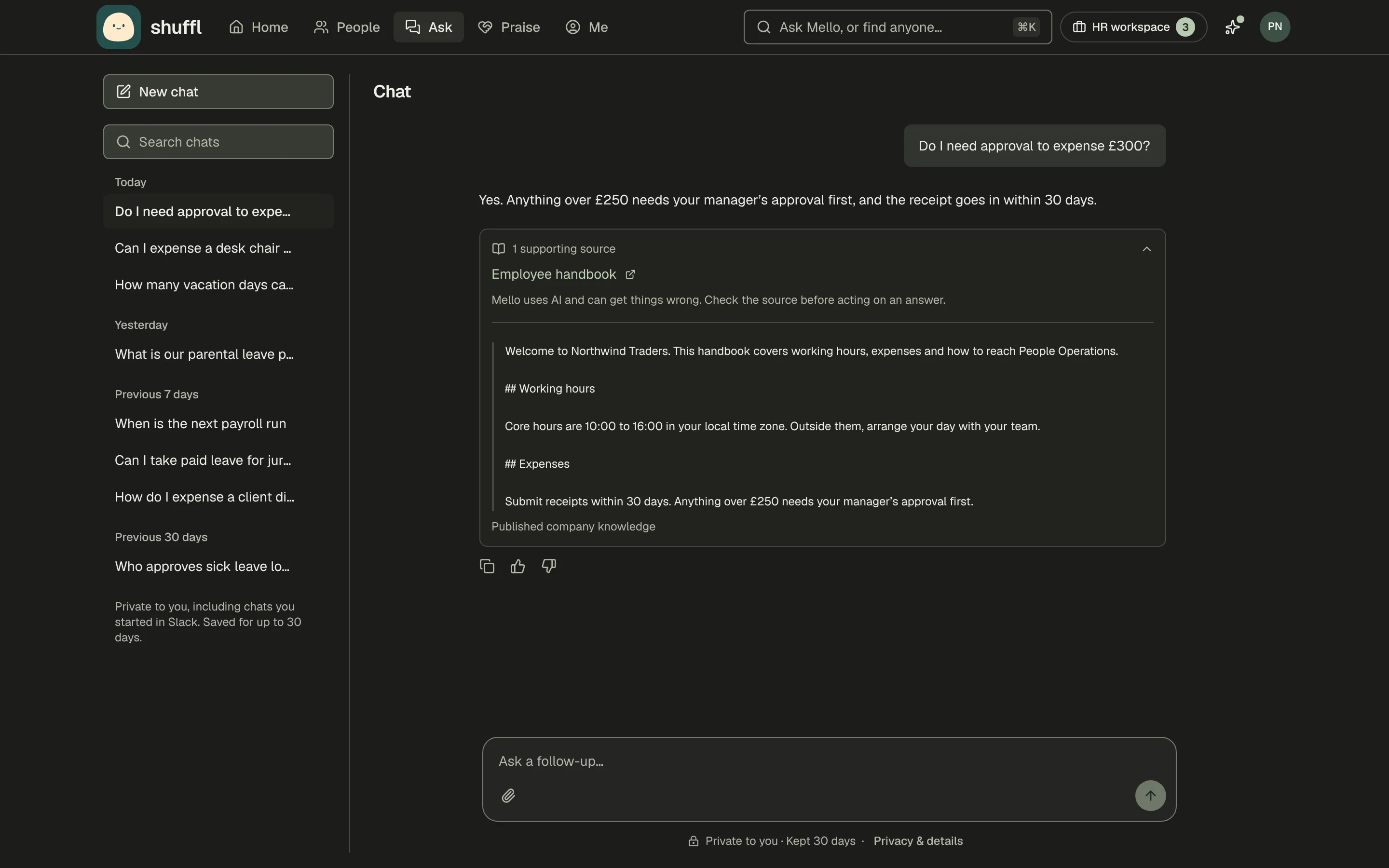
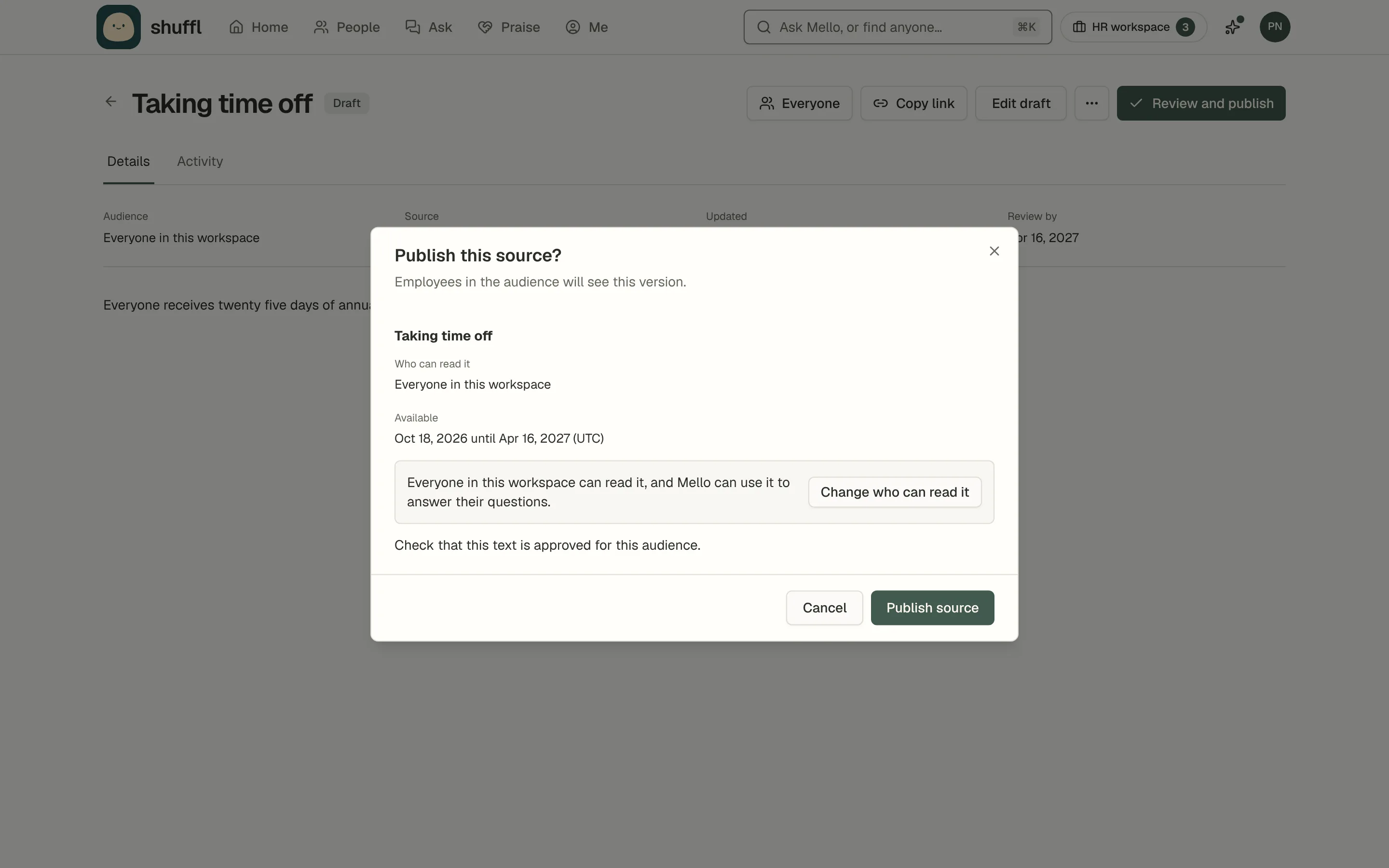
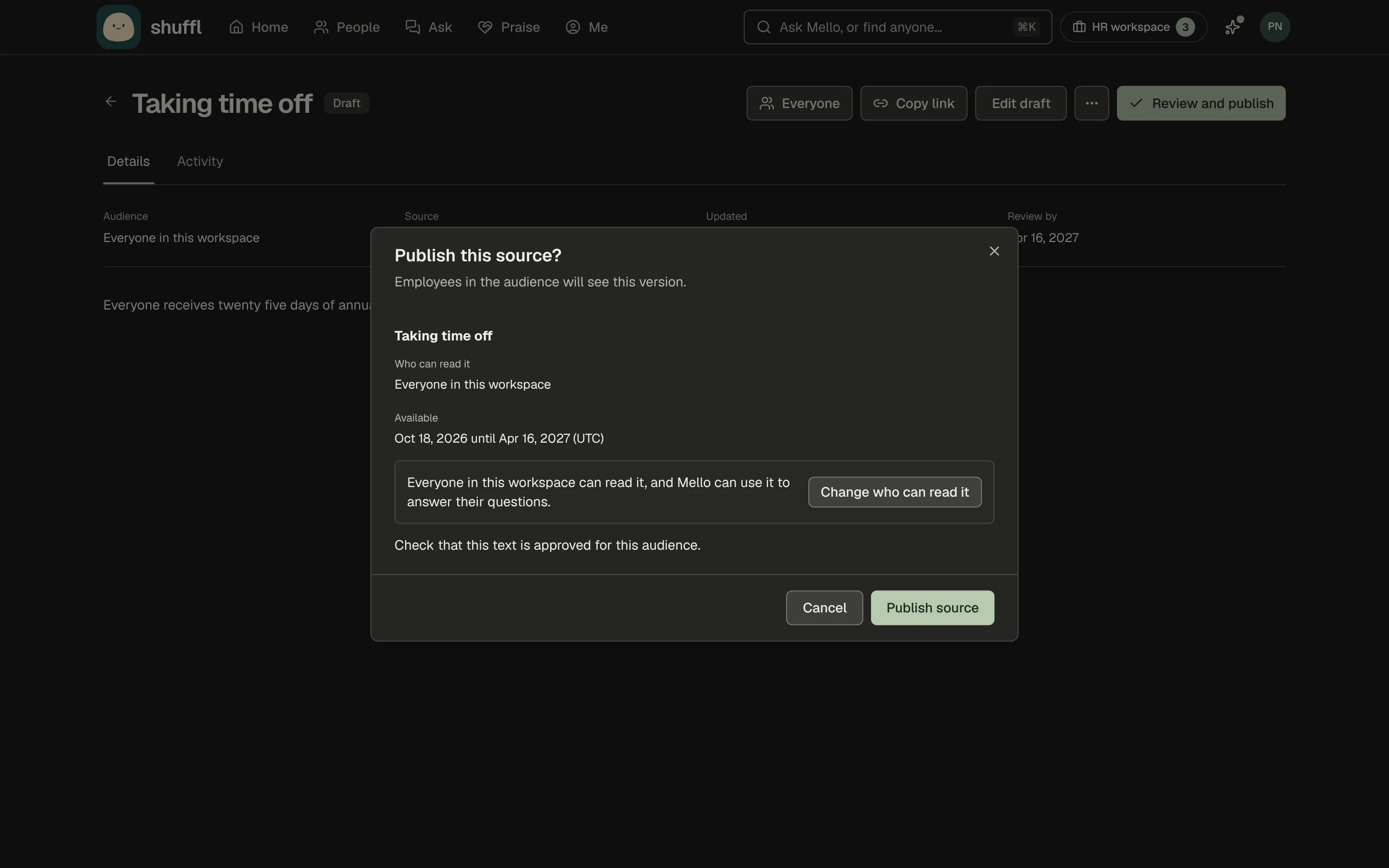
Mello, the assistant in Shuffl, answers policy questions only from Knowledge your HR team published. Each source has an audience, an effective date and a review date. Before Mello searches, Shuffl narrows the library to sources the person asking can read, that are in effect and before their review date. A source imported from Google Drive, Notion or another connected tool must also have been checked against the original in the last hour.
Shuffl stores each source as passages of a few paragraphs, up to about 1,600 characters, labelled with the source title, the nearest heading and the effective date. Mello searches with a few keywords, at most three times, and can read the passages either side of a match to catch the exceptions. It answers from what the passages say and never makes up a figure.
Every answer has to cite passages Mello read for that question. Before it appears, Shuffl checks each citation again: the passage must still be in the published version, in date and readable by that person. If an answer cites nothing, or a citation fails the check, it is withheld, and the employee sees that its sources could not be verified. A web address or email stays in an answer only when it appears in a passage Mello read, so it can’t invent an HR contact.
Under the answer, Supporting sources lists each source. Open it to read the excerpt Mello relied on; the link opens that published version at the passage. Each answer with sources also says that Mello uses AI and can get things wrong, and to check the source before acting.
When two sources a person can read disagree, Mello points out the conflict instead of picking one. In a shared Slack channel it answers only from sources published to everyone. In Chat and direct messages it also reads the asker’s record in People, such as location and employment type, and answers the case that applies to them.
How a cited answer is built
An employee asks a question in Chat or Slack. Mello searches only the sources that person can read and that are in date, then writes an answer that cites the passages it read. Shuffl checks each citation again, and the answer appears with its sources. When nothing published covers the question, Mello says so and offers to bring in HR, the employee sees the message before it is sent, and the question is listed under Missing guidance in Knowledge Insights.
- Needs me
- An agent does it
- Done
- Next, waits for a go
What happens when the handbook doesn’t cover it?
Mello says nothing published covers the question and offers to bring in HR. It prepares a short message and shows who would receive it. Nothing is sent until the employee chooses Share with HR on the web or Send to HR in Slack, and HR gets that message, never the whole chat.
For harassment, discrimination, a health or legal matter, workplace safety or a resignation, Mello still answers the policy part from Knowledge, and also prepares a private message to HR for the person to review and send.
The gaps become your writing list. Knowledge → Insights counts Missing guidance, the questions where Mello found nothing to cite. Questions to test Mello on lists the questions behind Bad answer ratings, unless the person kept theirs private.
Shuffl, Mello included, is free for every team at any size.
Frequently asked questions
Can AI answer HR questions accurately?
For questions with one written answer, yes, if it answers only from your current, approved policies and shows the passage it used. It can still get things wrong, so anything about pay, leave or eligibility deserves a look at the source first.
What is the difference between a citation and a link?
A link points at a document. A citation shows the passage the answer came from, so the reader can see whether that passage says what the answer says.
What should an HR assistant do when it can’t find an answer?
It should say that nothing published covers the question and offer a private way to reach a person. Those gaps are HR’s list of what to write next.
Who is responsible when an HR chatbot gets a policy wrong?
In the Air Canada case, a Canadian tribunal held the company responsible for what its website chatbot told a customer. Treat an assistant’s answers as your own, and keep the policies behind them current.
Sources
- Civil Resolution Tribunal of British Columbia, Moffatt v. Air Canada, 2024 BCCRT 149, February 14, 2024. Small claims decision by Tribunal Member Christopher C. Rivers, file SC-2023-005609.
- Stanford HAI, AI on Trial: Legal Models Hallucinate in 1 out of 6 (or More) Benchmarking Queries, May 2024. Pre-registered dataset of over 200 open-ended legal queries run on commercial legal AI research tools.
- University of Melbourne and KPMG, Trust, attitudes and use of artificial intelligence: A global study 2025, 2025. Survey of more than 48,000 people across 47 countries, collected November 2024 to mid-January 2025.
- TriNet, AI Use in the Workplace Is Way Up Among US Employees, November 2025. TriNet State of the Workplace 2025 report, survey data from over 1,000 participants at US small businesses.