
Launch announcements
Pulse survey launch announcement
A post that tells employees a pulse survey is starting: how often, how long it takes and who sees the answers.
Pulse, in the HR workspace. Shuffl doesn’t post announcements for you. Pulse, in the HR workspace, is where you choose Start pulse and set the schedule.
People answer more honestly when they know who sees what. Say it plainly before the first question arrives.
The privacy lines match what Shuffl shows every employee before their first question.
Shuffl · HR by the numbers
Trust shapes how honestly people answer

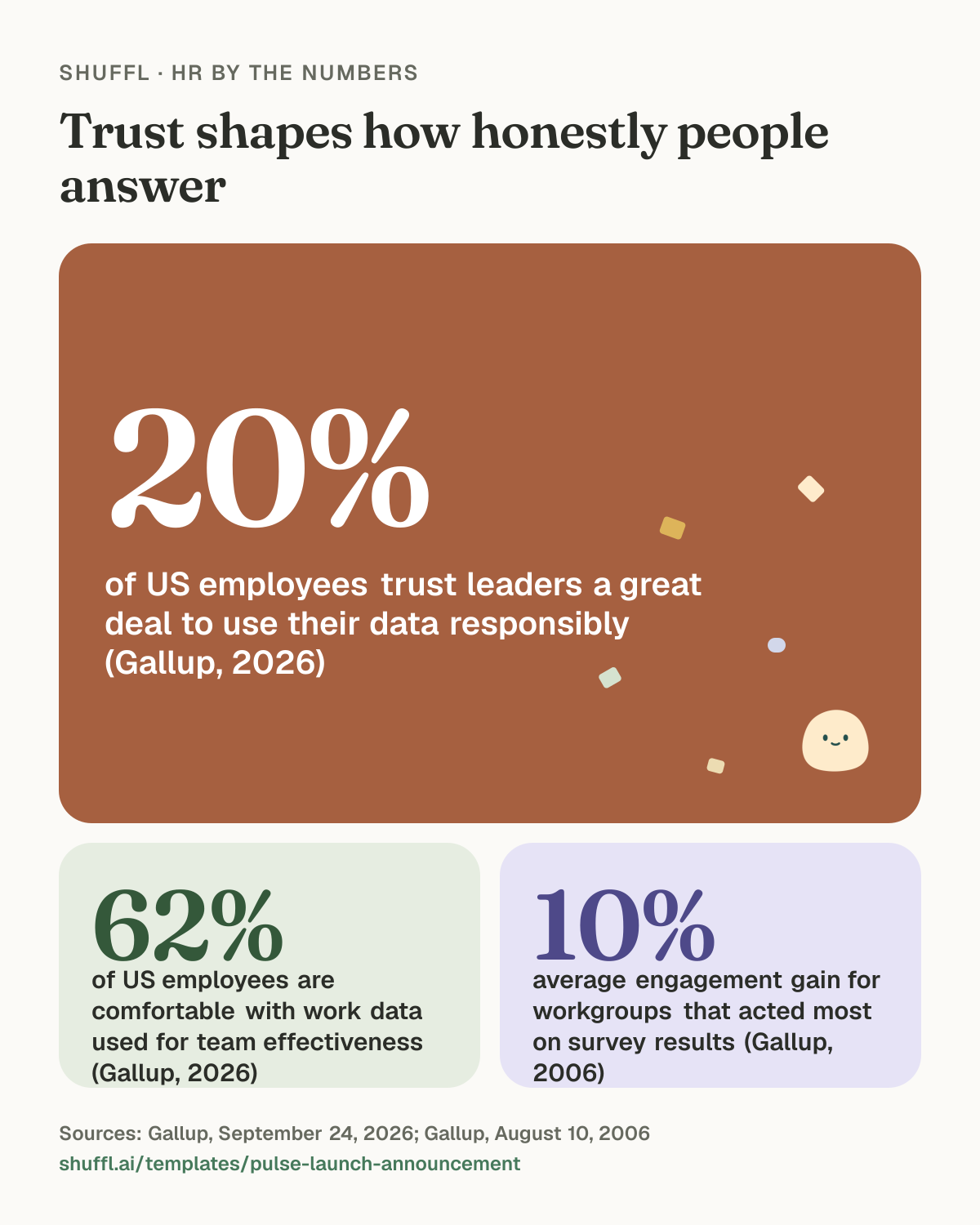
Trust shapes how honestly people answer. 20% of US employees trust leaders a great deal to use their data responsibly (Gallup, 2026) (Gallup, September 24, 2026). 62% of US employees are comfortable with work data used for team effectiveness (Gallup, 2026) (Gallup, September 24, 2026). 10% average engagement gain for workgroups that acted most on survey results (Gallup, 2006) (Gallup, August 10, 2006).
Announcement post
Replace the bracketed parts. Shuffl’s reporting floor starts at 7 people and can only be raised, so use your own number if you raised it.
Starting [day], we’re asking one short question at a time about how work is going.

Questions arrive as a direct message in Slack, or by email if you don’t use Slack, [days and time]. Each one takes a few seconds, and you can skip any of them.

Your answers are confidential, not anonymous. HR sees totals for groups of [7] or more people, never your answer or your name next to one.

We’ll share what we hear and what we change because of it. Questions? Ask [name] or reply here.
How to adapt it
- Post it a day or two before the first question, not on the same day.
- Promise only what you will do: share results, then say what you changed.
- Don’t call it anonymous. Confidential is accurate, because Shuffl knows who answered so it can count participation.
What the research says
Trust in how employee data is used is low. In 2026, 20% of US employees said they trust their leaders a great deal to use employee data responsibly, and 43% trust them somewhat. Engaged employees were far more trusting (40%) than those not engaged (13%).1
Purpose matters. 62% of employees were comfortable with data about their work being used to support team effectiveness and goals, compared with 53% for performance reviews.1 If pulse results are used to improve teams and not to rate individuals, say so plainly.
What you do afterwards counts most. In Gallup’s analysis, workgroups in the top quarter on acting on survey results increased their engagement scores by an average of 10%, while those in the bottom quarter saw scores fall by 3%.2
Common mistakes
- Not saying how often questions will arrive, so the first one feels like spam.
- Announcing only from HR. A line from a senior leader shows it matters.
- Launching in the middle of a reorg or year-end crunch, when people have little time or trust to spare.
- Planning nothing after launch. Draft the first “what we heard” message before the first question goes out.
Common questions
- Should pulse surveys be anonymous?
- Most are confidential instead: the system knows who answered so it can count participation, but HR only sees results for groups above a minimum size. Use the word that is accurate, and explain who sees what before the first question.
- How often should you run a pulse survey?
- Weekly or every two weeks works for one or two short questions. Ask only as often as you can look at results and respond, or people learn the answers go nowhere.
- How do you get people to answer pulse surveys?
- Keep each question quick, explain why you’re asking, and show what changed because of earlier answers. A short note from managers in team meetings helps more than reminders.
Sources
Read on . Numbers change as new studies come out, so check the source before you quote it.
- Gallup, Employee Data Use: One in Five Trust Leaders a Great Deal, September 24, 2026. By Andy Kemp and Ryan Pendell. 22,573 employed U.S. adults, May 6-20, 2026, margin of error ±0.9 points.
- Gallup, What to Do With Employee Survey Results, August 10, 2006. By Joanne Earl, Melissa Dunn Lampe and Andrew Buksin.