
Onboarding and playbooks
Policy roll-out plan
A plan for a new or changed policy: everyone it applies to reads it and confirms on the same date, with a reminder a week later.
New playbook. Opens a new playbook with these steps and timings. Each person’s steps wait for your approval before they send.
A policy only works if people know it exists. Publishing it is half the job; the other half is making sure each person reads it and you can show they did.
This plan sends everyone the policy on one date with a to-do to read and confirm it, then a gentle reminder a week later.
Shuffl · HR by the numbers
Publishing is half the job

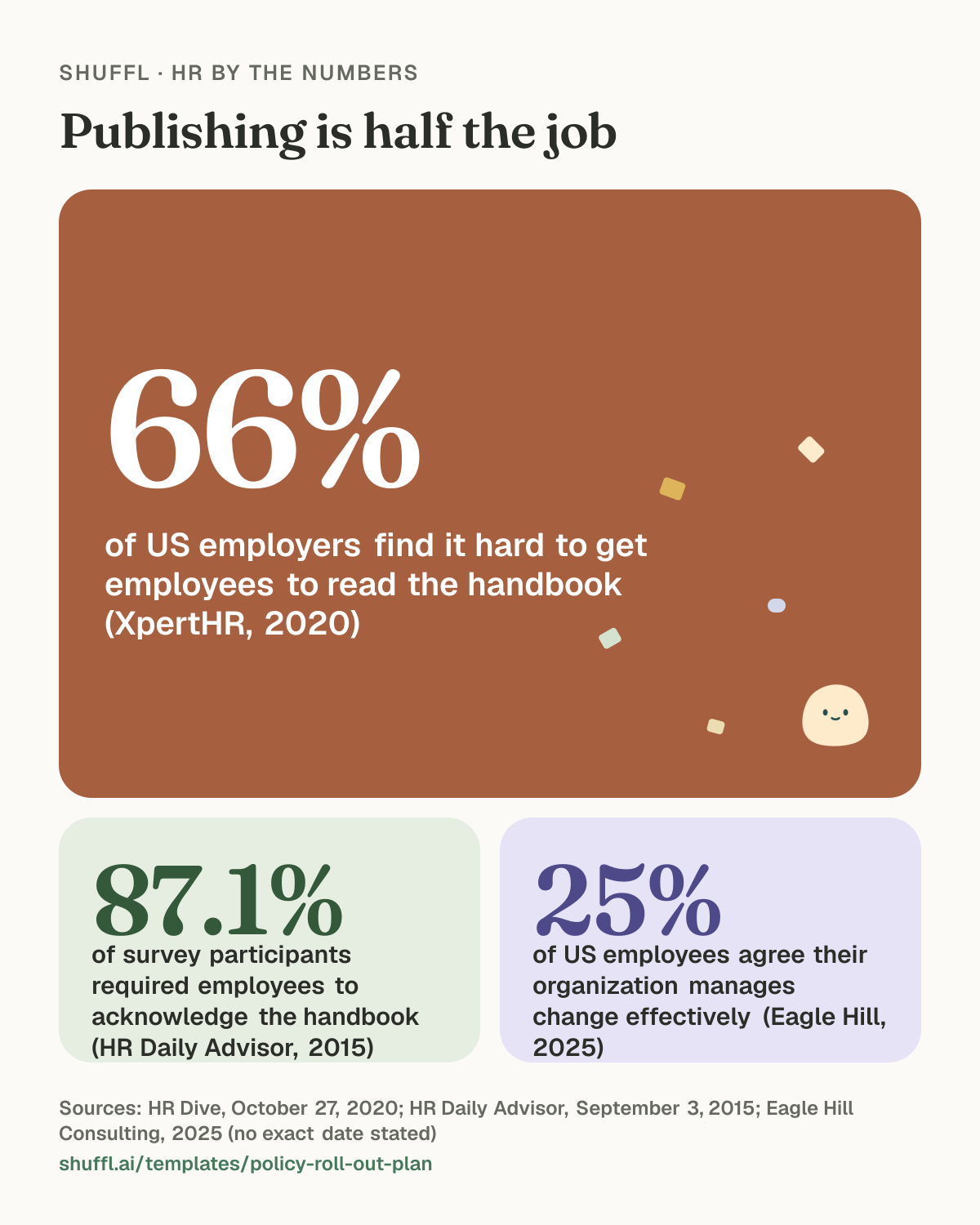
Publishing is half the job. 66% of US employers find it hard to get employees to read the handbook (XpertHR, 2020) (HR Dive, October 27, 2020). 87.1% of survey participants required employees to acknowledge the handbook (HR Daily Advisor, 2015) (HR Daily Advisor, September 3, 2015). 25% of US employees agree their organization manages change effectively (Eagle Hill, 2025) (Eagle Hill Consulting, 2025 (no exact date stated)).
A policy has changed, each person
To each person, on the date you pick.
**A policy has changed, {{hire}}**

From today, a new policy applies to you. It takes a few minutes to read, and the button to confirm you’ve read it is on the page.

- [ ] Read and confirm the new policy
A reminder about the new policy
To each person, 7 days after the date you pick.
**A reminder about the new policy**

If you’ve already read and confirmed it, there’s nothing more to do. If not, it takes a few minutes, and questions go to {{manager}} or HR.
How to adapt it
- Shuffl fills in {{hire}} and {{manager}} for each person. Replace them by hand if you send the message yourself.
- Link the policy page to the first step, so the message opens it directly.
- Brief managers before the date, so they can answer questions when their team asks.
What the research says
Getting people to read a policy is the hard part. In a 2020 XpertHR survey of 619 US employers, 66% said getting employees to read the handbook was somewhat or very challenging.1
Many employers keep a record anyway. In a 2015 survey with 1,414 participants, 87.1% of participants required employees to acknowledge receiving the handbook, up from 81.9% in 2013: 20.6% asked people to confirm receipt and 66.9% asked them to confirm they had received and read it.2
How a change is rolled out matters. In a 2025 survey of US employees, only 25% agreed their organization manages change effectively and 40% felt listened to on how changes are rolled out to their team. Understanding the need for change (46%) and effective communication (35%) were the top two things that motivated them to embrace it.3
Regulators expect more than a document on a shared drive. The EEOC’s task force on workplace harassment said it is not enough simply to have a written policy: it should be written in clear, simple words in all the languages used in the workplace and communicated to employees regularly.4
What the law requires
In the UK, an employer usually needs an employee’s agreement to change their contract, and should consult or negotiate with employees or their representatives and explain the reasons for the change.5 Changes to the written statement of employment particulars must be given to employees within one month of the change.6
Elsewhere, check whether the policy forms part of employment contracts or a collective agreement, and what local law says about changing them, before the roll-out date.
Common mistakes
- Posting the policy and assuming people read it. Send it to each person with a clear ask to read and confirm.
- Asking for confirmation without saying what changed. Put a short summary of the change, and the reason for it, at the top.
- Writing only in legal language. The EEOC’s task force recommends clear, simple words in all the languages people at work use.4
- Leaving managers out. Brief them before the date so they can answer their team’s questions.
- Sharing it once. Repeat the main points in onboarding, training and team meetings.
Common questions
- Do employees have to sign a policy acknowledgement?
- Many employers ask for one. In a 2015 HR Daily Advisor survey, 87.1% of participants required employees to acknowledge receiving the handbook: 20.6% asked people to confirm they had received it, and 66.9% asked them to confirm they had received and read it. A dated confirmation shows who was sent which version, and when.
- How much notice should you give before a policy change?
- It depends on what changes. In the UK, changing an employee’s contract usually needs their agreement, and changes to the written statement of employment particulars must be given to employees within one month of the change. For other policies, leave time for people to read the change and ask questions before it takes effect.
- How often should you re-share a policy?
- More than once. The EEOC’s task force on workplace harassment said having a written policy is not enough on its own, and recommended communicating policies to employees often, in a variety of forms.
Sources
Read on . Laws change, so check the source before you act. This page is general information, not legal advice.
- HR Dive, HR’s top handbook headache? Getting employees to read it, survey says, October 27, 2020. By Kate Tornone. Reports an XpertHR survey of 619 U.S. employers.
- HR Daily Advisor, More Results from the 2015 Policies Survey!, September 3, 2015. By Stephen Bruce. 2015 Policies Survey, conducted July 2015; 1,414 participants.
- Eagle Hill Consulting, The state of organizational change management: U.S. employee insights, 2025 (no exact date stated). Survey by Ipsos for Eagle Hill of 1,448 employed U.S. adults, August 21-25, 2025, nationally representative.
- U.S. Equal Employment Opportunity Commission, Select Task Force on the Study of Harassment in the Workplace: Report of Co-Chairs Chai R. Feldblum and Victoria A. Lipnic, June 2016.
- GOV.UK, Changing an employment contract: Getting agreement, No date stated; read October 2026.
- GOV.UK, Employment contracts: Written statement of employment particulars, No date stated; read October 2026.