
Onboarding and playbooks
Promotion playbook
A playbook for someone promoted: new goals with their manager, the change recorded by HR, a check-in at 30 days and a review at 90.
New playbook. Opens a new playbook with these steps and timings. Each person’s steps wait for your approval before they send.
A promotion changes what someone owns and who relies on them, even when their desk stays the same. Treating the first weeks as a small onboarding makes the step up clearer.
This playbook starts on the day the promotion takes effect. Their manager agrees new goals, HR records the change, and a check-in after a month asks how it is going.
Shuffl · HR by the numbers
A step up is a fresh start

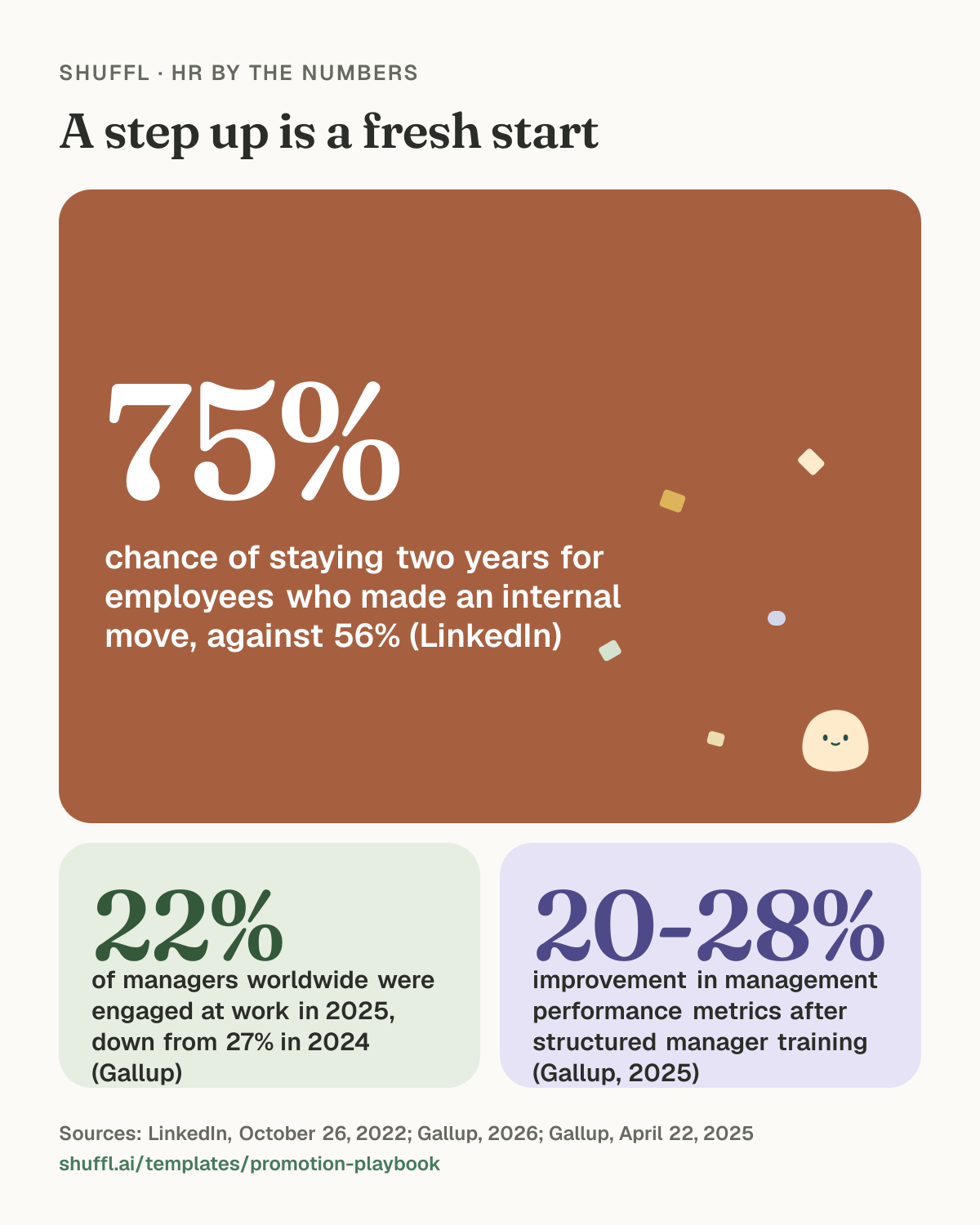
A step up is a fresh start. 75% chance of staying two years for employees who made an internal move, against 56% (LinkedIn) (LinkedIn, October 26, 2022). 22% of managers worldwide were engaged at work in 2025, down from 27% in 2024 (Gallup) (Gallup, 2026). 20-28% improvement in management performance metrics after structured manager training (Gallup, 2025) (Gallup, April 22, 2025).
Congratulations, person promoted
To the person promoted, on the day they join.
**Congratulations, {{hire}}**

Your new role starts today. The first weeks are for learning what is different: what you now own, who relies on you and what good looks like.

- [ ] Agree your goals for the new role with {{manager}}
- [ ] Update your job title on your profile
Set person promoted up in their new role
To their manager, on the day they join.
**Set {{hire}} up in their new role**

- [ ] Tell the team about the promotion
- [ ] Write down what changes in their responsibilities
- [ ] Agree goals for their first 90 days
Record person promoted’s promotion
To HR, on the day they join.
**Record {{hire}}’s promotion**

- [ ] Update their job title in People
- [ ] Confirm the new pay and when it starts in writing
- [ ] Check their access matches the new role
Meet your manager’s manager
To the person promoted, 7 days after the day they join.
**Meet your manager’s manager**

A short conversation about what the business needs from your new role this year, and how it fits with the rest of the team.
Hand over your old work
To the person promoted, 14 days after the day they join.
**Hand over your old work**

The hardest part of a step up is letting go of the old job. Agree who now picks up what you used to do.

- [ ] List what you did in your old role and who takes each piece
A month in your new role
To the person promoted, 30 days after the day they join.
**A month in your new role**

Answered anonymously:
- I know what is expected of me in my new role.
- I have the support I need to do it well.
- What would help most in the next two months?
Review person promoted’s first 90 days in the role
To their manager, 90 days after the day they join.
**Review {{hire}}’s first 90 days in the role**

- [ ] Look back at the goals you agreed
- [ ] Agree what comes next
How to adapt it
- Shuffl fills in {{hire}} and {{manager}} for each person. Replace them by hand if you send the message yourself.
- Put the new pay and its start date in writing on the first day.
- Agree who takes over the old work, so the promotion is not two jobs at once.
What the research says
Promoting from within pays off. LinkedIn found that employees who made an internal move had a 75% chance of staying two years, against 56% for those who hadn’t.1 In Wharton research on a US investment bank’s personnel data from 2003 to 2009, external hires got significantly lower performance ratings in their first two years than internal staff promoted into similar jobs.2
A step into management is the hardest kind. Global manager engagement fell from 27% to 22% between 2024 and 2025, according to Gallup.3 Gallup also reports that managers who get structured training see management performance metrics improve by 20% to 28%.4
What the law requires
In the UK, changes to the written statement of employment particulars must be given to the employee within one month of the change.5 A promotion that changes job title, pay or hours usually counts. Elsewhere, check what local law and the employment contract say about recording a change of role.
Common mistakes
- Announcing it before telling the person what changes. Agree the new responsibilities first.
- Leaving the old job attached. Agree who takes each piece, or the promotion becomes two jobs.
- Confirming new pay by word of mouth. Put the amount and the start date in writing.
- Assuming a strong performer already knows the new role. Check in after a month and ask what would help.
Common questions
- How should a promotion be announced?
- Their manager tells the team first, ideally on the day it takes effect, with a line on what the person will now own. Then share it more widely, so people know who to go to.
- Does someone promoted internally need onboarding?
- Yes. They know the company, but the role is new. Agree goals, hand over the old work and check in after a month, the same way you would for a new hire.
- Do you need to confirm a promotion in writing?
- In the UK, changes to the written statement of employment particulars, such as a new job title or pay, must be given to the employee in writing within one month of the change. Check the rules for each country your people work in.
Sources
Read on . Laws change, so check the source before you act. This page is general information, not legal advice.
- LinkedIn, Making internal mobility and career development easier for talent professionals, October 26, 2022. By the LinkedIn Corporate Communications Team. Figures from LinkedIn’s Global Talent Trends report.
- Knowledge at Wharton, Why External Hires Get Paid More, and Perform Worse, than Internal Staff, March 28, 2012. On research by Matthew Bidwell using personnel data from a U.S. investment banking division, 2003 to 2009.
- Gallup, State of the Global Workplace: 2026 Report, 2026. Data collected January to December 2025; 263,810 respondents, 141,444 of them employed.
- Gallup, Global Engagement Falls for the Second Time Since 2009, April 22, 2025. By Jim Harter and Ryan Pendell. The article does not name the study behind the 20% to 28% figure.
- GOV.UK, Employment contracts: Written statement of employment particulars, No date stated; read October 2026.