
Onboarding and playbooks
Going on leave playbook
A playbook for someone about to start parental, medical or other long leave: handover and cover, how much contact they want, and pay and benefits in writing.
New playbook. Opens a new playbook with these steps and timings. Each person’s steps wait for your approval before they send.
A good return starts before the leave does. Agreeing cover, contact and pay in advance lets the person switch off and spares the team guesswork.
This playbook starts a few weeks before the leave. The person, their manager and HR each get their own steps, and Back from leave picks up on their return.
Shuffl · HR by the numbers
A good return starts before the leave

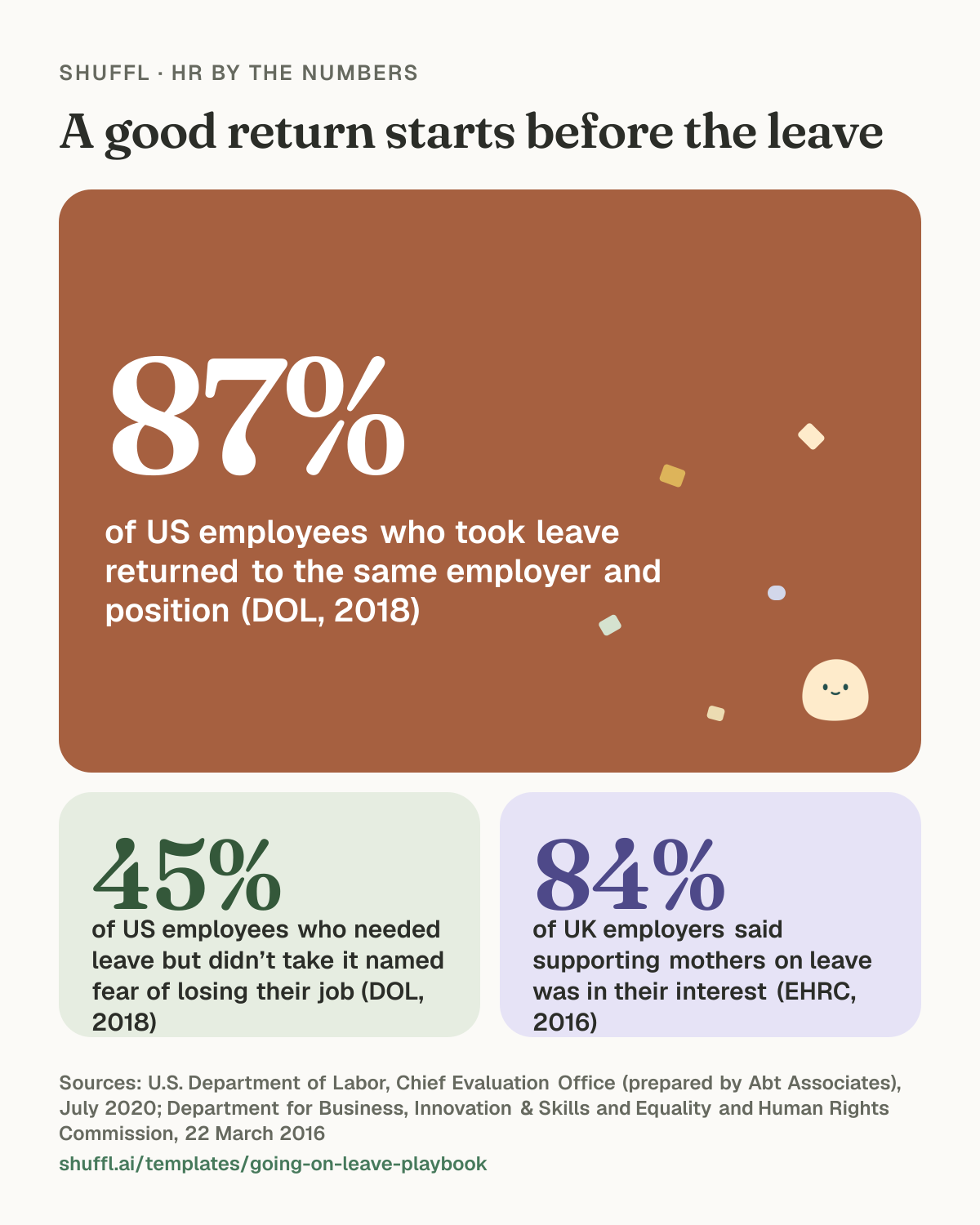
A good return starts before the leave. 87% of US employees who took leave returned to the same employer and position (DOL, 2018) (U.S. Department of Labor, Chief Evaluation Office (prepared by Abt Associates), July 2020). 45% of US employees who needed leave but didn’t take it named fear of losing their job (DOL, 2018) (U.S. Department of Labor, Chief Evaluation Office (prepared by Abt Associates), July 2020). 84% of UK employers said supporting mothers on leave was in their interest (EHRC, 2016) (Department for Business, Innovation & Skills and Equality and Human Rights Commission, 22 March 2016).
Before your leave, person going on leave
To the person going on leave, on the day they join.
**Before your leave, {{hire}}**

A little planning now means you can switch off while you are away and come back without surprises.

- [ ] Agree your dates with {{manager}}
- [ ] Tell {{manager}} how much contact you would like while away
- [ ] Write handover notes for your work
Plan cover for person going on leave’s leave
To their manager, on the day they join.
**Plan cover for {{hire}}’s leave**

- [ ] Agree who covers each part of their work
- [ ] Agree with {{hire}} how you will keep in touch, if at all
- [ ] Tell the team who to ask while they are away
Get person going on leave’s leave ready
To HR, on the day they join.
**Get {{hire}}’s leave ready**

- [ ] Confirm their leave dates and pay in writing
- [ ] Explain what happens to their benefits during leave
- [ ] Record them as on leave in People when it starts
Your leave, in writing
To the person going on leave, 3 days after the day they join.
**Your leave, in writing**

Take a few minutes to read the leave policy, so you know your pay, your benefits and how to change your return date.

- [ ] Read the leave policy
Your last week before leave
To the person going on leave, 10 days after the day they join.
**Your last week before leave**

Hand over what is left, then set an out-of-office message. Nobody expects you to check in while you are away.

- [ ] Hand over to the people covering your work
- [ ] Set an out-of-office message
Check person going on leave’s handover is done
To their manager, 10 days after the day they join.
**Check {{hire}}’s handover is done**

- [ ] Thank them before they go
How to adapt it
- Shuffl fills in {{hire}} and {{manager}} for each person. Replace them by hand if you send the message yourself.
- Ask how much contact they want while away, and write it down.
- Mark them on leave in People when it starts, so Back from leave starts on their return.
What the research says
Most people come back. In the Department of Labor’s 2018 surveys, 87% of US employees who took leave returned to the same employer and position. Among people who needed leave but didn’t take it, 45% named fear of losing their job.1
What happens around the leave shapes the return. In a UK study of 3,254 mothers, 77% reported a negative or possibly discriminatory experience during pregnancy, maternity leave or on their return, and 11% felt forced to leave their job.2
Employers see the point of getting it right: 84% in the same study said supporting pregnant women and mothers on leave was in their interest, most often because it helped them keep staff.2
What the law requires
In the US, group health cover continues during FMLA leave on the same terms as before.3 In the UK, people on parental leave keep their right to pay rises made while they are away, and can work up to 10 keeping in touch days during maternity or adoption leave if both sides agree.4
To change their return date from maternity leave in the UK, an employee must give at least 8 weeks’ notice.5 Check the rules for each country your people work in.
Common mistakes
- Planning cover in the last week. Agree who picks up what while there is still time to hand over properly.
- Guessing how much contact they want. Ask, write it down, and treat keeping in touch days as optional for both sides.4
- Leaving pay and benefits to a phone call. Put the dates, pay and what happens to benefits in writing.
- Forgetting to record the leave. Mark them on leave in People, so their return is planned too.
Common questions
- How much should you contact someone on parental leave?
- Agree it before the leave starts and write it down. Some people want a monthly update, some want nothing until they are back. In the UK, keeping in touch days during maternity or adoption leave need both sides to agree the work and the pay in advance.
- What should a handover before leave cover?
- Who covers each part of their work, who people should ask instead, where their files and notes are, and the date they expect to be back. A page of notes is enough; the point is that nobody has to guess.
- What happens to benefits during leave in the US?
- Under the FMLA, an employer keeps group health cover going on the same terms as if the person were still at work. Other benefits and pay depend on your policy and local law, so confirm them in writing before the leave starts.
Sources
Read on . Laws change, so check the source before you act. This page is general information, not legal advice.
- U.S. Department of Labor, Chief Evaluation Office (prepared by Abt Associates), Employee and Worksite Perspectives of the Family and Medical Leave Act: Executive Summary for Results from the 2018 Surveys, July 2020. 2018 surveys of 4,470 U.S. employees and 2,206 worksites, by phone and web.
- Department for Business, Innovation & Skills and Equality and Human Rights Commission, Pregnancy and maternity-related discrimination and disadvantage: summary of key findings, 22 March 2016. Research by IFF Research for the Department for Business, Innovation & Skills and the Equality and Human Rights Commission. Survey interviews with 3,254 mothers and 3,034 employers in Great Britain.
- U.S. Department of Labor, Wage and Hour Division, Family and Medical Leave Act, No date stated; read October 2026.
- GOV.UK, Employee rights when taking maternity and other types of parental leave, No date stated; read October 2026.
- GOV.UK, Maternity pay and leave: Leave, Current page, read October 2026.